Sunday, 24 November 2024

Doctor Who Night 2024: Eric Saward's Vision

For our 22nd* annual Doctor Who Night we watched some stories from season 22. We started with Attack of the Cybermannys, which was written by "Paula Moore" - a cunning pseudonym that Eric Saward used to fool the BBC into letting him write more scripts than he was really allowed to under their rules.

While an enormous step up in quality from the preceding story, this is a confused mess of a plot that is trying to be a sequel to Resurrection of the Daleks and The Tenth Planet and Tomb of the Cybermannys, while including topical references to Halley's Comet in a subplot that doesn't really go anywhere.

Speaking of subplots that don't go anywhere - something of a Sawardian trademark - the ultimate example of this has to be the way that escaped prisoners Bates and Stratton never meet or interact with the Doctor or Peri, and are killed off without accomplishing anything relevant to the main plot.

Another Sawardian trademark is the presence of space mercenaries - in this case Lytton (Maurice Colbourne), returning from Resurrection of the Daleks but with an almost unrecognisably different personality - whom it seems the writer would rather spend his time with than the Doctor and Companion. The early scenes establishing Lytton as a London gangster, diamond thief and all-round hardmanny seem to belong to a different show - not necessarily a bad one, but not Doctor Who.

Lytton eventually comes a cropper thanks to the third - and worst - Sawardian trademark: his love of gratuitous violence.


I always thought that radiation gravity gold was the Cybermannys' one weakness, but according to the Doctor:
"The Cybermen have one weakness. They'll react to the distress of their own kind."

I assume there's at least one Big Finish story out there about how undercover policemanny Russell somehow survived and ended up on Skaro, where he became the Kaleds' chief scientist? No? Funny how some actor reuse matters more to the superfans than others, mew.

Revelation of the Daleks, also written by Eric Saward (under his own name this time), is in general a much better story than Attack of the Cybermannys, although it is arguably an even worse Doctor Who story, what with the way the Doctor and Peri are kept away from the main plot for more than half of the duration. It is also an enormous step down in quality from the preceding story, for obvious reasons.

The parade of characters we are introduced to - who are mostly being set up in part one only to get killed off in part two - are interestingly grotesque and have a complex set of relationships with each other and with Davros, who sits at the heart of the story like a pider in its web. In many ways this is his story, showing him as a genius manipulator of the greed and vanity of the mannys around him, as well as the mad scientist we have seen him as before. It is trying to do something new with the character, and it is a pity that this doesn't extend beyond this one story, since the next time we will see him will be In Remembrance of the Daleks.

Most of the characters come in pairs, forming double acts as Saward tries to copy the writing style of Robert Holmes: Kara and Vogel, Orcini and Bostock (the obligatory space mercenaries for this story), Takis and Lilt (with a totally tropical taste), Natasha and Grigory. This gives one member of each pair somebody to tell their exposition to, which is good because this script has a lot of exposition to get through - to the point where there is a character whose role is to give a running commentary on events to all the mannys in suspended animation, a.k.a. the viewers at home.

This is the DJ, played by Alexei Sayle, a baffling inclusion even by the already eclectic standards of this story. Peri thinks he is a Space American, but it turns out he is just putting the voice on, which is ironic because Nicola Bryant is also putting the voice on to play Peri.

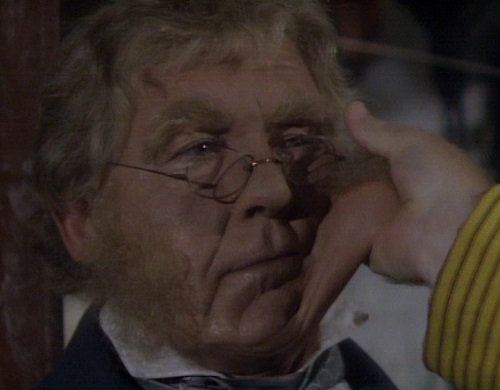
While the level of violence is less than in some stories this season (the worst offenders are Attack of the Cybermannys, Vengeance on Varos and The Two Doctors), it still includes a manny getting stabbed with a syringe and injected with embalming fluid. This scene is played for laughs, since even as he goes
his wig falls off, lol.

Not played for komedy is the scene with the see-through Dalek, inside which is a manny being turned into a Dalek. Doctor Who Mazagine once called this "the single most up-chuckingly disgusting thing seen in the show ever." Although this was before the return of the new series, so could easily be superseded by [spoiled for choice when it comes to this punchline -Ed]


After this season aired on the BBC, the series came within a gnat's crotchet of getting cancelled. I think it is quite clear who is chiefly to blame.


* I'm not sure how we managed that when I was only made in 2008. It must have somehow involved time travel.

Thursday, 7 November 2024

Space Buttons

Despite the impending pantomime season this is nothing to do with a Space Panto written by Terry Nation. Sorry to disappoint, zanni.

This is actually about the visible futuristic space buttons I just noticed on Avon's costume, which you can see here:


Isn't it odd that I never noticed these before? I suppose I must have been too busy looking at Avon.

Purr.

Sunday, 29 September 2024

Ben Steed tries to decide on a name for his latest episode


The Planet of Manly Men and Weak Women
Avon and Gunn Sar
The Planet of Gunn Sar
The Moobs of Gunn Sar
The Manly Moobs of Gunn Sar
Gunn Sar's Moobs
Avon and Gunn Sar's Moobs
The Power of Gunn Sar's Moobs
Power ✔

Monday, 2 September 2024

Best end credits of all time?

In any list of the best TV end credit sequences of all time, Terrahawks has to be in consideration for the top spot. It is glorious in its full early-80s fake CGI (very much in the style of The Hitch-Hiker's Guide to the Galaxy TV series), which portrays a wonderfully simple concept of the goody Zeroids and baddy Cubes playing a game of Noughts-and-Crosses.

I mean just take a look at this:


Purr.

And in this one the Cubes cheat, lol!

Wednesday, 14 August 2024

An Unexpected Crossover

Combat Colin was a comic strip that ran in the pages of Action Force and then, later, in the pages of Transformers and Action Force. It was written and drawn by Lew Stringer, who had previously written Robo-Capers for the Transfomers comic prior to the addition of Action Force to that title.

From November to December of 1989 the Combat Colin strip featured a five-part story (each part consisting of only a single page) that crossed over with the setting of a certain 1960s TV show, and included multiple references to the most iconic imagery and dialogue from that series, as well as a couple of title drops gratuitously crowbarred in.

I can only assume that most, if not all, of these references would have been lost on the intended readership of the strip, who would have been much too young to have seen the programme in question upon broadcast - even on repeat. And DVDs hadn't been invented back then!


The first reference to The Prisoner, other than the font used for the story title, is the knockout gas being put through the keyhole to incapacitate our heroes. This on its own could have been passed off as a coincidence - the real clincher comes in the final panels where we see the arrival of Combat Colin and Semi-Automatic Steve in a suspiciously Village-like place.


The second instalment references the famous exchange between Number Six and Number Two from the title sequence, even if it is somewhat mangled:
"Where am I?"
"In the place!"
"What do you want?"
"We want information!"

After encountering a number of other characters familiar to regular readers of Combat Colin who are respectively "the prisoners" and "the warders," the plot diverges from that of The Prisoner by revealing the identity of "Number One" early - it is Colin's old enemy "the Brain!"


Part three sees Colin attempt an immediate escape in a similar style to Number Six's early attempt from Arrival - though Colin's use of a penny-farthing is borrowing a different element of the show's iconography.

Making his way across the beach, Colin's shout of defiance is undeniably that of Number Six:
"I'm not a number... ...I'm Combat Colin!"
The pursuing Mountain Man answers him:
"Please yourself... ...It's your funeral!"
Clang!


Title drops continue in part four when Madprof tells Colin
"Better start living in harmony with this place, pal!"
and the comics tradition of teasing the next episode is here done with a simple:
Next week: Free for all!

Other Prisoner references on this page include the Brain making his base in "the greenish dome" and, after the heroes and villains team up against him, the Brain describes them as
"Six of one, and half a dozen of the other!"


The original plot, of the Brain stealing Colin's Combat Trousers to use against him, concludes in part five with no explicit Prisoner references other than the "Village" setting continuing from earlier parts, and there's one line that sounds more like it could have come from Police Squad:
"Now you'll be a prisoner, Brain, ~ in Wallytown jail!"

Monday, 12 August 2024

Big Gay Longcat reviews Doctor Who: The Trial of a Time Lord

Part


So Robert Holmes went
before he could finish his script for the final instalment of this fourteen-part epic. His protégé, script editor Eric Saward, finished it, but the producer John Nathan-Turner rejected this script because of the cliffhanger ending that Holmes and Saward had put in. It seems very likely this would have involved a crash-zoom to the Doctor's face, but we'll never know because it was never made. Instead JN-T turned to Pip and Jane Baker (the writers of parts nine to twelve) to write an alternative part fourteen with a happy ending, with the side effect that the plot crashed between two very different writing styles between the penultimate and ultimate episodes.

This is immediately obvious from the first moments of the final part - the Bakers, having no idea how Holmes and Saward intended to resolve the cliffhanger to part thirteen, had to make up a solution of their own. Glitz runs over and tries to save the Doctor from disappearing under the quicksand, but fails.

The Doctor then pops back up, perfectly alright again. The justification for this seems to be that this was an illusion, which is a dangerous precedent to set (for the viewers, if not the Doctor) because it means that it is harder for us to accept later threats to the Doctor as being genuine when the plot requires them to be.


The Valeyard appears to talk to the Doctor, all the while teleporting around like a second-rate Tim the Enchanter. He explains, in a roundabout, overly verbose kind of way, that he wants to kill the Doctor because this will free him of the good side of his personality. A cleverer writer would have made use of this motivation later on in the plot, by (for example) having the Doctor's conscience burden the Valeyard at a crucial moment and interfere with his evil plans, but the Bakers seem to have forgotten they introduced this trait for him by the time they wrote the climax.

The Valeyard vanishes and the Doctor and Glitz have to run away from "asphyxiating nerve gas." The Doctor claims
"This is in deadly earnest."
so apparently we are supposed to take this threat seriously. Glitz, like the viewer, cannot tell the real threats apart from the illusions. I can't blame him - this seems more than a little arbitrary to me.

The Doctor and Glitz make their way to a hut on the beach, which turns out to be the Master's TARDIS.


The Master hypno-eyeses the Doctor with a flashing light and some noises. He sends the Doctor out into the Victorian-era location of the Valeyard's "Fantasy Factory" base to act as bait. When the Valeyard comes out the Master attempts to pewpewpew him, but he has a forcefield that deflects the Master's pews. The Valeyard shouts at him
"You really are a second rate adversary."
and then returns fire by throwing explosive feathers at him. The Master and Glitz run away while the Valeyard does an evil lol.

The Doctor snaps out of his hypno-eyesed state when he hears Mel's voice. Mel takes the Doctor back to the trial room, where there is a subtle wrongness to the way Mel and the Inquisitor speak to him - staying too still, or pausing just slightly too long before speaking. This is either a very clever way of indication that this is all an illusion of the Matrix, or else yet another example of the director not being very good at his job.

They replay a short excerpt from the end of Terror of the Vervoids, which Mel says is an accurate depiction of what happened. The Inquisitor then finds the Doctor guilty of "genocide" and insists that
"Your life is therefore forfeit."


The camera then pulls back to show the Inquisitor and Mel watching the courtroom from another version of the courtroom. While this is easily the best twist of the episode, it is responsible for the many subsequent theories that this courtroom could be another illusory one in turn, and that therefore every adventure the Doctor has from this point on still takes place within the Matrix. Perhaps the Time Lords should have named their Matrix after a different film?

Mel takes the key to the Matrix from the Keeper and runs for the seventh door. The Doctor, meanwhile, is on an old cart being taken through the dimly lit Victorian streets by some Gallifreyan guards. It's a good thing we've already seen that this isn't real, or else this would have been a massive giveaway. The big question now is why the Doctor hasn't noticed yet, but of course he has and is only playing along. When Mel comes to 'save' the Doctor - with her most panto line-reading yet
"Never mind the Sydney Carton heroics, you're not signing on as a martyr yet."
the cart vanishes and he tumbles to the ground. Instead of being grateful for Mel's rescue, he is grumpy.

Back in his TARDIS, the Master attempts to hypno-eyes Glitz, and when that doesn't W-word he instead bribes Glitz with a large chest full of prop pirate treasure - it's super effective!

Now in the Valeyard's base, the Doctor and Mel search for clues. Mel opens the door to the waiting room, but instead of being teleported to a beach she instead sees a dragon who breathes fire at her. Naturally, this bit was my friend Dragon's favourite bit in the whole story, and I also enjoyed it for the odd way it foreshadows Mel's final story the following year.

Glitz captures Mr Popplewick and brings him into the room. Popplewick directs the Doctor and Mel to where "Mr J J Chambers" is to be found "across the courtyard." Once they have gone, Popplewick paws over the Matrix secrets to Glitz. He then attempts to shoot Glitz with a gun, but Glitz has already stolen the bullet. The Master arrives and points a gun of his own at Glitz, and takes him (still carrying the secrets) back to his TARDIS. This short scene of all these baddys double-crossing each other is almost too good to belong in this episode.


The Doctor pulls the Mr Popplewick disguise off to reveal he is really the Valeyard using an old-school mask like the Master used to back forward in the UNIT era.
"The performance was too grotesque to be real. I have never been able to resist a touch of the Grand Guignol."

Mel opens the Valeyard's cupboard to reveal
"A megabyte modem!"
With such power the Valeyard can connect to the internets! He will be unstoppable!

The Valeyard's plan is revealed. He wants to assassinate the Time Lords attending the Doctor's trial by firing a "particle disseminator" (a pewpewpew gun) through his modem to the courtroom. The Doctor sends Mel to warn them while the Valeyard does another evil lol.

In the courtroom the Time Lords are concerned with the news they've just heard, that "the High Council has been deposed." The Master attempts a coup by holding the Matrix hostage. He makes a speech that is somewhat reminiscent of his universal ultimatum from Logopolis:
"What I have to impart is of vital importance to all of you. Now that Gallifrey is collapsing into chaos, none of you will be needed. Your office will be abolished. Only I can impose order. I have control of the Matrix. To disregard my commands will be to invite summary execution."
His plan is then immediately defeated by the Valeyard because he booby-trapped the Matrix secrets that they stole, which now activates and hits the Master and Glitz with some kind of effect that makes them go all slow-motion and black and white. So it seems the Valeyard was correct to call the Master "a second rate adversary" since he can defeat the Master without even being there.


The Valeyard taunts the Doctor:
"There's nothing you can do to prevent the catharsis of spurious morality."
At least I think that's a taunt, I don't really know what it means, mew. I like the sound of the word "catharsis" though.

Mel bursts into the courtroom and warns them of the danger. The guards run away while the Time Lords, encumbered by their costumes, just have to duck as the Matrix TV screen explodes and lets some dangerous SFX into the room. The Doctor manages to break the Valeyard's modem - oh noes! How will he post his important opinions on who is best out of Blake and Tarrant now? The Doctor and the Valeyard run away from the "feedback" (the manifest form of a thousand angy cats telling him his opinions are this: wrong) but the Valeyard is caught by the SFX and pewed.


The Doctor escapes back to the trial room where he is presumably just as guilty of genocide as he was in the fake courtroom earlier.
Doctor: "Now, let me see, where were we? I was about to be sentenced, I believe?"
Inquisitor: "All charges against you are dismissed, Doctor."
Phew, thank goodness for Gallifreyan make-it-up-as-you-go-along Law! The Inquisitor also tells the Doctor that
"The young woman, Miss Perpugilliam Brown, is alive and well and living as a warrior queen with King Yrcanos."


This is not quite what the Master told her in the previous episode, which was that Peri had been made a queen by King Yrcanos - not that she was a warrior, nor that she was with Yrcanos. Though if he offered, I can't imagine her turning down BRIAN BLESSED, can you?

The Doctor suggests that the Inquisitor should stand to be the next President of the Time Lords, no doubt thinking her flexible attitude towards law and order makes her eminently qualified for the job. The Doctor and Mel then head off to the TARDIS for the traditional quick exit now that the story's over - except, of course, that Mel didn't arrive by TARDIS, and in fact the Doctor hasn't even met her yet.

You might think this impending temporal paradox might worry the Doctor, but he is more concerned with Mel putting him "back" on the exercise and diet plan we saw him on at the start of Terror of the Vervoids - though this isn't really "back" on it for him, since he won't have started it yet. Mew. The Doctor's last lines are him complaining about carrot juice. There's a good chance this is what brings on his next regeneration...

Back in the courtroom, the Keeper of the Matrix has also regenerated - into the Valeyard! He turns to camera and does an evil lol for our benefit. The Bakers snuck in a cliffhanger after all.


The considerable problems encountered by the production team when making The Trial of a Time Lord - not least the death of Robert Holmes and the resignation of Eric Saward - go a long way to explaining the problems that we viewers can see on screen when we watch it. But arguably the story was flawed from its conception, especially the "Christmas Future" segment which required much more careful pawing in order for it to make sense as part of the overall trial story.

The other segments were hardly free of issues - The Mysterious Planet had a glaring plot hole that betrayed the fact that Robert Holmes was no longer around to fix it in another draft, and Mindfuck suffered from the gaping flaw that we in the audience lost our connection to the Doctor's motivations for more than a whole episode, without even a satisfying payoff to justify it.

The story suffered throughout from mediocre direction and a lack of ambition in the smaller things that undercut what would otherwise have been the show's most ambitious story since the 1960s - as exemplified by the majestic opening model shot cutting to a dull beige interior set.

And yet, in spite of all its many flaws (and in some cases actually because of them, varoonik), The Trial of a Time Lord is a tremendously enjoyable story to watch - a colourful, fun, silly, messy romp; a pantomime across time and space, if you will. I mean, a story that contains both the lines
"I AM A MAN OF ACTION, NOT REASON!"
and
"Whoever's been dumped in there has been pulverised into fragments and sent floating into space, and in my book that's murder."
can hardly be all bad, can it?

It may be the longest (which ought to mean best) story the series ever attempted, but the decision to split it into four identifiable parts means it need never be a burdensome time commitment - one can dip into it for an episode or two and simply bask in whatever nonsense one sees unfolding on screen. In that respect the story it most closely resembles might be The Time Monster, only with a less good Master.

On the subject of the Master - the Valeyard ends up here becoming a much better Master than we have seen since the glory days of Roger Delgado - even being revealed as the Doctor's dark side, a long since abandoned possible origin for the Master. Michael Jayston does his best to make the character stand out, especially once he gets the chance to be out of the courtroom in the final two parts, but really the only reason he isn't the Master is so that we can have the twist where he turns out to be an evil Doctor. It's easy to see why the Valeyard never returned - the universe simply has no need for two characters who are both the hero's shadow, metaphorically or literally, or both.

I have made repeated reference to the make-it-up-as-they-go-along nature of Gallifreyan Law in these reviews. I think the reason this is so obvious - more so than in the other times the Doctor ended up being tried by the Time Lords - is due to the trial format and courtroom setup on this occasion being so close to that of a real British courtoom trial - judge, jury, prosecutor, defendant in the dock, prosecution evidence followed by defence evidence, witnesses, and so on. The result is an uncanny valley effect where the audience - familiar with real life courtroom procedure, if only from other TV shows - feels cheated when it then proceeds to make up its own rules, which wouldn't be the case if the trial was wholly alien from the very beginning. The trial at the end of The War Games being the purrfect example of the latter.

And given the central importance of the trial to the story - the clue is in the name - it is surprising to me that the makers did not get David Fisher in to be one of the writers. Fisher wrote for the series back during Tom Baker's era, but he also had considerable experience as a prolific writer for the 1970s TV series Crown Court - a show entirely concerned with courtroom trials. Why not at least get him involved for the structure and writing of the courtroom scenes?

We can see in The Trial of a Time Lord the forerunner of many of the tropes that would go on to be common in the 2005 revival series of Doctor Who. Most obviously, it is almost impossible to imagine the new series without some sort of overarching plot arc running across an entire season. But digging a little deeper, we can see more things in common - the arc being forced to intrude into stories that don't need its presence, making them worse than if they had been allowed to stand alone; the build up to a grand finale that is then written in a hurry so that it all unravels like a load of bollocks (I told him that was a mixed metaphor and he would insist -ed); and the chickening out of killing off Companions after saying they have been/will be. Even an insistence on spending the budget on impressive bits of SFX because the showrunner producer is embarassed by the show's reputation for being unable to compete with glossy American sci-fi can be traced to here.

At least in Trial of a Time Lord the Doctor acting out of character can be explained away as the Matrix lying to us.

Finally, I must say something about the controversy that surrounds The Trial of a Time Lord's cliffhangers. Contrary to poular belief, not every episode ends with a crash-zoom to the Doctor's face. In fact, only eight of the 14 episodes end in this way, which is only just more than half. Of course, of the other six, three feature close ups of the Doctor's face (four if we count the Valeyard as the Doctor) without a zoom, which means it feels like it happens more than it does. Only parts three and nine are completely free of this repeated phenomenon, so it is no wonder the story has the reputation it does, but there is actually more variety there than you might expect.

Saturday, 29 June 2024

Big Gay Longcat reviews Doctor Who: The Trial of a Time Lord Part Thirteen


Colin Baker's finest hour (well... finest 24 minutes) as the Doctor begins with the arrival of James Bree as the Keeper of the Matrix, the only manny to remember the Doctor's first trial by the Time Lords.

The Doctor is back to using insulting nicknames for the Valeyard, calling him "the Railyard." Moving from the lowbrow to the highbrow in the same speech, he then compares him to "Ananias, Baron Munchausen, and every other famous liar."

The Inquisitor has brought in the Keeper of the Matrix to prove that the Matrix cannot have been tampered with as the Doctor claims, but the Doctor quickly seizes upon what he says in his testimony as evidence that "the Matrix can be physically penetrated." Oo-er.

It has been a while since we have seen the very expensive space station, so we go back to see a cut down version of the same SFX sequence (I'm only surprised they didn't show the whole thing again) except that this time the light beam brings in two boxes, not one TARDIS.


Glitz gets out of one, and Mel is inside the other. They don't look very comfortable - certainly not bigger on the inside than they are on the outside! But you know the rules: if a cat fits, a cat sits. Glitz says
"Dibber? What's happened to your voice, lad?"
Bonnie Langford gives the second of her most panto-level line readings when she replies:
"I'm not Dibber. Neither am I a lad."
They enter the courtroom, surprising everybody there.


The Master appears on their TV screen, leading to the Doctor saying
"Oh no, now I really am finished!"
lol. The Master, after establishing that he is speaking to them "from within the Matrix (proof, if proof be need be, that not only qualified people can enter here)," says that he has sent Glitz and Mel to be witnesses on the Doctor's behalf. The Inquisitor says
"The Doctor may, in his defence, call witnesses to rebut your evidence, after which you may cross-examine them. That is the procedure, Valeyard."
which adds even more credence to the theory that the Time Lords are making up the rules as they go along, if even the Valeyard has to be told what their procedure is.

Glitz starts to give the explanation missing from the Mysterious Planet section, about what the secrets were that Drathro was protecting and which Glitz and Dibber were so interested in stealing - secrets that the Valeyard had so clumsily drawn attention to by ham-fistedly bun-censoring it. These were taken from the Matrix. The Valeyard accuses Glitz of lying, to which the Doctor responds
"I don't think so, Stackyard."
It also comes out that the Earth was moved "billions of miles across space" (as the Master puts it, perhaps because by now they have realised that sounds a lot more impressive than "a couple of light years" when talking about astronomical distances) by order of the High Council of Time Lords.

This is quite a stagy scene so far, in which Glitz and Mel in particular can both at times be seen standing around waiting patiently for their next cues to come up. But it's all worth it for the speech that the Doctor now gives, one of the defining moments of the sixth Doctor (and in a good way, not in a strangling-Peri way):


"In all my travellings throughout the universe I have battled against evil, against power-mad conspirators. I should have stayed here. The oldest civilisation: decadent, degenerate, and rotten to the core, ha! Power-mad conspirators... Daleks, Sontarans, Cybermen... they're still in the nursery compared to us. Ten million years of absolute power, that's what it takes to be really corrupt!"

This is a direct continuation and logical extension of writer Robert Holmes's first Time Lord-centred story, The Deadly Assassin, the first to suggest the Hofflike Time Lords are really an insular civilisation in a state of decline, with their great power used only for self-preservation. One could therefore see this episode as the climax of a long story arc that began with The Deadly Assassin and which continued through the intervening Gallifrey-set stories (The Invasion of Time, Arc of Infinity, The Five Doctors) with each one revealing more aspects of the messed up society of the Time Lords. How appropriate it is that the Master, who was present for the start of this conflict, is here again at its end.

The stakes get even higher as the Master reveals the Valeyard's role in the High Council's plan:
"They made a deal with the Valeyard, or as I've always known him, the Doctor, to adjust the evidence. In return for which, he was promised the remainder of the Doctor's regenerations."
I love this revelation, especially the amount of ambiguity that is squeezed into the Master's few words of explanation about what he means by "the Doctor":
"There is some evil in all of us, Doctor, even you. The Valeyard is an amalgamation of the darker sides of your nature, somewhere between your twelfth and final incarnation."
It is strange to think that we are now well past the "twelfth incarnation" of the Doctor on television in our time, but that must have still seemed very distant in 1986. The Valeyard responds to this by running away.


The Doctor chases him, but he has escaped into the Matrix using "the seventh door." The Keeper lets the Doctor and Glitz in to follow the Valeyard, warning them "the Matrix is a micro-universe." If the parallels to The Deadly Assassin hadn't been apparent before, they are about to become blindingly obvious.

Appearing in the Matrix, which looks like a Victorian edition of The Great Pottery Throw Down, the Doctor hears the Valeyard doing an evil laugh, and some other lolrandom sound effects so that we know we are in a place of illusions. For some reason the Doctor decides to look for the Valeyard in a barrel, which a manny tries to drag him into so that he gets wet. Oh noes!

Back in the courtroom, the Master tells the Inquisitor about which parts of the Matrix evidence had been altered by the Valeyard, including that Peri is alive, "as a queen, set up on high by that warmongering fool Yrcanos." This is an odd way of phrasing it, which we should try to remember when the time comes for the Inquisitor to pass this news on to the Doctor.

The Master explains his interest in the trial, hoping that one version of the Doctor will destroy the other. This leads to another quite extraorinarily panto line reading from Bonnie Langford:
"How utterly evil!"


In the Matrix, the Doctor and Glitz meet Mr Popplewick, looking a lot like Anthony Hopkins as Pierre Bezukhov in the BBC's War & Peace - which is a good thing to look like if you want to beat the shit out of Colin Baker. This encounter with Victorian bureaucracy confuses Glitz, but the Doctor explains that the Valeyard wants to "humiliate" him before he kills him.

The second Mr Popplewick they meet wants the Doctor to sign a consent form:
"The corridors in this factory are very long and dark. Should you unexpectedly die, our blessed proprietor, Mr J J Chambers, insists he inherits your remaining lives."
The Doctor agrees to sign while saying
"Obviously the Valeyard doesn't trust the High Council to honour their side of the bargain."
Mr Popplewick sends the Doctor to a waiting room, which turns out to be a beach. He hears the Valeyard doing another evil laugh, and then lots of mannys' paws come out from under the sand to grab him. The Doctor tries to escape by using the old classic
"This is an illusion. I deny it!"
The paws try to drag him under the sand, and the Doctor tries to help them by shoogling himself under. The unseen Valeyard says
"Goodbye, Doctor."


Crash cut (not a zoom) to the Doctor's face - cliffhanger!