Saturday, 1 January 2011

Happy New Caturday

Hello everyone. It is Caturday today.

I didn't get a Forever Active Mobility Vehicle for Caturday, but I did get a picture which is even better than that. I will share it with the Internets so you can see how good it is.


Who is that handsome cat in the picture? It is me.

I like things that remind me of me, so I am a happy cat today.

Wednesday, 29 December 2010

The Prisoner Challenge: Musical Appendix

This is the "celebrating, triumphant, joyful" music from Fall Out.

The Prisoner Challenge: Fall Out

How can I review Fall Out, my favourite piece of television ever?

I mean, The Prisoner isn't my favourite series of all time - I have only watched it all in the last five-or-so years and there are a number of series that have been with me for so long (e.g Doctor Who, Blackadder) that I don't think they can ever be overtaken.

Ah well, I'll take a deep breath, and here goes...


It's the music, I think, that makes it. I've seen plenty of films and TV programmes that are weird and wonderful - Aeon Flux, Sapphire and Steel, to name but two - but the music in Fall Out adds so much to the experience of watching it that even when it threatens to be a string of nonsense robbing a magnificent series of a coherent ending, the music is there saying "this is it." I love the music.

Once Upon A Time is a tough episode to follow. The performances by McGoohan and Leo McKern were sublime, and it culminates in Number 2 dying and Number 6 has passed the Village's "ultimate test." If that had been the end we might have been left satisfied that Number 6 had finally won out over the Village, and in as near-to-perfect an Ultimate Showdown as one could wish for.

But that wasn't quite the end. It finished with the Supervisor standing at the door. "Congratulations," he says. "What do you desire?"
"Number 1."
"I'll take you."

We are promised the answer to the question "Who is Number 1?" that Number 6 has been asking every episode since the series began. And if that question is to be answered, why not the others? Where is the Village and whose side is it on? Maybe even: who is Number 6 and why did he resign?

Fall Out picks up events from exactly where Once Upon A Time left off. Number 6, the Supervisor and the Butler leave the Embryo Room and go down in a lift to a room where Number 6 is given a suit of clothes like those he arrived in the Village wearing.
"We thought you would feel... happier... as yourself."


Doors open to reveal McGoohan. He is dressed as his old self again, but his face is still suspicious.


All You Need is Love (by The Beatles) plays. They walk down a corridor past a selection of jukeboxes - this isn't incidental music; it's playing where they are. And given where they are, this couldn't be more incongruous. But this is just the beginning...


They enter an underground chamber full of soldiers and men in masks and robes - the assembled delegates who are, or so it seems, the secret masters of the Village.


The Supervisor joins them at 'Identification.'


There is a man dressed as a judge, he is the 'President' of this assembly and is played by Kenneth Griffith, who was Number 2 in The Girl Who Was Death, so perhaps he has a similar role here?


Number 6 is presented to the President, who says "he must no longer be referred to as Number 6 or a number of any kind." So with that I shall no longer refer to McGoohan's character as "Number 6" as, from this point on, neither do they.


The President calls McGoohan "sir" and invites him to sit in the "chair of honour." McGoohan appears puzzled by what they are doing but goes along with it, perhaps still suspecting this is yet another Village plot.


Number 48 (played by Alexis Kanner, and one has to presume this is not the same character he played in Living in Harmony) is presented to the assembled delegates, and McGoohan, as an example of rebellious youth. He is found guilty of a number of crimes relating to this and is held prisoner.

Then the late Number 2 of Once Upon A Time (Leo McKern) is resuscitated. This is a neat trick if he really was dead, but it is unclear if this was the case. McKern steps up to the President's podium and addresses the assembly. It appears he doesn't know how his seeming death was accomplished by the Village, but the President says "there have to be some security secrets that are kept from a late Number 2."

McGoohan interrupts their exchange to ask of McKern: "Did you ever meet Number 1?"
"Face to face?"
"Yes."
"Not him," is the ambiguous answer, and then he looks at the rocket that dominates this chamber. It is marked with a big, red '1.'


He stares into its green 'eye' and then spits. For this he is seized and put with the captive Number 48; no longer Number 2 but a prisoner.

The President deplores the forms of rebellion exhibited by Number 48 and the former Number 2. "They are to be stamped out," he says.
But then he turns to McGoohan's form of rebellion: "He has revolted, resisted, fought, held fast, maintained, destroyed resistance, overcome coercion." On behalf of the Village the President concedes that he was right, and then offers him a choice: "lead us, or go."

If he chooses to go then they will give him his house back (the key to the door is offered in token of this), £1,000,000 in traveller's cheques, a passport - specified as being "valid for anywhere" - and a bag of "petty cash." All in all a tempting prize, but what's the catch?

Ever suspicious of Village tricks, McGoohan asks the question that destroyed the General: "Why?"
And to every answer the President gives him he asks it again, until:
"I'm an individual?"
"You are on your own."
And then, more explicitly, the President says "we concede. We offer, we plead, for you to lead us."

These words echo the last, desperate attempt by McKern's Number 2 in Once Upon A Time to find out why Number 6 resigned. Could it be that the Village has learned from this and is trying a final plan, gambling that this will succeed where all their other attempts have failed?

"Or go?"
"Go if you wish," says the President with sincerity in his voice.
It seems he is persuaded they are genuine, as he rises from the 'chair of honour' with a smile on his face. The masked delegates applaud as he picks up and pockets the items offered from him to take if he chose to leave.

Before he departs, he accepts the President's offer to address the assembly, ascending the podium to do so. But when he speaks the delegates shout over him and drown him out.


Four times they do this, as the President looks on silently. He gives up, and the President says "Sir, on behalf of us all, we thank you." There is a look of utter bemusement on McGoohan's face.

The President continues "and now I take it that you are prepared to meet Number 1? Follow me, if you would be so kind sir." Accompanied by the Butler, McGoohan enters the lair of Number 1 and comes face to face with a masked figure with the number '1' on his robes.


This is possibly the most famous - or infamous - scene of The Prisoner. So much so that I'm not even going to go into any more detail than that. If elements of Once Upon A Time were open to individual interpretation, how much more so the rest of this episode?


Who is Number 1? My present theory is that the answer we are given - on screen, before our very eyes - isn't the answer, because none of the questions asked by The Prisoner are answered - we don't find out who Number 6 is or why he resigned. We don't find out which side the Village was on. And the closest we get to finding out where the Village is - well, that's ambiguous to say the least, not to mention contradicted by other episodes. So we get an ending in Fall Out, but no answers.

Not convinced? Alright, how about this one then: McGoohan sees himself because they have just made him their leader. It seems very likely that Number 6 believed that Number 1 was a fixed person - like Ernst Stavro Blofeld, Number 1 of SPECTRE in the James Bond films - and viewers had been led to believe this as well. Now it seems that Number 1 can be replaced. But how? If Number 1 has the power to replace Number 2, who has the power to replace Number 1? No individual, it would seem, but a committee...

No? Like the film Clue, I have a third possibility for you. If they can bring back McKern from the dead, why not Curtis - the lookalike from The Schizoid Man? He's not Number 1 though; there is no Number 1. The delegates assembled outside rule the Village by committee, with Number 2 (who may or may not be the same person as the President) as their representative in the Village. In this scenario, Curtis is playing Number 1 as part of their plan to break Number 6, and based on McGoohan's reaction, it almost succeeds...

There are endless other possibilities, up to and including that the whole thing happens in the mind of McGoohan (Patrick McGoohan, the actor and star of Danger Man) while driving his car to his resignation. It's ambiguous; there is no definitely right answer. And there never will be.

The episode continues: McGoohan and the Butler release McKern and Number 48, then the four of them overpower guards to take possession of their machine guns. McGoohan then activates the rocket.


As the rocket counts down the four make their escape in a running gun battle with the soldiers as All You Need is Love plays over the scene.

It had to come to this in the end - he can't just leave the Village, it has to be destroyed or the threat it poses will always be there. And that would mean he'll never really be free as long as it exists. Just like McKern said in Once Upon A Time: "'til death do us part."

The Village is evacuated by helicopter, but the four make their escape using the detachable vehicle - a truck - from the Embryo Room. The Butler drives it down a long tunnel, smashing through the gates at the end, to freedom.

The rocket takes off, and Rover is seemingly destroyed in the blast.

Where was the Village? Well wherever it was, we next see the truck on the A20 road, 27 miles from London. They drop off the young man who was Number 48 and he begins hitch-hiking.

I believe they're free - the music, celebrating, triumphant, joyful, suggests this. I find myself humming this to myself for days, sometimes weeks, after every time I watch Fall Out.

They continue into London and then abandon the truck. The former Number 2 leaves them to go on to the Houses of Parliament, while McGoohan and the Butler have an encounter with a policeman. But whatever McGoohan says to him (we don't hear), they don't get arrested.

They get on a bus and are then at McGoohan's house. His Lotus, KAR120C, is parked outside and McGoohan gets inside and drives off, while the Butler goes into the house. The door opens automatically for him, and there is a noise like the opening of a door in the Village.

What does this mean? A final note of ambiguity as the episode, and the series, draws to a close. McGoohan drives his car down the road - the very shot that began The Prisoner is used to end it.

Monday, 20 December 2010

The Prisoner Challenge: Once Upon A Time


Leo McKern returns as Number 2.

This Number 2, last seen in the second episode The Chimes of Big Ben, has been brought back to the Village for the second-to-last episode, and he's not happy about it.

It seems from his single-mindedness that he has been brought back for one purpose only - to break Number 6 - and to achieve this he demands to use a method called "Degree Absolute." Although, as always, we don't hear the voice of his superior (Number 1?), it is clear that he is unwilling, but eventually acquiesces, granting Number 2 one week to try his plan.


Number 6 is hypnotised and regressed back to his childhood. Number 2 and the Butler take him to a sealed room below Number 2's house. And for the great majority of this episode it is only these three - Number 6, Number 2 and his Butler - that appear.


A strong, constant light seems to keep Number 6 hypnotised, following him around the room as the age of childhood plays out, the sealed room full of schoolroom and playground objects.

If you know this episode then I'm sure you'll know from this point on it's all in the dialogue between Number 2 and Number 6 (the Butler silent as ever). Every time I watch different lines, interpretations and meanings stand out for me: what follows is just for this time. And if you don't know this episode...

"All the world's a stage,
And all the men and women merely players:
They have their exits and their entrances;
And one man in his time plays many parts,
His acts being seven ages. At first the infant,
Mewling and puking in the nurse's arms.
And then the whining school-boy, with his satchel
And shining morning face, creeping like snail
Unwillingly to school. And then the lover,
Sighing like furnace, with a woeful ballad
Made to his mistress' eyebrow. Then a soldier,
Full of strange oaths and bearded like the pard,
Jealous in honour, sudden and quick in quarrel,
Seeking the bubble reputation
Even in the cannon's mouth. And then the justice,
In fair round belly with good capon lined,
With eyes severe and beard of formal cut,
Full of wise saws and modern instances;
And so he plays his part. The sixth age shifts
Into the lean and slipper'd pantaloon,
With spectacles on nose and pouch on side,
His youthful hose, well saved, a world too wide
For his shrunk shank; and his big manly voice,
Turning again toward childish treble, pipes
And whistles in his sound."

Number 2 takes Number 6 through his childhood to the point of his graduation, all the time taking the roles of father, teacher or mentor, and then asks why he resigned. But Number 6 can't - or won't - answer, and becomes violent with Number 2 until the Butler clubs him unconscious.
"I'm beginning to like him," says Number 2 when this happens.

Number 2 takes Number 6 through his days of boxing training to the point of him being "the champ" and then asks him why he resigned. Again violence is the response.

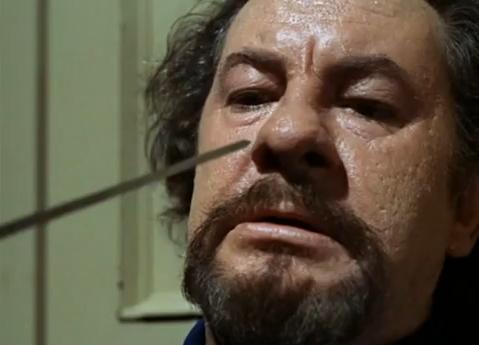
Next it is fencing. And by this point the intensity of the two actors - McGoohan and McKern - is incredible. Number 6 disarms Number 2, and McKern taunts McGoohan and dares him to kill, but McGoohan refuses. Just look at their faces in this scene:


McKern, in particular, was supposed to have been brought to the brink of either a nervous breakdown or a heart attack (accounts differ, according to Wikipedia). I can believe it of either. Just look at the difference between here:
and here:

But even if not true and it's pure acting; what acting!

Next Number 2 takes Number 6 back to a scene that could have been his recruitment into the secret service - as a cocky young man convinced the job he has applied for is a cover for the sort of work he really wants; that he thinks he's really qualified for.

This is followed by a scene that shows another side of Number 6 we have not previously seen - up in court for a driving offence, he tries to use his position to get off the charge, but the judge - Number 2 of course - isn't having it.

Amongst all of this rapid and intense wordplay is some kind of safeguard built into Number 6's hypnosis - he can't say or recognise the number "six" - and Number 2 tests this every so often to check the conditioning remains in place.

Number 6 is put behind bars. Number 2 again asks him why he resigned and this time seems to get an answer: "Peace... Peace of mind."
Then he begins to turn the tables on Number 2 until McKern says "I'll kill you!"
To this McGoohan gives the best response to that threat I can imagine:
"I'll die."
Number 6 gets a knife and hands it to Number 2, making it easy for him to carry out his threat. He lies on the floor to make himself helpless. But this time it is Number 2 that cannot kill; the reverse of the fencing scene.

Number 2 moves on to the next stage in Number 6's life - the war. We see scenes of Number 6 as a crewman of a plane dropping bombs on (presumably) Germany, until forced to bail out. He is then a prisoner of a German-shouting McKern in the place of those who captured him.

Both the times that Number 6 comes back to being himself are when he is behind bars - a prisoner, just as he is in the Village. But this time Number 6 has broken through his conditioning, and Number 2 realises it when McGoohan says the number six.

Number 6, now aware of his surroundings, has recognised the plan Number 2 is using as Degree Absolute, and he knows the risks being taken by Number 2 - in this 'doctor/patient' relationship, sometimes they can switch places.
"Why don't you resign?" he asks.


The light now follows Number 2 around, not Number 6, as he shows Number 6 around "the Embryo Room."

"Last scene of all,
That ends this strange eventful history,
Is second childishness and mere oblivion,
Sans teeth, sans eyes, sans taste, sans everything."

There are only five minutes until Number 2's week is up. Number 6 locks Number 2 behind the bars of the detachable living area. The Butler does nothing to interfere, indeed by taking the key from Number 6 he appears to have swapped sides along with the light.
"He thinks you're the boss now."
"I am."

As the clock counts down the final minutes the tables have turned completely and it is Number 2 that is broken by Number 6. The intensity of their duel - for the actors as well as their characters - reaches its climax as McGoohan counts down the last minute second by second.

In the final moments the desperate Number 2 almost succeeds by asking - with humility - why Number 6 resigned, instead of demanding the answer from a position of authority, but it is too late. "Six," he gasps, with six seconds left on the clock.
"Die, Six, die!" shouts McGoohan at this point, and presumably he doesn't mean himself.

And at zero, Number 2 (or is it Number 6 now?) dies.

The Supervisor stands at the open door. "Congratulations," he says. "What do you desire?"

"Number 1."

"I'll take you."

Is this it?

Next: Fall Out

Sunday, 19 December 2010

Reinforcements for Longcat!

I has new friends to help me not get my long stolen by Longstealer.
They are the Rainbow Warriors!


Their leader is Geofroi.

Thursday, 16 December 2010

The Prisoner Challenge: The Girl Who Was Death

This was the first episode of The Prisoner I ever saw, on Sky TV a good number of years before I saw any of the rest of the series. It's not representative of The Prisoner in any way, being - in its own way - just as much of a format-breaker as Do Not Forsake Me Oh My Darling or Living in Harmony.

None of these three episodes feature much of the Village, the setting of the great majority of the series, though I would say this episode lies between those two in how successfully it retains the important themes of the series while stepping outside the setting.

Superficially the story of The Girl Who Was Death resembles a spy thriller (such as Danger Man), but turned up to 11 with pulp adventure elements ranging from bombs disguised as cricket balls to ridiculously elaborate slow-moving deathtraps, and downright silly elements such as the recorded (Mission: Impossible-esque) briefing answering back to the listener's comments.


Justine Lord as Sonia Schnipps, a.k.a.The Girl Who Was Death

Once 'Number 6' (what else can I call McGoohan's character?) is on the girl in white's trail, the escapes maintain a consistent level of absurdity only matched by the most outrageous of James Bond's. And yet, for all the comedic moments, there is a dramatic tension about them - I want Number 6 to escape and catch the girl to unravel the mystery.

The escapes go from an exploding cricket ball to being poisoned in the pub - while Number 6 simply evades the former, his solution to escape the latter is ingenious. He is then locked in a turkish bath (while fully dressed in a Sherlock Holmes kit) and goes on to box with the 'Killer' for the clue leading him to the 'Tunnel of Love' (where she first confesses her love for him... as an opponent).

She leads him a merry dance across fairground rides (where there is a cameo by Alexis Kanner as the irate photographer) and then on to a car chase where she taunts him:
"You'll make a beautiful corpse. I'm going to do you the honour of letting you die... superbly."

She's mad. But her madness is seemingly contagious - she bamboozles him with a special effect, turning the projected backgrounds of the car chase scene around.

Fourth wall? What fourth wall?

"You may not see my face, but you may know my name. My name is Death."
She leads him to the isolated street she has set up, and continues to taunt him as he continues to hunt for her.
"You are a born survivor. I am a born killer. We were made for each other."

He survives a hail of bullets from a machine gun and falling through a trapdoor above a pit full of spikes. "Incidentally, they're electrified."
He gets out into a room mined to explode in 90 seconds (she's good enough to warn him of this). He climbs along a pipe to avoid touching the floor. The pipe sizzles. "That's the hotline. Or had you noticed?"

He swings into a room full of poisoned candles that explode if they're blown out. Shut in by steel doors, he begins to choke. But his solution is as ingenious as this trap is ludicrous. He sets up enough of the candles by a door to blast his way through when they're extinguished.

Wearing a spiked German WW1 helmet - white, like all her clothing - she chucks grenades at him while shouting "Whee!"
He tries to get out by driving a digger, but the grenades disable it and she finishes it off with an anti-tank missile. "Bye bye lover."

Thinking him dead she departs by helicopter. But guess who is clinging to the underside?


This episode has so far carried off its absurd plot with immense charm, and I love the music that accompanies it and lends the whole thing a surreal atmosphere. But after this point the best part of the episode is over and the ending is something of a rushed disappointment by comparison.

Number 6 is brought to the villain's lair, inside a lighthouse where a man with a literal Napoleon Complex (Professor Schnipps, played by Kenneth Griffith) plots a plot lifted from Moonraker (the book, not the film) - to destroy London with a big rocket. And aside from his mad daughter he is assisted by a parade of Irish, Scottish and Welsh stereotypes who bumble about until they kill themselves with guns Number 6 had rigged to backfire.

Despite the girl managing to capture Number 6 to tie him up inside the rocket for one final deathtrap, father and daughter are also bunglers, displaying so little competence in these scenes that I have to wonder how their plan ever got this far? It's maybe best not to think too hard about it, this is supposed to be a comedy episode.

They get blown up with backfiring grenades, taking the whole lighthouse ("it's only a model") with them. Then the scene fades to Number 6 in the Village - he's been telling a story to three children (and their un-PC toys).

"Goodnight children... everywhere."

Although I find the ending - or what is basically the last 'act' of the episode - to be anticlimactic, there is much to recommend about the sequence of escapes that make up the middle of the story and the overall theme.

On the one hand this is an episode that doesn't take itself too seriously, e.g. the fourth-wall-breaking car chase scene, but by presenting the overall comedic plot as part of a story told by Number 6 it allows it to be part of The Prisoner continuity - just as the VR in Living in Harmony allowed the Wild West setting to exist within the Village setting.

While Number 2 and his assistant (who bear a resemblance to Schnipps and his daughter) fail to learn anything about Number 6 from the story he tells, I think it is possible to interpret the story within the context of the series, coming as it does between Living in Harmony and the final two (linked) episodes.

In Living in Harmony we see what the Village has in store for Number 6 - the fate of the Sheriff is a possible fate for Number 6 if he continues to resist them. As the Judge says, "Nobody walks out on me. I'm not letting you join some other outfit. I'll kill you first."

The story he tells in The Girl Who Was Death is Number 6's answer to this: Bring it.
Just as his character does in the story, he intends to survive anything and everything they can throw at him and win through in the end. He remains as defiant as he was in Arrival when he said "I've resigned. I will not be pushed, filed, stamped, indexed, briefed, debriefed, or numbered."

So what happens when an unstoppable force meets an immovable object?

Next: Once Upon A Time

Friday, 10 December 2010