Showing posts with label internets. Show all posts

Saturday, 7 March 2026

Sharpe, season one (1993)

Well sir, upon sighting the series, I naturally gave the order for it to be reviewed on my blog. That's my style, sir.


The moment the electric guitar kicks in you know you're in for an entertaining couple of hours of Sean Bean killing Frenchmannys and calling English toffs "bastards." Or possibly the other way around...

Sharpe's Rifles

My memory of this series was faulty - I remembered this initial episode as being fairly average, with a minimal plot due to the need to set up all of the main characters, not only Sean Bean's Richard Sharpe - surely still his best and most memorable role, despite all the many things he has died been in since - but the rest of the Chosen Mannys, not to mention the premise of the Napoleonic setting of 1809, just as the British army is about to invade French-occupied Spain.

But this is only partially correct - there is a lot of setting up and introducing of main characters, which occupies most of the first half of the 100 minute episode duration, though the characters are almost without exception introduced organically, with a chance for every one to show a bit of unique personality, and likewise the exposition is very cleverly handled. Brian Cox (not that one) as Major Hogan, the intelligence officer W-wording directly for David Troughton's General Arthur Wellesley (who has not yet been made the Duke of Wellington and regenerated into Hugh Fraser), delivers most of the exposition to Sharpe and via him to us the viewers, but as Sharpe has only just been made an officer the show has a built-in excuse for him not to know much about Hogan's schemes until he is told them.

Where the episode gets good is after the "proper officers" Major Dunnett and Captain Murray (played by proper poshos Julian Fellowes and Tim Bentinck respectively) get killed off in a French ambush, Sharpe is left in command of a rag-tag group of Player Characters, the crack shots of the Chosen Mannys squadron who all carry the rifles of the episode title. They don't treat him with automatic respect due his rank because he is not a proper officer, having only just been made a lieutenant (I can't wait until Sharpe gets promoted again so I don't have to spell that word any more, mew) by Wellesley at the beginning of the story. Therefore Sharpe has to win his mannys' respect, which he sets about doing by being a dirty fighter just like them, but he also shows his intelligence by the use of cunning ruses to outwit and escape from a French force that outnumbers them and just generally has them at a disadvantage.

The plot really gets underway when the Chosen Mannys team up with some Spanish guerillas, led by Commandante Teresa Moreno (Assumpta Serna, almost the only woman in this whole programme but doing enough acting to more than make up for it) who soon becomes Sharpe's love interest. We also see the beginning of Sharpe's relationship with Sergeant Patrick Harper (Daragh O'Malley) as they go from enemies to lovers best friends over the course of the episode - Harper starts off trying to kill Sharpe in a mutiny after the "proper officers" are all killed, and ends up sticking around to save the day in one of the coolest set-piece scenes in the whole series (you might think the show is playing its paw a little early, but just wait until the next programme...) when he kills two French cavalrymannys in just a few seconds.

The various plot strands that have been set up then all come together for an impressive climax that succeeds really well as the first instalment in a series, with Sharpe and co achieving a symbolically significant victory that foreshadows the greater victories they will win in later stories. So I guess you could say that on it's own Sharpe's Rifles is a touch lacking, because some of the later ones take what it does well and do it better, building on the excellent setting up done here without the need to establish series premise and characters. But there's still a lot to recommend about this opener on its own merits.


Sharpe's Eagle

This was the first Sharpe novel written, which you can kind of tell from the way the author Bernard Cornwell absolutely stuffed the plot full of ideas, many of which might have on their own been the subject of a later book once the series was established, but here sharing space with all the other ideas.

In terms of the TV story, this is the best individual episode of the whole run, an absolute tour de force from start to finish (though, it must be said, not the best introduction to the series, which is why it was good that they adapted both it and Sharpe's Rifles together). This is the episode that introduces the classic Sharpe trope of Sharpe vs the toffs instead of the French, because although there are two battles with the French in the story, there are no named French characters as baddys this time.

Instead we have Sir Henry Simmerson, colonel of the South Essex regiment,  as played by Michael "Redvers Fenn-Cooper" Cochrane, the most instantly hateable of all the English upper class officers to appear in the entire series. His cowardice and incompetence sets the plot in motion when he bungles a mission to destroy a bridge over a Spanish river, resulting in the death of his second-in-command Major Lennox (who Sharpe has backstory with and respects) and the dishonour of the regiment when the French force nicks off with "the King's Colours" i.e. the regimental standard.

As he lies dying, Lennox asks Sharpe to take the French equivalent, an "Imperial Eagle," at the upcoming battle to restore their lost honour, and Sharpe silently vows to do so, hence the name of the story. This is followed by one of the greatest scenes of the series in which Simmerson is disciplined by General Arthur Wellesley - easily David Troughton's finest scene - who gives Simmerson enough rope to hang himself by trying to blame anyone and everyone else and Simmerson ends up completely humiliated. Troughton exploding with anger when Simmerson tries to pin the blame on the dead Major Lennox is perfectly timed, demonstrating Wellesley's contempt for the cowardice and dishonourable behaviour of Simmerson. Cochrane, it has to be said, is also superb as he plays what must be the ultimate screen bounder.


When Sharpe gets promoted to the rank of captain after the fiasco, which is as much to spite Simmerson and his nepotistic attempt top get his own nephew promoted as it is for Sharpe's own merits, Simmerson sends his nephew and another lieutenant named Berry (played by a young and unknown Daniel "Bond, James Bond" Craig, the first of a succession of before-they-were-famous actors to play Sharpe's baddys or henchmannys-of-the-week) to kill Sharpe.

Berry comes pretty close to killing Sharpe while on a night patrol, but forgets that Sharpe has mannys on his side and Harper kills Berry first. There's so much focus on Sharpe himself and the variety of guest characters (Cornwell stuffing this story with a much larger guest cast than most Sharpe stories) that there isn't much time for the Chosen Mannys to get screentime - again it is a good thing they all got their chance in the first episode - but Harper gets enough here to become well-established as the main secondary character, which will of course continue for the rest of the series.

Other guest actors of note include Brian Cox in his second and final appearance as Major Hogan, again giving the orders to Sharpe and being the main officer-on-Sharpe's-side, though their relationship is subtly different than in Sharpe's Rifles, since Sharpe is a bit more used to Hogan's ways by now, and a lot of the exposition is delivered not to Sharpe but by him, to the raw recruits of the South Essex regiment.

There's also Gavan O'Herlihy (recognisable because this was not long after he was in a pawful of episodes of Twin Peaks) as Captain Leroy, an inappropriate American Virginian. He has a subplot where he sort of gets on with Sharpe and helps him out when he needs money, but has his own motives for doing so, and he is an interesting character who adds a little bit more depth to the plot, but is another example of Cornwell throwing another character into the story even though he isn't strictly necessary.

I'm not sure this review can really do the episode justice in conveying just how great it is. It really is packed full of action and incident, and scarcely a moment is wasted. The baddys are proper boo-hiss baddys, and Sharpe and Harper and their allies seem even more heroic by way of contrast. This is the point where Sharpe really gets going.

The only downside one might find with the story is the fact that the series might just have peaked too early, what with this being only the second instalment, so it is going to need something special next time so that the follow-up doesn't feel like a letdown by comparison to this one. Something like a really great baddy...

Monday, 23 February 2026

Hey...


I think they mean "shouldn't", mew.

Friday, 8 January 2021

Thursday, 31 December 2020

Wednesday, 10 April 2019

Thursday, 12 April 2018

Big Gay Longcat reviews Doctor Who: The Greatest Show in the Galaxy Part Four


Mags turning into a weredoge gets Captain Cook a high score from the audience. He tries to give the Doctor some exposition but the incidental music is going as crazy as Mags (maybe it is being performed by another weredoge?) and it is very hard to make out what the Captain is saying.

The little manny in the audience's eyes glow. The Doctor escapes from the ring but Mags chases him (doggys like chases). He goes up to the three audience members and all of their eyes glow now and this somehow causes the Doctor to fall back into the ring. He is only saved when Mags turns upon Captain Cook and the Captain goes

Ace and Kingpin look in the space bus for the missing piece of the medallion. The bus conductor robot tries to kill Ace, but when Kingpin finds the missing piece he gets his memories back. He remembers the robot has a self-destruct button and gets Ace to press it. Instead of simply going "blargh I am ded" the robot goes


Mags scares the clowns so she and the Doctor can get away. The mannys in the audience "want more" so the clowns turn on the Ringmaster and Morgana, making them do a disappearing magic act. Then all of the clowns do the thing with their hands.


I somehow don't think the Ringmaster and Morgana will be coming back. It's like Paul Daniels' 1987 Hallowe'en special all over again!

The mannys in the audience want the Doctor. He goes back so Mags can run away, and the clowns chase her (doggys like chases) in their scary black death car.


When the Doctor goes back into the Circus he goes into a special effect and winds up in a different sort of arena - one that is old and stone and not the Circus from before. The three audience members are still there, but they also look very different - made of stone with sinister faces.


The Doctor recognises them as "the gods of Ragnarok."

It makes sense that there are three gods of Ragnarok because there are three cat gods: Ceiling Cat, who sees all; The Maker of Cats, who made us into cats out of socks; and The Hoff. Nobody knows why The Hoff is the third cat god, but he is. Unlike religious mannys, who worship their gods, we are cats so we merely acknowledge our gods as equals.

The gods of Ragnarok are obviously bad gods because they use their giant eye to watch things from below, like Basement Cat does, while Ceiling Cat watches from above and is a good cat.

"I have fought the gods of Ragnarok all through time."
says the Doctor. While you might think that the Doctor has never met the gods of Ragnarok before now, remember that everything in this story is a metaphor for something else outside the story, including the gods. The gods say
"Entertain us!"
"Entertain us or die! So long as you entertain us you may live."
"When you no longer entertain us you die!"
The Doctor does magic tricks for the gods. They shoot some pewpewpews at him, but they don't kill him yet. They say
"You are nearing the end, Doctor."
and
"You are on the brink of destruction, Doctor. We want something bigger, something better."
This gives us a clue as to who the gods represent in the show but, just as this story has been doing throughout, I'm going to hold back on revealing the answers for now...


Mags meets up with Ace and Kingpin. Ace lures the clowns to where Chekhov's Bellboy's robot from part one is, and because she has the remote control now she can has it turn its pewpewpew eyes upon the clowns.

Five clowns come out of the clown car, which is not that many really but what can we expect on a BBC budget?

Ace, Kingpin and Mags steal the clown car to get back to the Circus quickly. The gods make Captain Cook come back to life as a zombie and he steals the medallion from Kingpin just before he can throw it down the well to where the Doctor is.

Ace and Mags together knock it out of Zombie Captain Cook's hands so it falls into the well, where the Doctor catches it and uses it to reflect the gods' pewpewpews back upon them. The gods and the "Dark Circus" (as Kingpin calls it) collapse, so the gods must have been load-bearing baddys.


The Circus tent explodes behind him as the Doctor walks away, not looking at it.

Kingpin and Mags decide to make a new Circus, one that can't possibly go wrong, mew. They invite the Doctor and Ace to join them but the Doctor declines, and the last line of the story is him saying
"I find circuses a little... sinister."


The Greatest Show in the Galaxy is a flawed classic. It has great and memorable baddys, and a plot which manages to be both an exciting mystery and, at the same time, an allegory for Doctor Who's place in the world at the time when it was 25 years old. It is a fresh and original story, and a fine way to conclude the anniversary season.

It isn't perfect - the mystery is so slow in playing out its hand that the first half of the story can be quite hard to follow at times, and this is not helped by the incidental music intruding on some key lines of dialogue.

There are a lot of characters who get introduced quite quickly - some of them only existing to get killed off or to provide some early exposition - with the result that they end up quite broad and one-dimensional. The character of Whizzkid is an example of this, as well as being an unnecessary and unwelcome caricature of Doctor Who fans.

"It was your show all along, wasn't it?"
Ace asks the Doctor. The gods of Ragnarok are the BBC Management. They can't kill the Doctor while he is still entertaining, not even though they want to, not even though he is their greatest enemy and stands against everything they believe in. They want "something bigger, something better" and yet are prepared to sit there while the Doctor performs his low-budget magic tricks one after another.
And then by the time they try to kill him off, it is too late.

Despite the TV series getting cancelled the following year Doctor Who is, of course, still with us - and by that I don't just mean the new series that came back to BBC TV in 2005. Target novelisations of the TV stories were available before they began to be released on VHS (and later DVD). In the 1990s they would be repeated on the satellite channel UK Gold, allowing cats and mannys who were too young to have seen them on the BBC to watch them and become fans that way. Plus there were many original book stories, comic strips, Doctor Who Magazine and Big Finish... and all that before the internets truly came along!

By its 25th birthday in 1988 Doctor Who had grown to be far more than just another TV programme. It was The Greatest Show in the Galaxy.

Sunday, 24 September 2017

Epic Sax Manny at Eurovision

Yet more proof (as if any were needed) for how great Eurovision is. Here's Moldova's entry from 2010:

Monday, 17 July 2017

New Doctor Who announced...

... and still not a cat, nor even a doggy. Maybe next time...


In the '80s it was a publicity stunt. In the '90s it was a joke. In the '00s it became a possibility. Now it's a reality.

It just took a little time, that's all.

Thursday, 15 December 2016

Sunday, 13 November 2016

10 Reasons Cats Don't Tweet

#catsdonttweet


#1. We are not birdies.

#2.
This election is a total sham and a travesty. We are not a democracy!
-- Donald Trump (@realDonaldTrump) November 7, 2012

#3.
The electoral college is a disaster for a democracy.
-- Donald Trump (@realDonaldTrump) November 7, 2012

#4.
My twitter has become so powerful that I can actually make my enemies tell the truth.
-- Donald Trump (@realDonaldTrump) October 17, 2012

#5.
The concept of global warming was created by and for the Chinese in order to make U.S. manufacturing non-competitive.
-- Donald Trump (@realDonaldTrump) November 6, 2012

#6.
It's freezing and snowing in New York--we need global warming!
-- Donald Trump (@realDonaldTrump) November 7, 2012

#7.
26,000 unreported sexual assults in the military-only 238 convictions. What did these geniuses expect when they put men & women together?
-- Donald Trump (@realDonaldTrump) May 8, 2013

#8.
Hillary Clinton has announced that she is letting her husband out to campaign but HE'S DEMONSTRATED A PENCHANT FOR SEXISM, so inappropriate!
-- Donald Trump (@realDonaldTrump) December 27, 2015

#9.
I refuse to call Megyn Kelly a bimbo, because that would not be politically correct. Instead I will only call her a lightweight reporter!
-- Donald Trump (@realDonaldTrump) January 27, 2016

#10.
The election is absolutely being rigged by the dishonest and distorted media pushing Crooked Hillary - but also at many polling places - SAD
-- Donald Trump (@realDonaldTrump) October 16, 2016

Monday, 1 February 2016

Stoppit and Tidyup


in "The Weekend of Woe"


Tidyup woke up one fine Saturday morning. He had no idea what fate had in store for him, as several of his friends had decided to pay a visit.
 
"Muuuuuh!" he said


"Let's go and visit Tidyup today. You can drive," said Eat Your Greens to Comb Your Hair


"Alright then, but only if you phone The Big Bad I Said No! and have an argument with him," said Comb Your Hair to Eat Your Greens


"Right then, Eat Your Greens, we're coming down there too!" shouted The Big Bad I Said No!


"Let's see if Sleepy Old Go To Bed wants to come with us, seeing as we have no idea where Tidyup lives," said Stoppit, but it sounded like "Ee ee ee ee ee eeee."


"I have no idea where Tidyup lives either, but that's no reason not to go," said Sleepy Old Go To Bed, adding "Stoppit can use his mobile to get directions, if we get lost."

Which, of course, they did


But they got there in the end


Everyone got drunk and lived happily ever after


Except Stoppit who suffered greatly from bogvom, and later sinkvom


Sleepy Old Go To Bed and Eat Your Greens talked bollocks in the kitchen for hours, and Sleepy Old Go To Bed and Stoppit felt not-at-all-well the next day

The End


"Sorry about the sinkvom," said Stoppit

Wednesday, 9 September 2015

These aren't the droids you're looking for

Starcat reviews Star Wars comics: STAR WARS (part two)

The story so far: Luke and C3PO are looking for R2D2.


What's wrong with Luke's face?


Luke is too involved now to go back and resume his old life. He is over the rainbow, and just like in The Wizard of Oz that means the story becomes colour from this point on. That seems the obvious reason for the sudden transition to colour pages to me, though I have heard some cats put forward the alternative explanation that the black and white pages were written before the invention of colour.
Gamma Longcat's theory, that some pages are black and white to keep down production costs of the comic book, is not taken seriously by other cat academics and I mention it only out of a sense of completeness.

The scene of combat between Luke and the Sandmanny plays out differently here than in the film version, with Luke being seen to be struck by the Sandmanny's weapon, accompanied by a "WHRAF" sound, but he is then rescued before being sent to sleeps.


Now we are introduced to Ben Kenobi, who confirms he is Obi-Wan Kenobi in accordance with the law of conservation of narrative detail.


The plot moves swiftly to the scene where Ben Kenobi sees Princess Leia's message. The message itself is different in the details: Princess Leia names her father as "Bail Antilles, Viceroy of Alderaan" and addresses Ben Kenobi as both "General" and "Commander".

This leads on to Ben Kenobi telling Luke about his father and the Jedi Knights.


The compression of the story from the film to the comic is felt keenly on this page. Luke is given his lightsabre and told about Darth Vader and "the Dark Side of "the Force"", but in the film this scene is contrasted with us seeing Darth Vader make use of the Dark Side aboard the Death Star.

Luke, briefly sporting a 5 O'Clock shadow, does not want to go to Alderaan with Ben Kenobi, but is talked round to it in a couple of panels. This misses out one of the most gratuitously scary* film scenes in all of Star Wars when Luke goes home and sees Uncle Owen and Aunt Beru turned into skeletons by Stormtroopers - the event that convinces him to go with Ben Kenobi and sets into motion all that follows.

* Or at least it was until betrayed and murdered by the Dark Side of internets memery.


I don't know why Ben Kenobi's face is blue in this picture.


They go to Mos Eisley Spaceport where Ben Kenobi uses the Force to hypno-eyes Stormtroopers. This serves a dual purpose within the narrative: to both escape from the Stormtroopers, and to demonstrate to Luke (and us viewers) what the Force is capable of in the hands of a Jedi Knight.


We meet Han Solo and Chewbacca, both great characters (although Han is basically only a prototype for Lando Calrissian). The scene when Ben Kenobi chops off a manny's arm with his lightsabre is omitted, so when Han says
You're pretty handy with that sabre, old man.
then we must either assume he knows of Ben Kenobi by reputation, if we didn't know about the missing film scene, or else groan at the pun if we did.

Here Han wants to be paid
Ten thousand.. in advance.
and for the sake of brevity we don't see Ben Kenobi haggle him down to seventeen. I think that's what happens, I'm not good at numbers.


Instead we skip straight to the Millennium Falcon flying into space, missing out the brief action scene of the Stormtroopers catching up and shooting at them. That means the above pictured panel is our first sight of the Millennium Falcon in the comic strip.

Up to this point various film scenes with Princess Leia, Darth Vader and Governor Tarkin have been missed out to keep the action with C3PO and the other heroes. But now we reach an important scene that cannot be dropped so, for one page only, we cut to...


This is our first meeting with the principal baddy of Star Wars, Governor Tarkin of Whitstable. He shows he is a baddy straight away by blowing up the planet Alderaan. Taking up half of the page, the planet blowing up is one of the biggest and best pictures in the comic so far, as if to emphasise its importance to the plot.

Even though this is not a cliffhanger, it seems to me that this is a dramatic moment on which to leave things for today. Join me next time when our heroes will reach the Death Star and attempt a prisoner transfer from cell block 1138.


Appendix 1

There are lots of different versions of the Star Wars film that have been released over the years, and it may be that you know a different one from us cats. The format in which we are familiar with Star Wars is a VHS transfer of a Betamax recording of the September 1983 showing on the Grampian region of the ITV channel.
In other words: the best version of Star Wars.

While the first set of adverts were paused out of the recording, we are fortunate that the second ad break remains on the video. This occurs between Luke taking his "first step into a larger world" and Governor Tarkin receiving news from Dantooine.

There are eight adverts, and because they are adverts from 1983 they all look very dated now, like they come from another world that existed long before us cats or even the internets were made. These adverts are:

1. Smarties


2. Maxell Video Tape


This is an especially exciting advert because there is a cat in it!

3. The Great Composers magazine


This advert is useful in dating the broadcast of our copy of Star Wars to 1983, due to its publication date. Another advert appears in a later ad break that is even more useful for this purpose, but I will discuss it when we reach that advert.

4. Spry Crisp 'n Dry


5. McCain Pizza

I can't find a video of this on the internets. McCain Pizza is a kind of manny noms. The advert is most noteworthy for having Ian Holm provide the voiceover.

6. British Gas fires

Another advert that I cannot track down on the internets. The advert claims that
they're so beautiful to look at
so it is a shame that you cannot judge for yourselves, mew.

7. The Home Computer Course magazine


This is the second advert within the same ad break to have an Ian Holm voiceover. He must have been a very busy manny in the early 1980s.

8. Jaffa Cakes


This advert from the internets is too long to be exactly the same one as we know from Star Wars, but if you missed out the first 16 seconds then it would be the same.

Saturday, 29 November 2014

Cosmos: Sisters of the Sun

This programme begins with a short sequence on the dawn of astronomy when ancient peoples all over the Earth used the human talent for pattern recognition to name constellations and use their movement in the night sky to predict the seasons.

For the real meat of the episode we jump forward to the late-19th century. A scientist called Edward Pickering employed "computers" - a team of women - to map the stars, taking years to classify hundreds of thousands of stars.

The team was led by Annie Jump Cannon and Henrietta Swan Leavitt, who used spectroscopy to determine the stars' chemical composition and came up with 7 categories and 10 sub-categories with which to classify them.


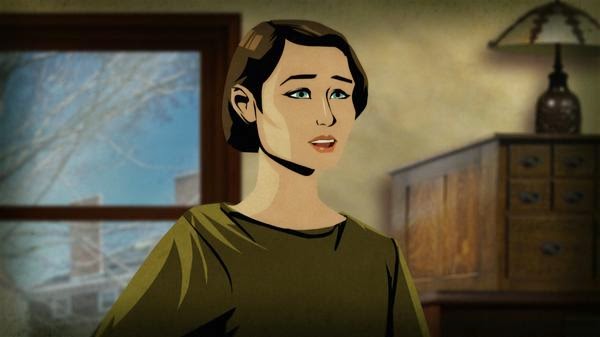
The animated segments of the episode beautifully show them working at their day jobs as Tyson's respectful voiceover keeps things interesting.

Cecilia Payne came from the UK to join their group and worked out that the categories they had come up with corresponded to a star's temperature. Her PhD thesis was that stars were primarily composed of hydrogen and helium (something I would have assumed was known before then, but before Payne made this discovery astronomers thought that stars were made up of the same elements as the Earth and in roughly the same proportions). If Tyson's voiceover was respectful before, he is positively in awe as he describes this, saying it pioneered modern astrophysics.

The next section of the programme is on the life of stars from 'birth' to 'death', including the sun - we see the sun becoming a red giant in 4 to 5 billion years, then collapsing again into a white dwarf, as Tyson discusses the atomic processes that cause these transformations.

Other stars have different fates in store depending on their size and mass, and if they are part of binary star systems. The heaviest stars end up as supernovas, black holes, or hypernovas. Eta Carinae is 100 times heavier than the sun and could become a hypernova, destroying entire star systems and their planets up to hundreds of light years away from the centre of the explosion. Tyson reassures us earth is 7500 light years from Eta Carinae and is safe, but will see it as the brightest star in the sky when it goes.


Tyson closes the episode by talking about how the milky way galaxy would look from the point of view of a globular cluster, in one of the most poetic speeches in all of Cosmos - and echoing closely Carl Sagan's lines from the original series:

"A still more glorious dawn awaits.
Not a sunrise, but a galaxy rise.
A morning filled with 200 billion suns.
The rising of the milky way."

Sunday, 16 November 2014

There's a reason that Cats Don't Tweet


This is what things like #gamergate look like to cats.

Hint: Servalan is a baddy. Context.