Showing posts with label Jarvik. Show all posts

Monday, 6 May 2024

Campion (1989)

Peter "Davo" Davison stars as Albert Campion in this BBC detective series. Made around the same time as the BBC's Miss Marple series (which Davo made a guest appearance in) and the start of ITV's long-running Poirot, this has a similar feel and production style - helped a lot by this having a similar 1920s-30s period setting. Eight novels were adapated, with each being split across two 50-minute episodes.

Campion as a character is a posho with a shady past, able to pass among the aristocracy and the criminal classes just as easily. He also has a sense of humour, which involves cracking lame jokes at inopportune times, such as when a body has just been discovered. Davo fits the part well, able to give Campion a lightness of touch that sets him apart from other TV detectives of this subgenre, although his voice and mannerisms do occasionally remind me of his time as the Doctor. He also puts me in mind of a similar detective character, Mr Laxworthy, memorably played by Bernard Hepton in the 1970s Rivals of Sherlock Holmes series, with his superior intelligence and habit of using criminals (or ex-criminals) to do his dirty W-word for him.

Foremost of these ex-criminal servants is Campion's mannyservant Magersfontein Lugg, played by Brian "Gaffer" Glover. The third regular character is the ubiquitous friendly rival police Inspector (what private detective would be without one?) Stanislaus Oates, played by Andrew "Jarvik" Burt. Purr. Not as dim as some, Burt has the unenviable task of carving out his own niche in an overcrowded field full of Lestrades, Japps, and Slacks.

If names like "Magersfontein" and "Stanislaus" seem a bit too pointedly unlikely, I am quite sure this is deliberate. The series is played straight (save for Campion's in-character humour), but the events it depicts are at times so OTT that they must come across to viewers as parodies of the genre. That is because they are - something which I think is important to keep in mind as, paradoxically, this makes it easier to take them seriously.


1. Look to the Lady

The first story is a perfect example of what I mean, with an absurd plot about a noble family who keep an ancient chalice in their country house, which they must keep safe or else forfeit all of their wealth and estate. Fake chalices abound, as well as supernatural elements that Campion and Lugg reveal have mundane explanations... or do they? And then at the end it is implied that the chalice is your actual Holy Grail.

On first hearing the theme music you could be forgiven for thinking it was too twee to be real, but the important thing to remember is that it is Peter "Button Moon" Davison that is singing the "Da-da-da-da-de-da-dum" bits himself, and that knowledge suddenly makes it pawesome.


2. Police at the Funeral

A more conventional murder-mystery than the first story, much more approachable for any fan of the genre, though the downside of this is that Campion comes across as more of a conventional, Agatha Christie-style detective in this one than in the first, where he got to make use of a broader selection of his skills.

The guest cast in this is pretty impressive, with Mary "Dance of the Dead" Morris as the stern matriarch of the upper-class family Campion is staying with, and Timothy West as Inspector Oates's prime suspect. West had a run of appearances alongside Davo in the late '80s, this being the third after they were in the same Miss Marple together, and then West made a memorable one-off appearance in Davo's A Very Peculiar Practice.


3. The Case of the Late Pig

Davo is reunited with Michael "Hedin" Gough in the most convoluted case yet. With mysterious cryptic letters, a dead manny turning up only to have been killed again, and bodysnatching, not to mention a substantial cast of suspects to be introduced, there's little time for Campion and Lugg's own eccentricities so it resembles a more generic murder mystery. Since this also happened in Police at the Funeral, it seems the promise of the first story for Campion to be a manny of many skills beyond just being an amateur detective seems to have fallen by the wayside, now he's just an amateur detective with an ex-criminal for a mannyservant sidekick.

That said, the actual murder mystery plot is a good one. The audience is kept guessing throughout part one, and it isn't until after a second murder takes place that things begin to fall into place. John Fortune also appears, and the police presence is provided by Moray "George Frobisher in Rumpole" Watson.


4. Death of a Ghost

This is the first time we hear "Albert" Campion addressed as "Bertie," which made me think that surely somebody somewhere has done a crossover with Jeeves and Wooster? Once again this has little room for Campion to show any of his skills other than his detecting, though there is a larger role for Chief Inspector Oates this time, with Lugg somewhat sidelined and mostly reduced to sniping quips and making impertinent comments about Campion's lack of progress with the case.

A strong first part sets up a nice mystery, and the second part looks to be confounding the typical tropes of the genre when Campion explains who did it and how well before the end of the episode. But Oates needs proof before he will arrest the suspect, which Campion lacks, so the final act is him trying to get the murderer to incriminate themselves.

There are shades of Columbo in this, perhaps (though we viewers don't actually know Campion is right, having not seen them do it like we would have in a Columbo), but few Columbos have a resolution that's as poorly handled as this, with Campion coming out on top only through luck, not through using his brains or skills. This ending lets the story down badly, making this the weakest of the series so far. Davo does get to do some nice "drunk as a lord" acting, though, so it's not terrible.

Milton Johns and Rosalie Crutchley are the main guest actors of note. I daresay there were a few other faces we cats recognised from other TV programmes of the era.


5. Sweet Danger

The second season sees a change to the titles, with Davo no longer being allowed to sing along with the theme tune. To make up for it, we get what is definitely the best story yet, largely thanks to the presence of Iain Cuthbertson as a master criminal. In a welcome change from yet another murder mystery, this is a plot with a treasure hunt and a race against the baddys to get to it first.

Campion even has more allies (or Companions, might we call them?) than just Lugg in this one, with David "Pangol" Haig as an old friend, and Lysette "Krull" Anthony as a love-interest-of-the-week helping him out, while Cuthbertson has on his side reliable old character actors Paul Brooke and Richard Pearson, the latter playing a random satanist.

The twists and turns of the plot get increasingly outlandish, but at least this is the first time since the first episode where the series has fulfilled its promise of being more than just a knock-off Agatha Christie, and Campion more than a generic period detective. The presence of Cuthbertson tips it over into being the best story of the whole series by a comfortable margin.


6. Dancers in Mourning

We return to murder mysteries with a bang. A murder is followed by the killer having to do more murders and murder attempts to try and keep their identity from the first murder covered up, including one done using a bomb that explodes in public, killing several innocent bystanders. This is a spectacular event to end the first episode on, but the spirit of JNT lives on when that's not the cliffhanger - instead there's an additonal scene where Campion is told about the bombing, and then Davo looks into camera while making a sort of "well whaddaya know?" type face as the credits start to roll.

The convoluted tale takes screen time away from the regulars, though Campion still has time to fall for a married woman, the second episode in a row to feature an unsuitable love-interest-of-the-week for him. On the plus side, we see more of Chief Inspector Oates, and while he can't quite keep up with Campion, he is shown to be no fool. The biggest problem with this story is that too many of the characters are ahead of the viewers - knowing things we've not been made privy to, that sort of thing - that we are left playing catchup in a pretty unsatisfactory manner.

The main guest star is Ian "Drusus" Ogilvy, who plays a stage musical actor. Despite the packed plot, the first part takes time to show us a significant amount of his musical number, which I suspect was more fun for the actors than the viewers. And pity the poor choreographer who must have been asked to recreate a deliberatly hideous, cheesy 1930s dance routine.

Oh yes, the series is now confirmed as being set in the mid-1930s. I'm no great expert on the inter-war period, but it feels to me like it could have been set any time in the '20s or '30s due to the lack of any topical events pinning it to a particular year, save that they have started being more specific in the dates they give on screen.


7. Flowers for the Judge

Probably the best of the straight murder-mystery plots, largely thanks to a satisfying twist ending. Part of the story looks as though it may have been shot around the same London docklands environment where Davo would have made Resurrection of the Daleks a few years earlier, needing little changed to make it plausibly the 1930s.

Christopher "Any politics?" Benjamin has a guest appearance as a magistrate, though the main guest characters are played by Robert Lang (most familiar to me as the titular "fascist beast" from the Rumpole episode of the same name) and Barrie Ingham (who I would like to say is best known for playing Sejanus in ITV's The Caesars, but obviously he is really best known for playing the worst Irish stereotype of all time in an episode of Star Trek the Next Generation) as two of the murder suspects.


8. Mystery Mile

The final story has parallels with the earlier Sweet Danger, since in both Campion goes up against a mysterious master criminal and his organisation. While this is undoubtedly one of the better stories of the series, with Campion using his criminal skills and contacts, and assembling his own gang to combat the villain's gang - and to rescue the damsel-in-distress-of-the-week - it is clearly inferior to Sweet Danger, lacking an adversary of Cuthbertson's stature. This time the criminal's identity is unknown, though anyone familiar with the genre may be able to deduce who it is by applying the law of conservation of narrative details to the shortlist of possible suspects.

Spoilers for the identity of the main villain follow: There are really only two possible candidates, and since Miles "House of Cards" Anderson is too obviously playing a wrongun, it can only really be Robert Robinson (not that one, tush and fipsy) and his wandering foreign accent. Was Paul Freeman not available?

Other guest actors of note include Geoffrey Bayldon - who might have been a suspect/red herring if only he had been in it for long enough - and Gary Parker, who was a familiar rentayank on British TV screens in the late '80s and early '90s.

Andrew Burt is missing and much missed from the final two stories, as a result of which neither end up having much involvement from the police. They are both quite packed stories, so it might be that he was cut for time, I am - alas - not at all familiar with the original Campion novels in order to say how much was omitted, added, or changed in adapting them for TV.

Oh, and just as Jon Pertwee got the gratuitous chase sequence included in his swansong, here Davo gets the opportunity to sing.


In many ways this series is worth checking out for Davo alone. Made only five years after he left Doctor Who, he is a leading manny again and playing a heroic character with some traits in common with the Doctor, yet he has matured considerably as an actor. When he is allowed to (some scripts just didn't seem to have the room) he gives Campion an edge which we really only saw him give the Doctor in Caves of Androzani. Perhaps it helped having Brian Glover as his sidekick instead of Janet Fielding?

The three stories in which Campion is allowed to be more than just a generic period TV detective, easily taken for a ripoff of an Agatha Christie, show what could have been done with the series, but even these are - with one exception - hampered by the style of the production. Even when trying to convey to us that people's lives are in danger or other high stakes situations, the feeling you mostly get as a viewer is that this is a comfy pair of slippers; a sleepy Sunday evening drama. Campion's sense of humour, where he cracks barely-witty jokes in the face of adversity, doesn't help, but the tone is set from the outset, with an incredibly lightweight title sequence and theme music.

So it was probably destined to never be considered a classic of the genre - especially with David Suchet's definitive Poirot starting around that same time - but it has a number of positives that make it worthwhile, not least the strong regular cast and interesting guest cast, which I have tried to highlight here.

I have to wonder how easy it would be to edit the series, possibly using clips taken from Black Orchid, to give the impression that Campion was the Doctor all the time? After all, in the first episode it was stated that "Albert Campion" was not his real name, and that he was a minor member of the aristocracy... in other words he is related to lords, or Time Lords..?

Saturday, 6 May 2023

Rumpole of the Bailey, Season Three (1983)

This season saw a major shake up in the regular cast, with Peter Bowles and Patricia Hodge, both mainstays of the show up until now, only appearing once each. From now on they would make only one or two guest appearances per season, instead of being main characters.

This begins in the first episode of the season, Rumpole and the Genuine Article, which sees Guthrie Featherstone QC MP (Bowles) promoted to a new role in the series as a comedically incompetent judge. Naturally his first case involves Rumpole, defending someone accused of art forgery. When "Featherstone J" boasts that his "judicial eye" can always tell when someone is lying to him, such as a witness, Rumpole takes mischievous delight in proving him wrong.

The best episode of the season is the format-breaker away from London, by now well established as a once-a-season occurrence. In Rumpole and the Golden Thread, Rumpole travels to a former British colony in Africa (a made up one, but perhaps somewhat akin to Ghana or Zimbabwe, alas I'm not knowledgeable enough to say which might be the closest real-world comparison) to defend an opposition politician accused of murder. The stakes feel higher than ever in this case, not only because this country has no juries at its trials, only a single judge appointed by the president-dictator with no love for the accused, but mainly because it still has the death penalty.

It turns out the accused wants to be found guilty, because he thinks a politically motivated guilty verdict will provoke a revolution in the country, and is horrified when Rumpole gets him acquitted by exposing his affair with a woman of a different tribe in order to give him an alibi - with the result that he is politically discredited. This might have been better if the preceding episode had not also featured an accused who secretly wanted Rumpole to fail - at this point the series is in real danger of over-using that particular trope.

What saves the episode and makes it one of the very best of the series is the coda when Rumpole is himself arrested, following a misunderstanding by officials over the meaning of the phrase "doing a murder" - they think this means Rumpole is involved in a conspiracy to have someone killed, when really this is just barrister-speak for participating in a murder trial.

But it means that we finally see made explicit what had until now only been hinted at - that Rumpole's motivation for being a barrister and always acting for the defence (never the prosecution) is based on his own fear of being arrested, convicted and imprisoned. Presumably this comes from his formative experiences at boarding school - experiences that Rumpole has compared to prison ever since the first episode.


Rumpole and the Old Boy Net
is a turning point for the series, introducing as it does a character who will be a mainstay from this point on. The replacement for Guthrie Featherstone as head of Rumpole's barrister chambers, and with it the role of regular comic foil for Rumpole, is the pious and pompous Sam Ballard QC, wonderfully played by Peter "Vincent Stoat" Blythe. He is perhaps a bit more of a match for Rumpole than Featherstone or Erskine-Brown, at least at first, although we only see them opposite each other in court once in this season, in this his first appearance.

Memorable one-off guest actors we see in this season include Vernon Dobtcheff as an art expert, not reprising his role as a barrister from the original Play for TodayRumpole and the Golden Thread featured Joseph Marcell (still probably best known today for being in The Fresh Prince of Bel-Air) and High Quarshie (Solomon in Doctor Who's Daleks in Manhattan - an actor of his quality and that was the role they wasted him in?). Rumpole and the Old Boy Net saw Jack "Professor Travers" Watling appear as a witness. Meanwhile on the bench, guest judges of note included two more memorable appearances by Bill Fraser as Judge Bullingham, and one by Peter "Saruman" Howell. 

Roland Culver (best known to me for playing Augustus in The Caesars) was another guest judge in the fifth episode, Rumpole and the Sporting Life. Unusually for Rumpole of the Bailey, this judge is portrayed sympathetically - he is a judge who, we are told, once passed a death sentence on someone who it later (too late!) turned out was innocent (almost certainly based on a real case) and so carries this on his conscience when judging murder trials. This episode is also notable for featuring Andrew "Jarvik" Burt as an unlikable murder victim.

The final episode of the season, Rumpole and the Last Resort, again tries to wrongfoot viewers into thinking this could be the very final end for Rumpole when he appears to collapse and die in Judge Bullingham's court. This is then revealed to be a ruse on his part to draw out an elusive rogue solicitor who had been cheating the widows of recently deceased barristers out of their money.

In addition to an incongruous appearance from Jim "Bishop Brennan" Norton as a private detective, this episode also features Terence Rigby (Roy "Soldier" Bland in Tinker Tailor Soldier Spy) as the dodgy solicitor in question, who meets his match when he tries his con on Rumpole's supposed widow, She Who Must Be Obeyed.

Their confrontation is a great scene, and makes for a fine send-off for Peggy Thorpe-Bates, since this would end up being her last time playing Hilda Rumpole. Of the three actresses who played Hilda on TV, Thorpe-Bates was easily the best, giving her character nuance and layers that the others could not match. In this I would compare her to Barbara Murray as the first Pamela Wilder in The Power Game, Virginia Stride as the first Miss Belman in The Mind of Mr. J. G. Reeder, or Stephen Greif as the first Space Commander Travis.

Monday, 8 February 2021

Big Gay Longcat reviews Blakes 7: Dawn of the Gods (part two)


"Welcome to Kraandor, my friends, an artificial planet, which is the palace of the Lord Thaarn, master of the universe. I am the Caliph of Kraandor."

The arrival of the preposterous character of the Caliph of Kraandor is the moment this episode goes irretrievably to shit. He pewpewpews Tarrant to demonstrate that he can dress as stupidly as he likes when he's the only one with a fuctioning pewpewpew gun, or "neuronic whip" as he calls it. Having captured them, the Caliph then goes onto the Liberator where he captures Dayna as well. At least Dayna can take some comfort that they could be bothered to capture her on-screen this time.

In a cell, Cally tells the others what she knows of the Thaarn:
"The story goes back through the mists of time, to the dawn of the gods."
Clang!
"There were seven gods who discovered the planet Auron, and on it left the first man and woman. A million years went by. The gods returned. They were no older even though a million years had passed."
"Not impossible if they had a spaceship capable of traveling at near the speed of light."


James Follett did research for this sci-fi script of his, and he wants to make sure we know it! Cally continues:
"The gods returned and were pleased with what they saw, and they bestowed on the people of Auron great gifts: new types of crops, which ended hunger, constant peace..."
"And telepathy?"
"...and telepathy was promised. But one of the gods was very jealous. He didn't believe that the people of Auron deserved all this. He was frightened they would one day become so powerful they would challenge the supremacy of the gods themselves. And in his rage, he killed another god. The five remaining gods were so angry, they built a chariot for him and sent him beyond the threshold of space and time. The mad god swore a terrible vengeance. He said that he would return again. He said that he alone would discover the eternal secrets and become the one great master of the universe. You see, a legend."

When the story is done, the Caliph brings Dayna in and takes Cally away to meet the Thaarn.


The Caliph introduces the others to Groff, who is played by Terry Scully, Henry vi from An Age of Kings. First Julian Glover in Breakdown, then Paul Daneman in Killer, and now Terry Scully for Dawn of the Gods. Did the BBC just round up actors from An Age of Kings to be in all the shit episodes of Blakes 7?
That probably means there's a parallel universe out there where...
"When wash the lasht time you felt the warmth of the Earth's shun on your naked back? Or lifted your face to the heavensh and laughed with the joy of being alive? How long shince you wept at the death of a friend? Doeshn't mean a thing to you, doesh it, Mish Moneyp... er, Madam Preshident? You've shurrounded yourself with machinesh and weaponsh, mindlesh men and heartlesh mutoidsh, and when they've done your work, and the machinesh have done your thinking, what ish there left in you that feelsh?"

Now I'm left wondering what Sean Connery would have looked like if he had been in Blakes 7?


Something a bit like this, I suppose. Mew.


Back at the plot, Groff and the Caliph want to know where Orac is, because they know he is one of the regular characters but not what he looks like (this is what happens if you read the Radio Times but don't actually watch the episodes). This leads to what is the only good bit in this otherwise awful second half of the story, where the Caliph whips out his neuronic whip and says
"The neuronic whip is on an automatic setting. It has only to sense one lie and it will boil your brains in your skull. Where is Orac?"
"If he's not on the ship, I don't know where he is."
"How tall is he?"
Tarrant indicates how high off the floor Orac usually is.
"A dwarf?"
"We never think of him as one."
"What is the color of his hair?"
"He hasn't got any. A bald dwarf shouldn't be too hard to find."
Lol, the Caliph is outwitted by Tarrant not lying.

Groff takes Avon and Tarrant to a room where he wants them to do W-Word. Oh noes!


Tarrant wants to at least be allowed to use a computer if he is going to be forced to do W-Word, presumably so that he can skive off and look at the internets when Groff isn't looking... er, I've heard that's something mannys do sometimes. Groff says that the Thaarn will not allow computers on Kraandor. Avon then starts asking Groff about the Thaarn's gravity generator that brought the Liberator here, claiming that he needs to know for the W-Word but we can tell that really he is only W-Wording on a plan to escape, lol.

Groff tells them that the Caliph has sent "a salvage team" to destroy the Liberator and steal all its Herculaneum, so they will not be able to use it to escape. It then cuts to show the salvage team trying to do this, but they are interrupted by the Liberator's self-defence mechanism, as seen all the way back (no, not quite that far back) in Space Fall. Despite them being baddys, Orac tries to warn the salvage team about the danger, but either they ignore him or it was already too late from them, as it pews them and they go


Cally is trying to have some sleeps while the Thaarn is watching Carl Sagan's Cosmos on his three TV sets (pretty impressive, since that series wouldn't be broadcast until later on in 1980), and he is also wittering on about taking over the universe using gravity:
"He who controls gravity, controls everything!"
Also considered as a possible slogan: The gravity must flow!
Cally doesn't want to be a ruler of the universe, clearly considering sleeps to be more important. Cally showing a sensible, cat-like sense of priorities here. The Thaarn eventually agrees to shut up and let her have some sleeps. Maybe he thinks she's just being grumpy and will agree to rule the universe with him after she wakes up?

Avon has deduced that "putting the gravity generator into full reverse would cause Krandor to disintegrate." To this Groff adds:
"Worse than that, it would blow up."
But they can't reverse the gravity generator while the "energy isolators" are on, and only the Thaarn has control of them.

Cally wakes up and pretends to join the Thaarn, tricking him into turning off his energy isolators. As soon as he does this, their pewpewpew guns start functioning again, and Avon and Tarrant immediately shoot their guards and escape, rescuing Vila and Dayna on the way out.

Cally pulls back the Thaarn's curtain (Blakes 7 not having had the budget for a giant Wizard of Oz head - nor even a giant Zardoz head - we have only heard his voice up until now) and we see that he is one of the Talosians who has escaped from Star Trek's The Cage. We even get a double jump cut to show him in dramatic close up.


This is a technique that is made more effective when it is not over-used, so we are lucky that it being used in this piss-poor excuse for an episode in no way detracts from the power of its use at the end of Blake.

Groff tries to aid their escape by reversing the gravity generator. The Caliph comes in, but before he can use his neural whip to stop Groff, Groff punches him and then they have a fight. The Caliph wins and pewpewpews Groff, but he still manages to finish pulling the big lever before he dies, which blows up Kraandor.

Cally catches up with the others and they get back into the Liberator and escape before the planet blows up. The Thaarn also escapes in his own spaceship. For reasons that are not made explicit, but may be due to her pitying the Thaarn for only ever appearing as the baddy in one episode, and an exceptionally shit one at that, Cally lies to the others and tells them she "never saw him." Avon says
"I suspect we have made another enemy."
Orac gets all huffy and says
"It is intolerable! There is insufficient room in the galaxy for his intellect and mine."
Tarrant says
"I don't know, he did have one redeeming feature. He didn't like computers."
and this weak put down passes for the end of episode joke.


Can I use "Dawn of the Gods" and "good" in the same sentence? Certainly: Dawn of the Gods is a good candidate for worst episode of Blakes 7. Perhaps only Ben Steed's episodes are worse, and at least Harvest of Kairos is a lot more fun than this.

Calling this Dawn of the Gods is an insult to both dawns and gods. I wouldn't like to be in James Follett's position when the Hoff hears about this!

Thursday, 14 February 2019

Tarrant's Valentine

We know that Tarrant and Jarvik used to know each other. Jarvik tells Servalan
"You don't know Tarrant, madam. He's a man."
And after Jarvik dies, not only does Tarrant say of him that
"He was a special sort of man."
Tarrant also sometimes dresses like Jarvik. Compare Jarvik's costume here


to the costume that Tarrant wears in Rumours of Death:


I think we have to consider it a definite possibility that Tarrant and Jarvik used to go out with each other. No wonder they enjoyed having a manly wrestle so much.


I bet Avon was jealous.

Sunday, 9 September 2018

Big Gay Longcat reviews Blakes 7: Animals


There are three episodes of Blakes 7 that I haven't looked at yet on this blog, and the only one of those that has Servalan in it is...


Oh dear.

Animals starts with Scorpio! in space already. Dayna is defending some manny called Justin against Tarrant's accusation that Justin is a mad scientist, because Tarrant has noticed a pattern emerging when it comes to the scientists they meet living isolated existences on planets far from Federation space in order to conduct their experiments.

Dayna defends Justin because she knows him from before she joined the series, and there's also a pattern there regarding old friends that means this Justin's chances of surviving to the end of the episode are, to put it mildly, not good.

Dayna teleports down to the planet where she meets Og and his friends, who are the "animals" of the title even though there is another reading that the real "animals" are, of course, Mannys. Dayna runs away, shooting a couple of Og's friends with her pewpewpew gun until she sees Justin. Who is the real "animal" here? Do you see?

Federation pursuit ships attack Scorpio! and Tarrant has to fly away from their special effects.


Inside Justin's base he gets a bit creepy with Dayna while giving her - and us - the exposition about who he is and what mad science he does. He is a genetic engineer and surgeon who has made the animals, and not out of socks like would be perfectly normal. He doesn't say why for now, so as to save some exposition for later.

Dayna is stuck on the planet because Tarrant has gone back to Xenon Base to get Scorpio! repaired. Meanwhile Servalan has found out about the Federation ships that attacked Scorpio! earlier and is interested in the mysterious ship and the planet it was near, so she gets her henchmanny-of-the-week to give her the exposition about Justin's planet "Bucol 2" which is top secret, so of course that only makes her even more interested.
"Set a course for Bucol 2."
Darth Vader needed the Force to know the rebels were on Hoth, but Servalan just knows that if it is mentioned to her on-screen, it must mean Avon and his friends are involved.

Tarrant is proved right, Justin is definitely a mad scientist, and even Dayna says his work is "insane" when she finds out he was working for the Federation trying to make "radiation proof commandos."


Avon finally appears in the episode on board Scorpio!, trying to repair it with Orac, Vila and Soolin. There is some comedy business where Vila has to go into a dirty and smelly part of Scorpio! to do some repairs when he doesn't want to. The fact that a normally reliable Vila-being-silly scene isn't funny bodes ill for the rest of this episode.

Justin tries to justify (justinfy?) all the bad experiments he has done. It seems he and Dayna are coming around to each other's point of view, or it may be that Dayna is playing along with her mad friend until Scorpio! comes back and she can teleport away? He is very creepy.


Servalan meets with Ardus, who is played by Kevin Stoney. Kevin Stoney had already been in Blakes 7 back in Hostage, where he played a different character but also one who only met Servalan out of all the regular characters. Ardus gives Servalan more exposition about Bucol 2.

Because this is season four, Servalan is of course pretending to be Commissioner Sleer, and Ardus recognises her and has to pretend not to. But Servalan knows that he knows who she is and has him blowed up, although she would probably have done that anyway.

Servalan's spaceship lands on Bucol 2. Dayna goes outside to give Og noms and he throws her stunt double off a cliff, at the bottom of which Servalan's Federation troopers just happen to be passing. Back at Xenon Base, Avon and the others are finally ready to go and rescue Dayna, having not done very much so far this episode.

Justin finds Dayna's dropped pewpewpew gun and shouts
"DAYNA!"
so loudly that William Shatner took notes. Justin thinks Dayna is ded so he goes back to his base where he gets drunk and starts wrecking the place.

Dayna has been captured by Servalan and is made to tell her all the things we - and she - already know. But this scene isn't a complete waste of time, as it cleverly establishes that Servalan has a lie-detecting machine which goes "bong" every time Dayna tells a lie. This means that when Servalan asks Dayna if she loves Justin (a fairly out of the blue question but it does help us move on with the plot so I'll let it pass) and Dayna says "of course not" it goes "bong."

The idea that Dayna is in love with creepy Justin is pretty difficult to swallow, especially when you consider that Dayna knows Avon. Servalan says
"I have to have him, Dayna, you do see that?"
It sounds like everybody loves Justin now. He's no Jarvik, and writer Allan Prior is no Ben Steed... for which small mercy we must be thankful.

Servalan has another convenient machine that hypno-eyeses Dayna into hating Justin so that she will betray him. Most of the hypno-eyesing is done off screen, perhaps the BBC were worried that if viewers saw it then we would be hypno-eyesed into hating him too? They need not have worried, the episode has been successful enough at that already.

Dayna goes back to Justin's base and he lets her in. Dayna then lets in Servalan because for some reason her hating Justin also makes her want to team up with Servalan, even though she killed Dayna's father.


Servalan always knew how to make an entrance.

Servalan captures Justin and sends her troopers to go and capture Og after learning that Og is the cleverest and most important of the animals.

Avon, Tarrant and Soolin finally teleport onto the planet. They dramatically burst into Justin's base and then Avon dramatically kicks a chair out of the way and then he dramatically slips on the floor.


LOL.

This is actually the best bit of Animals, because the episode is so bad that you take what entertainment you can get from it. Avon looks a bit annoyed when he finds out that the front door has been left wide open when Servalan took her prisoners away, which means he slipped on the floor for nothing. This scene is all of Blakes 7 in microcosm.

Justin persuades Servalan to de-hypno-eyes Dayna in exchange for his cooperation (de-hypno-eyesing seems to consist of Servalan saying "you love him, Dayna, you love him" repeatedly. The BBC not worried about this working on the viewers, then), and while they are doing this he hears Avon trying to contact Dayna over her bracelet... which she has conveniently taken off for this scene to allow Justin to do. It was also convenient for the plot that Avon didn't think to try contacting Dayna until now. Mew.

Avon, Tarrant and Soolin have a shootout with the Federation troopers. Dayna runs away and Servalan tries to shoot her but shoots Justin instead. Wait, isn't this almost exactly how Jarvik got killed back in Harvest of Kairos? What are the chances of that happening?

Dayna escapes and tries to rescue Og but he gets shot by a trooper. Servalan's ship flies away and Dayna sees Justin's body on the ground. Avon says to his bracelet "Vila, stand by to bring us up" while Dayna has a sad, and so brings the episode to an end. Not a moment too soon.


Animals is a terrible episode of Blakes 7. When the best bits consist of something that should have been an out-take, and a one-scene cameo from a decent character actor, you know you do not have a winner on your paws.

Animals' weaknesses are many, from the misfiring "comedy" scenes to the multiple glaring plot contrivances, but the episode's biggest crime is sidelining our heroes Avon, Vila and even Tarrant in favour of Justin, a character who has all of the negative qualities of Jarvik but none of the positives. Yes, Animals is so bad it leaves me pining for the glory days of Jarvik and his manly manliness.

Sunday, 31 August 2014

Jarvik and the Giant Ant

If any episode of Blakes 7 can said to be so very bad it is really good then that episode is Harvest of Kairos.

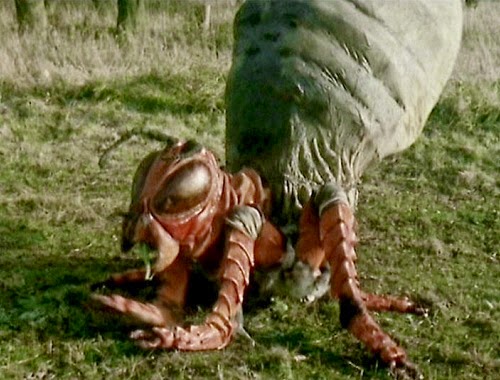
I have already reviewed Harvest of Kairos back in 2010, but this time I want to talk more about the conflicting ideas in it that make it so bad, because it does have a couple of good ideas in there buried under Jarvik and the giant ant.

Let's start with Jarvik; his first line of dialogue and his first action:


"Woman, you're beautiful."


Ben Steed starts as he means to go on in his first of three sexist scripts for the series. Jarvik is a MAN. He seduces Servalan by being the manliest manny MAN in the series (or at least he, and Ben Steed, thinks he is) and goes on to successfully capture the Liberator and beat Tarrant in a fight, all by being a MAN.

Here's some more dialogue from Jarvik to Servalan:
"But when was the last time you felt the warmth of the Earth's sun on your naked back? Or lifted your face to the heavens, and laughed with the joy of being alive? How long since you wept at the death of a friend? Doesn't mean a thing to you, does it, Madam President? You've surrounded yourself with machines and weapons, mindless men and heartless mutoids, and when they've done your work, and the machines have done your thinking, what is there left in you that feels?"


Jarvik is so camp it becomes funny instead of offensive, and his scenes end up as immensely enjoyable for it.


Also he is very manly too.


One of the main reasons I could never consider this episode as truly good is because the regular characters all have to act stupid in order to make Jarvik seem clever. Avon rescues the others from one set of Federation guards that capture them, but the second set are not cleverly hidden at all and would have been discovered instantly if they had looked inside the big boxes before stealing them.


Avon gets a couple of clever moments, but on the whole Paul Darrow does not look like he thought much of the script and seems to play most of his scenes and Avon's lines with a contemptuous, bored expression - even when captured by Servalan.
Maybe he is just jealous that she got to kiff Jarvik instead of him?


Down on the planet Kairos we see the giant ant monster, filmed out in the open in broad daylight because the director wanted to show off how impressive and scary it is.

Whenever I see mannys watch this episode they always laugh at the monster. Cthulhu insists that it is nervous laughter, and he says that they have probably just lost some points of Sanity.


Fortunately for Dayna, Jarvik turns up to save her from the monster. This scene has the nice touch of Tarrant outing Jarvik as a baddy by noticing he has a teleport bracelet so he must have come from the captured Liberator.

On the subject of good points, as Shallow pointed out in the comments of my last review the mystery of why Kairos is so dangerous is quite well done, paying off with the monster as it does, but it is not enough to save the episode from being a stupid, sexist mess of manliness and stupidity.

There is one scene that almost redeems the story, though. It comes near the end of the episode when Avon, Tarrant, Vila and Cally are on the old spaceship that they found on Kairos and are flying it towards the Liberator.


Avon gives their spaceship the properties of the Sopron, clumsily foreshadowed throughout the episode like Chekhov's Rock.


This is the one scene of the whole episode where Avon looks like he is enjoying himself. Maybe because he is saving the day again? Or maybe because he knows it is nearly over.


Tarrant bluffs Servalan and Jarvik that their spaceship is more powerful than the Liberator so they should surrender.


Jarvik laughs at this audacious bluff that he sees through because he is a MAN, but Servalan is fooled because Zen backs Tarrant up, and because she is not a MAN she believes the computer instead of Jarvik.

I like the way this scene works because Avon, Tarrant and Servalan (and even Zen) are all behaving in character - for a change - and so the way Servalan is defeated has an authenticity to it.


Jarvik is too manly to be in any other episodes of Blakes 7, so his friend Captain Shad shoots him instead of Dayna. That is why Jarvik-7 is the name of an artificial heart, not the name of an exceptionally manly spin-off series.


Avon thinks Jarvik was a "Federation thug" but Tarrant describes him as a "special sort of MAN."

Poor Jarvik, all he wanted to do was be a manly MAN.

Harvest of Kairos is a very entertaining episode, with so many ideas - good and bad - crashing into each other it is never boring. In a way its greatest crime is not having enough of Avon in it, although the character of Jarvik is almost manly enough to make up for that.

If it had been Ben Steed's only episode then I think the sexist angle would be less problematic and more comic (because here it - like all of Jarvik's MAN traits - is so over the top as to become laughable), but when you consider this along with Moloch and Power... well, I will discuss those episodes in due course.

Thursday, 18 March 2010

Big Gay Longcat reviews Blakes 7: Harvest of Kairos

Servalan has a new manny working for her - Jarvik - and he has a plan to take over the Liberator. Only Avon has the brain to stop him.

This is Duncan's worst episode of Blakes 7, so I had to be on my best behaviour to get to watch it again. No touching the buttons on the remote control, and no showing my red bum to anyone (hee hee, I am a naughty cat sometimes). But because I was a good cat I got to watch season 3's The Harvest of Kairos, by Ben Steed.

It starts in the middle of the action - Avon and Vila are already on a planet, and Tarrant has realised there are Federation ships after the Liberator. Avon comes back with Sopron rock, and Zen thinks it is a brain.

Servalan meets Jarvik. He is a manly manny. He kisses her then steals her guard's gun. Servalan hears the Liberator has escaped her trap. Jarvik then laughs and tells her Tarrant knew where her computers would set the trap.

Jarvik reveals to Servalan that he knew Tarrant when he was a captain and Tarrant was his lieutenant (long word is long). Servalan puts Jarvik in charge of capturing the Liberator and then says she wants him to kiff her again. In this scene she is a naughty Servalan who just wants kiffs from a manly man.

In the next scene she is back to being evil Servalan when she is more concerned with getting valuable kairopan than workers off the planet Kairos, leaving mannys behind to get killed by something mysterious. Woo-oo, it's a mystery! This is exciting, what could it be?

Tarrant wants to pirate the harvest of Kairos and get rich. Vila approves of this but Avon is more concerned with his Sopron. He gets Cally and Orac involved, even when there is a battle going on. It is hard to take the battle seriously because Avon is not interested in it and it is not exciting like most battles in Blakes 7.

The best bit of the battle is when Tarrant blows a kiff after he has destroyed a Federation spaceship. He goes "Mwah!"


Tarrant teleports on to the ship with the kairopan (is it like marzipan?) and he lets Vila, Cally and Dayna on as well. They get captured by Federation guards but Avon rescues them straight away. Avon was the only one clever enough to think there might be guards, but even he doesn't think there might be even more guards.

The Liberator gets captured off-screen between scenes - we see Jarvik's captain teleport on to Servalan's ship to show success. Servalan goes on to the Liberator and takes over, forcing Avon to let her command Zen. Avon outsmarts her and gets to make a condition that they get put down on the nearest habitable planet first. But the nearest planet is Kairos, which is deadly!

Servalan sends Jarvik down after them to kill Tarrant and the others. It is always Tarrant that they are interested in, not Avon or Vila or Cally or Dayna. I like Tarrant but I don't understand this bit, maybe it's because I'm only a cat. If I wasn't a cat, I might think that it was meant to be Blake instead of Tarrant, but Blake is gone now and Tarrant is here instead.

Jarvik finds a scary monster! It must be the monster that killed all the mannys that Servalan left behind. Dayna is menaced by the monster but Jarvik saves her, then when Tarrant sees his teleport bracelet he realises Servalan sent him. They fight. Jarvik wins and teleports back to the Liberator with Dayna.

Avon finds an old spaceship. He has a plan to escape using the Sopron but the others don't believe him. They take off in the old spaceship and Avon makes it work like Sopron to fool Zen, who thinks their ship is more powerful than the Liberator. Jarvik sees through their bluff but Servalan still runs away. Jarvik is then killed when a soldier is going to shoot Dayna but shoots him instead.

This is a very silly episode. It is all about Jarvik and his plan to capture the Liberator, which is supposed to be very clever. Jarvik is a manly manny but I don't think he is very clever. His plan only works because Avon and Tarrant are not being as clever as they usually are.

Jarvik isn't cleverer or more of a manly manny than Avon or Tarrant (nobody is more of a manly manny than Avon!) but the story makes everybody act as if he is, and that is why I think it is very silly.

Although it is a silly story there are some good bits to it - my best bit is the mystery of what kills all the mannys on Kairos. Everybody is scared but they don't know what about. Then it turns out to be a monster!


The monster doesn't do much except be scary (woo-oo, scary!) to Dayna and the audience, because everybody gets away from it. But if it hadn't appeared when it did then Dayna would not have been teleported up to the Liberator with Jarvik at the end.

This is not my worst episode of Blakes 7, as it still has Avon in it being clever (just not as clever as usual), but it is not one of the best and is definitely not up to the fabulous standard of the rest of season 3. Maybe I should have stuck to being a naughty cat...