Showing posts with label doctor who books project. Show all posts

Monday, 25 December 2023

The Transformers: Man of Iron


Man of Iron
was the first British Transformers story. After the initial four-part miniseries (that eventually ran to 80 issues) of the American Transformers had been reprinted in the UK comic, they began publishing original stories by British writers and artists.

While writer Simon Furman and artist Geoff Senior would later become synonymous with the series, and would take it in a direction that eschewed the necessity for using mannys as audience identification or POV characters, this was not something in place from the very beginning. Man of Iron was written by Steve Parkhouse, with art by John Ridgway, respectively the writer and artist of the Voyager stories for Doctor Who. As we might expect from such imaginitive creators, they had their own unique perspective on the world of the Transformers...


Very much beginning the story from the POV of mannys, it starts with Decepticon jets dropping bombs on an old English castle. The mannys don't know they're Decepticons, and we readers are only clued in by the blurry presence of the Decepticon insignia on their wings. They all appear as a dull grey, instead of the distinctive colourings of Starscream, Skywarp and Thundercracker.

It's as if they're trying to be "robots in disguise" from the readers as well as the mannys in the story.


Two bombs: one explodes; the other doesn't. This caues the police and the army to cordon off the castle, and send for the curator, Roy Harker.

From Roy, we are introduced to our main character, his son Sammy. Sammy is busy in the woods playing at Cultural Appropriation. His first thoughts that we are privy to:
"Running Wolf says... many moons must come and go until he tastes venison once more in his father's lodge..."
It was a different time. Sammy would be in his 40s now.


Sammy encounters the Autobot Jazz in the wood and runs away. Jazz says nothing (though he does step on and destroy Sammy's bow and arrow - the postmodern toy symbolically replacing the old-fashioned one), and is very much portrayed as the stranger in this scene, with Sammy the POV character. This is going to remain the case for the majority of the story, giving us a greater degree of removal from the Autobots than is usual even for the earliest introductory stories in the American comic - there we were shown the origin of the Transformers and the backstory of how they came to be on Earth before we were introduced to any of the main human characters.

We next see Jazz transformed into his car mode, framed in such a way that a reader with no preknowledge of the Transformers might not connect that this is the same robot. Or that, as he communicates with an "Autobot leader," that it is the car itself doing the talking and not some unseen person within.

Roy Harker, still trying to puzzle out what the mystery jets' intentions were, is summoned home because his son is "in a state of shock." The scene suddenly changes to a flashback to history, with the picture frames changing to a borderless style to clue us in on the transition.


In 1017, a battle between the armies of noblemannys was interrupted when "the ground was seized by a great shaking" and then "a man of iron of great height and girth" (clang!) appeared. And it wasn't just his height and girth that frightened the mannys, lol, because this man of iron also "carried a sword of fire, and a javelin of flame... and thunderbolts came from his hands..."

It is then revealed to us that all this historical exposition is being read out of a book by Roy to Sammy. Roy asks
"Sammy... the, er... robot you saw in the woods today... did it look like this?"


Sammy charitably says "that's more or less what it looked like" and this seems to confirm Roy's suspicions. He tells Sammy
"This is a drawing taken from an illuminated manuscript found in the castle chapel by my predecessor twenty five years ago... it's the man of iron...
The manuscript was completed in 1070, Sammy... it's over nine hundred years old!"


The sense this gives us of the enormity of history is something that wouldn't make sense in an American setting, so here we see the writer making good use of the choice to set it in Britain. Using the passage of centuries in this way reminds me of Dark Towers, where the ancient Tall Knight was so terrifying partly because of his extreme remoteness from life in the present day.


The next five pages are an extended, surreal dream sequence, where Sammy dreams about seeing a spaceship, the Decepticon Thundercracker in his jet mode, and the Autobot Mirage in humanoid robot form. As it goes on it becomes increasingly unclear to us what is real and what is in the dream, as Sammy appears to wake, and yet he and the objects in his bedroom go on to levitate around the room.

The picture of the man of iron flies out of the open window where it is taken up by a robot hand, as Sammy says
"The man of iron! He's flying! He's flying away!"
The dream sequence ends only when Roy breaks into the room to find Sammy is still sleeping, but that "there's a hurricane blowing through here..."


Shutting the window, Roy sees the back of the departing Mirage, as he stalks away into the night. Roy's response to his seeing this is to ask
"What the heck is going on around here?"

In the sort of transition that plays better in a TV show, the next day he asks the same question of an army captain at the castle. The captain tells him
"There's a very large object buried under the hill. Very large indeed."
"How large?"
"Well... ahh... at a rough estimate? About the size of an ocean-going liner."

Sammy, meanwhile, sees Jazz as a car, and doesn't connect him with the robot he saw the previous day.


Examining the car more closely, Sammy spots that it has "no driving mirrors. No wing mirrors, either." So while they may be robots in disguise, that doesn't guarantee that their disguise is perfect. This makes sense even if you know the backstory for why the Transformers turn into Earth vehicles, since the intelligence that repaired them and gave them their alternative forms mistaikenly believed the cars, jets, guns and cassette recorders to be Earth's indigenous lifeforms. It does contradict how the Autobots are often shown in other stories, however, although this is also true of the way John Ridgway draws them very closely to the appearance of their toys, while other artists would go for a more streamlined or stylised approach that made the characters both easier to draw and more individually distinctive.

Sammy is literally speechless when he sees the picture of the man of iron on the car's back seat, which the comic depicts by drawing a speech bubble but not filling it with any speech. Jazz, on the other paw, says
"Get in, Sammy!"
Sammy claims to have been taught by his mum "not to take lifts from strangers" but Jazz tricks Sammy inside with a persuasive, tempting offer:
"Why not just sit for a while in the front seat? Just pretend you're driving..."
Are we quite sure the "Heroic" Autobots are the goodys? If that ploy had failed would Jazz have offered to show Sammy some puppies?


As soon as Sammy's mum appears and calls for him, Jazz slams his door shut and kidnaps Sammy, driving away as Sammy shouts
"Mum! Help meee!"

This is the halfway point in the story, and so far the presence of the Transformers has been kept to a minimum level in their own comic that will scarcely, if ever, be seen again. They are as alien as they will ever be, with the Decepticons having unknowable motives and even the Autobots' motivation appearing sinister for now. Up to this stage they have lurked in the periphery of the story, which has been fantastic in establishing an atmosphere of mystery and suspense. Though this is completely lost upon any reader with too much prior knowledge of the Transformers, who know all about the Autobot-Decepticon conflict, and must therefore be aware that the Autobots are not baddys. Thus this only makes sense as one of the earliest Transformers stories, and could never have been successful if placed any later in the comic's run.

The second half of the story sees an immediate change in direction - with Sammy now in Jazz's hands (there's maybe a joke to be made here if you want it, mew), the Autobots reveal themselves to both him and, through him, to us the readers.
"Sometimes we disguise ourselves [...] so we can move around without being noticed [...] and sometimes we're discovered by accident. Like the day you saw me in the woods!"
"You mean the robot I saw in the woods was you?"
(He's not the sharpest, is our Sammy. Mew.)
"That's right, Sammy. That was the real me. My name is unpronouncable in your language... so just call me Jazz!"
This is the second time in this story when it has been stated that the Autobots' names are not their real names, but rather they are supposed to be "codenames." This contradicts many, many other Transformers stories, where it is generally accepted that their names are their names, but is arguably more 'realistic' than that they all have names that so neatly and precisely match their personality, form or function. Never mind, this is clearly an early attempt at worldbuilding by Parkhouse, just one that wouldn't be taken up by other writers.


Jazz meets up with Mirage and Trailbreaker, and then they are immediately attacked by Decepticon jets. The story is suddenly all action. Trailbreaker, having only joined in the story a page earlier, is attacked and damaged, and for all we know may even be killed since the last we see of him is his reporting to Jazz
"I hear you Jazz... it's no good. Everything's gone... just plain... ruined..."


Trailbreaker? More like Trailborken

Mirage tricks one of the Decepticons into crashing into a bridge, while the other one attacks Jazz. There is some confusion about the identity of the Decepticons involved in this attack, since they are both coloured dark blue like Thundercracker - this is far from the only time the precise number and nature of the Decepticon jets has been left vague, and the Transformers cartoon would be a lot worse than this for having multiple Thundercrackers, Skywarps and even Starscream lookalikes.

Jazz and Sammy are saved by the arrival of another Autobot, Bluestreak, who guns down the remaining Decepticon.


The action sequence comes to and end with the jet taking half a page to crash-land.

After this, the pace changes once again as Sammy is taken to the Autobot's spaceship...
"Gosh! Is that a spaceship? A real spaceship?"
asks Sammy, to which Jazz replies
"Not really. It's a shuttle-craft."
Jazz does not elaborate on this, but as readers we can deduce that this may be a technologically advanced craft, but it is not capable of flying through outer space - not only will this become significant later on in this story, it is key to the overarching story of the Transformers that they do not have access (at least at this early stage in the comics) to interplanetary travel, and are trapped on Earth after their actual spaceship - the Ark - crashed into it.


Out of the shuttle comes...


Optimus Prime!

In some ways the main character of the Transformers, certainly their most iconic figure, Optimus Prime would transcend his creator's intended function as a toy robot that turns into a truck to become one of the most beloved characters of the 20th century. That can be largely attributed to the way he was given a compassionate personality that ought to have acted counter to his purpose as a military leader, but instead allowed him to transcend that role. This made his death in The Transformers: The Movie (1985) all the more painful to viewers, but it also meant his eventual return from death was almost Christ-like to the generation that witnessed it.

There's little of that to be seen here (though there will be hints of it later on in the story), with the Autobot leader's function right now being to give Sammy - and through him, us - the exposition about what's going on:
"We are Autobots, Sammy. We come from the planet Cybertron. We are stranded here on Earth. We came to your country after picking up a signal. We tracked the signal from halfway round the world, all the way to Stansham. The signal is in our language. It has acted like a beacon, beaming out its message for millions of years...
We believe that scientists on our homeworld have sent a rescue craft for us. That craft is somewhere near the castle of Stansham. It may even be underneath it!"
The upshot is that the Autobots have to reach the craft before the Decepticons do. Sammy tells them that the soldiers his dad has been W-wording with are also looking for it, to which Optimus Prime replies that if the mannys get there first, the Decepticons "will destroy the craft, the castle, the village... everything!"


The next day, the soldiers have gotten as far as exposing part of the rescue craft and seen the Autobot symbol. With security efficiency worthy of UNIT, the captain is quite happy to chat with Roy Harker about it:
"We have reason to believe it's a craft, Mr Harker. Possibly extraterrestrial, though we have no proof of that. The signal may be a distress call... or an attempt to contact extraterrestrial beings near to Earth [...] or even here on the surface!"
To me that sounds too suspiciously accurate for speculation, maybe the captain does know more than he's telling Roy?

Roy has worries of his own, as he (and the writer) remembers that his son was last seen being "kidnapped by a driverless car." But he has more immediate problems when the ground shakes and the man of iron appears.


This isn't Jazz, but the man of iron of legend, who emerges from a secret undeground lair. It starts attacking the army, destroying a jeep, but then a Decepticon appears and blasts the man of iron, destroying it.


This is a great twist and subversion of reader expectations - after all the build up and the anticipation of his arrival, the man of iron is killed off only three pages after he made his entrance.

The Autobots arrive on the scene and battle is joined, the Decepticon jets (multiple Thundercrackers again) accompanied by Buzzsaw and Laserbeak (or their lookalikes). The narration draws a parallel between this battle and the historical battles fought over this site, in and around the castle.


This climactic fight is short - really only a page-and-a-half - before the Decepticons retreat (having none of them spoken a word throughout the entire story, leaving them a mysterious and alien presence - a far cry from the ranting, maniacal Megatron of the cartoons), with the Autobots taking possession of the rescue craft.

Sammy is reunited with his father and advises him to leave the area, something that he and the army were, rather sensibly, going to do anyway. The army soldiers are never explicitly identified as being from UNIT, but it would be a perfect fit, especially in an era when Marvel comics were also producing the Doctor Who comic strip.

Optimus Prime and Jazz discuss what to do now that they have the means to leave the Earth, and here we get a sense of the great wisdom and compassion of Optimus Prime as he takes the command decision:
"We cannot leave the Earth now, Jazz. The Decepticons would soon overrun the planet. Only we few stand in their way. We cannot leave. Nor can we leave the rescue ship intact. We have no choice but to destroy it."
The repetition of "we cannot leave" cleverly hints at the internal struggle that Optimus Prime faces over this dilemma, but when he makes his decision it is final - phrased as having been "no choice."

As readers we are made privy to information that would most certainly have altered Optimus Prime's decision had he been aware of it - the craft still has an occupant; a "navigator," for whom the man of iron was only an "attendant." The narration makes it clear that "Jazz could know nothing of this" and so he carries out his leader's order, and destroys the spaceship so that "nothing remained."


With that, the story is all but over. The last few panels are a melancholic epilogue, as the narration explains what happened afterwards in a far more poetic fashion than a story like this honestly deserves:
"Autumn came, leaves fell... Sammy was a year older and a year wiser. He never saw Jazz again...
But on clear, sharp nights, when stars glittered like needles and the night winds rattled his window... then he slept a fitful, fearful sleep...
...and the man of iron walked once more through his dreams."


Man of Iron
is one of the all time great Transformers stories for good reason, being an exceptionally tight, self-contained story that a reader needs no prior knowledge of the Transformers to enjoy. Indeed, arguably having too much knowledge of the Transformers might well lessen one's enjoyment of this story, because it runs counter to the more established tropes of the franchise in so many ways.

But if you can set 40 years of Transformers lore aside to experience their world afresh through Sammy's eyes, there's a lot here to enjoy. Though we never did find out what became of Trailbreaker...

Thursday, 17 January 2019

Funhouse


Funhouse is a whole lot of fun, with prizes to be won. It's a real crazy show where anything'll go.

The same is true of the Doctor Who story of the same name. The Doctor will have to use his body and his brain if he wants to play the game and escape from the monster that takes the shape of a mysterious house and wants to nom the TARDIS's energy.


The TARDIS is pulled off course, which the Doctor describes as
"Curious. Very curious."
even though it happens to him a lot. When he and Frobisher leave the TARDIS to investigate the house, they look out the window and see different things outside - Frobisher a tropical paradise, the Doctor a "horrible" wasteland - so the Doctor concludes it is "an illusion of some kind."

As they continue to investigate, one panel per page is given over to the thoughts of the housemonster as it sends its tentacles out to the TARDIS, and it needs to keep them inside itself long enough to have its noms, so it fills the house full of weird goings-on to keep the Doctor intrigued.


One of these takes the shape of Peri, making this her first appearance in the comics... sort of. When the Doctor rescues her she turns into a dragon for no reason and then disappears, all of which is enough to persuade the Doctor and Frobisher that they should leave, having had enough of the house's shit.

But the housemonster confuses them with illogical geography and illusionary mannys, including a sideways room and then a room with only one door.


This is all good fun stuff - it's a quiz, it's a race, it's a real wacky place, even if it does somewhat resemble the scenes set in the Matrix in The Deadly Assassin or Trial of a Time Lord (the latter of which hadn't yet been made when this story was written).

The Doctor can feel the TARDIS is under attack, and then Frobisher drops the title when he says
"Y'know, I've been thinking. This place is like some kind of crazy fairground funhouse, leadin' us by the nose since we arrived."
Clang!

Neither of them find a way to overcome the housemonster's illusions, which only cease to bother them when it gains control over the TARDIS and so doesn't need to distract our heroes any longer. They run back to the TARDIS only to hear the "Vworp! Vworp!" of it taking off, but instead of leaving them behind, the Doctor exclaims,
"It's not the TARDIS that's taken off, it's the whole house. And us along with it!

This is the halfway point in the story. Part 2 picks up with the Doctor and Frobisher getting inside the TARDIS and trying to begin their fight back. The Doctor's first plan is to attack it with an axe. This fails when the monster simply takes the axe off of him with its tentacles.

The Doctor thinks about what the house really is and what it wants, and he concludes:
"My guess is that it's a living entity, feeding on fear, emotion as raw energy. The more we feed it, the stronger it becomes."
They try to take a look at it using the scanner.


The mention of tentacles had already piqued his interest, but now Cthulhu is convinced that the housemonster is one of his Great Old Friends.

The Doctor comes up with another plan - one a bit more cerebral than his "hit it with an axe" plan from earlier: he rigs up a bit of string to the console - and he and Frobisher spend a couple of pages on setting it up before he tells Frobisher (and us by proxy, of course) what the plan is.
"We'll be protected from the worst of the temporal regression in here. When I pull this string, it'll disengage the circuit that protects the TARDIS passengers from the changing time field outside. You follow?"
"Er, well... no!"
I'm sure Frobisher speaks for us all there, mew.
"It's simple. Everything outside this room will regress in time at the same speed as the TARDIS -- including the house. It should "forget" what it's doing because it will have moved back to before it encountered us."

I don't know, that sounds a bit made up to me. But then the whole premise of Funhouse is that it's wacky, crazy and outrageous, so I suppose we have to let them off with that.


It turns out this plan is an excuse for some gratuitous past-Doctor cameos, as, when he runs back to the control room to dematerialise the TARDIS and free them from the house, the Doctor is regressed back through his previous five incarnations (and their costumes), and Frobisher is regressed to being a tiny baby Whifferdill - d'aww, so cute!

The plan works, and the house is
"Trapped in the time vortex. And since it has no materialisation circuits of its own, it'll stay there. Forever."
This appears to be confirmed by a four-panel "Epilogue" that shows the house patiently waiting for more noms to come to it.


Funhouse is not a bad little story, although a lot of its ideas have been done better elsewhere. It is saved from mediocrity by the unusual (although not unprecedented) decision to repeatedly show us the thoughts and point of view of the housemonster.

It reminded me of two other Doctor Who monsters - the first being Voorvolika from The Armageddon Chrysalis, a more malevolent monster than the house, but also one whose point of view part of the story was told from. The other was the monster called "House" from the TV episode The Doctor's Wife, who also wanted to nom the TARDIS. Given that, and its name, plus the illusions it could create, it could possibly even be the housemonster itself, come back for a sequel.

Wednesday, 16 January 2019

War-Game


War-Game (not to be confused with The War Games TV story) begins with the Doctor and Frobisher playing a game, which I can only presume will continue the time-honoured narrative device of games standing as a symbolic representation, or metaphor, for the events of the story itself.

In this case it is a game of the Doctor's own devising. As he puts it:
"I adapted it from an Earth game called Chess. Gave it an added dimension, you might say..."
I suspect this probably means the Doctor is making the rules of the game up as he goes along in order to win against Frobisher.


Derp!

Frobisher looks very surprised when the Doctor declares "checkmate" against him, although it later transpires that the Doctor has done this 23 times so maybe he shouldn't be.

The TARDIS arrives on a primitive planet but the scanner detects "traces of sophisticated electronic activity" which makes the Doctor want to investigate and so gets the plot underway.


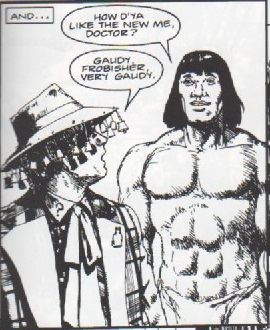
Frobisher remembers he can shapeshift for a change and disguises himself as Conan the Barbarian, although even in comic format they don't expect they can afford to get Arnold Schwarzenegger in to play him.

They spend a couple of pages wandering around a settlement that seems to be based on a 1960s telefantasy version of the Middle East, like something straight out of Danger Man or Mission: Impossible, until they get captured and sold as slaves.

The manny that buys them is Achmar, who works for "Kaon, lord of the seven provinces" and he takes them to his lord while hinting that Kaon knows about the TARDIS, or "the blue box in which you arrived" as Achmar calls it.

When they get to Kaon's castle, it turns out that Kaon is a Draconian.


This is presented as a big deal, deserving a whole page for just the one picture, and it is the cliffhanger ending to the first part of War-Game. Kaon isn't actually referred to as a Draconian yet, but the little text at the bottom of the page says
Next: Draconian measures!
which is an attempt at a funny play on the word "Draconian" meaning both "excessively harsh and severe" and "a Doctor Who alien not seen in the TV series since 1973." However this is just the comic having a little joke with us, as the next story is actually War-Game part 2.


Kaon tells the Doctor and Frobisher his backstory in a page where his face is surrounded by flashbacks where the action spills out of the panels - a stylish way of dumping a lot of exposition on us.
In brief, his spaceship crashed on this planet many years ago and he persuaded some of the locals to make him their chief by being better at fighting than them. The only other Draconian on the planet is his daughter Kara, who has been captured by Vegar, a rival chief. He wants the Doctor to help him rescue Kara using the TARDIS, which the Doctor agrees to since it will mean less violence than if Kaon sends his henchmannys to attack Vegar's mannys.

Kaon sends Achmar to lead a diversionary attack to distract Vegar away from their rescue attempt, which Frobisher compares to the Chess game from the start of the story. The Doctor, however, is not happy that those mannys are being sacrificed like Chess pawns.
"That was Chess, this is real..."
he says.


When some guards catch them, Frobisher tries becoming giant but only gets stabbed in the leg for his troubles. Maybe this is why he doesn't shapeshift into useful things to solve the plot all the time - he's a bit rubbish at it really!

Eventually they fight their way to the room where Kara is being held captive. Kaon fights Vegar while the Doctor and Frobisher free Kara. Vegar and Kaon kill each other, and Kara decides to stay on the planet to be chief in the place of her father.


War-Game is a strange story to find following directly after Once Upon a Time-Lord... (which made maximum usage of the comicbook medium) because it is so very much like the TV series of that era: the Doctor and Companion taking ages to get to the plot, a returning old monster/alien, the Doctor being sidelined in his own series, and violent scenes leading to almost all the guest characters ending up ded.

I wouldn't have been at all surprised to see the credits read "Written by Eric Saward, Produced by John Nathan-Turner." In fact it was written by Alan McKenzie, who here is to Eric Saward what Eric Saward was to Robert Holmes.

Friday, 15 June 2018

Once Upon a Time-Lord...


Once Upon a Time~Lord... (the comics love ellipses so much they're even making their way into titles now) is a direct continuation from the end of Polly the Glot, with the Doctor pursuing the renegade Time Lord Astrolabus who has penguinnapped Frobisher.

The TARDIS scanner proves to be useless, showing "an empty world, devoid of life" while we can see it has countryside, buildings, hot air balloons, Little Red Riding Hoods, and Black Riders.


As soon as the Doctor steps out of the TARDIS he is attacked by a Black Rider and cries out
"By Elbereth and Luthien the fair, you shall have neither the ring nor me!"
Even the Doctor is confused why he said that, but then Frobisher arrives and starts speaking in a strange way:
"I've been having a lovely time, Doctor! Come and meet some of my merry chums!"
"Merry chums? You're a guttersnipe from a slum on some backwater planet... you've never had a merry chum in your life!"
I can just imagine Colin Baker shouting "merry chums?" three times if it had been him delivering this dialogue. The Doctor seems to accept that this is the real Frobisher, but he doubts that the other things in the land are real, including the talking tree they meet. The Doctor has plenty of experience with illusionary landscapes, such as in The Mind Rober, The Deadly Assassin, or The Penalty, so he knows they have a "dark side" as well (although he may be thinking of The Force there).


Astrolabus is watching them and decides to let the little mannys and aliens in his audience choose their fate:
"Only you can decide, children! So on with your thinking caps... and let the story commence!"


Astrolabus is so powerful that he changes the very nature of the comic strip. For the next three pages the Doctor and Frobisher are trapped in a six-panel strip with rhyming couplets beneath each picture, and the main story told in text form at the bottom.

The perils they face are those of old-school adventure stories. The badger is friendly enough, although my friend Longdog is still suspicious of him, but the eyes in the woods are sinister.
"It's only the little people who live in the woods." "Yes, Doctor," replies Frobisher. "But what kind of little people? It seems to me that they're the kind of p-people who like to p-pick up a p-penguin!
Lol! Although a possibly trademark-infringing lol at that. Frobisher tries to run away and gets captured by primitive little mannys from before the era of Political Correctness, who intend to nom him.
"Don't they know they can't do that?" gasps the Doctor. "It would be too horrible, too tragic. Why, penguins taste awful and give you terrible heartburn!"
The Doctor is too busy making this joke to rescue Frobisher, but luckily Frobisher gets rescued by a passing Tarzanalike. The comic goes back to normal as the Doctor and Frobisher run towards a castle and get chased by a giant, but now Astrolabus has taken over the caption boxes.

While it seems as though the Doctor and Frobisher are escaping from the successive perils pretty easily, it is revealed that this is because the Doctor is mentally fighting Astrolabus for control of the story - when Astrolabus is dominant there is a new threat, but when the Doctor is in control they can get away.


In the castle, the Doctor finds Astrolabus and challenges him. They swordfight until the Doctor uncovers one of Astrolabus's arms, where he sees "the missing star charts" have been drawn. Astrolabus runs away and the Doctor chases him across a number of panels depicting different genres until Astrolabus gets even more meta and says
"Got to... get through... door. Short cut to... next page..."


"Made it! I'm in the clear! Out in the open! Untrammelled! Unshackled! Free!
If I can just make it to the next episode!"

"But what's this? I feel a power greater than my own! I'm losing control! It's taking over! By Odin's beard... que pasa?"

"Oh no! It can't be!! Not at this stage of the game! Please! Say it isn't so!"


On a minimalist page showing only Astrolabus and his footprints against a white void background, we see Astrolabus's costume has changed. Voyager arrives upon a ship of the desert (Clever. Clever. Clever.) as the Doctor uncovers Astrolabus to reveal his body is covered in the charts.

Voyager finally explains what the plot has been about.
"You stole the sacred charts for the secrets and the power they contained. For access to the last, the most mysterious dimension of all...
The dimension of death! 
You shall have your wish!
Death will be your dominion!"

He blasts Astrolabus with "a hurricane force" and then turns his camel around and leaves, telling the Doctor
"I have claimed that which is mine... you are free now, Timelord... you are free..."
Although Astrolabus is also a Time Lord, so there is an ambiguity as to which one of the two Voyager is talking to there.


The Doctor asks Astrolabus the question that's insoluble for manny or machine. The final exchange between them, as Astrolabus lies hidden behind a rock except for his withered hand, hints at something even more epic in scope than even that which we have seen.
"Such a shame... Doctor... that you had no interest... in my powers. You would have made... a worthy... successor...
You were just getting... the hang of it!"
"I follow nobody, Astrolabus. I'm free... I go my own way!"
"Aah, Doctor... How can you know?
How can you know... how long... I have been writing your life?
What will you do?
Now that I'm...
Gone?"


Astrolabus's castle explodes, in accordance with the rule of No Ontological Inertia. The Doctor and Frobisher find themselves back at the Ridgway Ringway Carnival, where Frobisher suggests visiting "the tattooed man" but the Doctor declines, saying
"I'd much rather go somewhere else."
and looking sad to show that he regards Astrolabus's death as a waste, and that this is not a totally happy ending after all.


Once Upon a Time~Lord... completes the story arc begun back in Voyager by tying up the Astrolabus-Voyager conflict. The sections where the different characters are playing with the medium of comic-strip storytelling is fantastically meta, and ensures that this is like nothing that could be done in the TV series (which would have a go at playing around with its own medium in Vengeance on Varos about the same time). As a result this a very distinctive, memorable conclusion to the plot, and sends off the characters of Astrolabus and Voyager in style.

Thursday, 14 June 2018

Polly the Glot


Polly the Glot is the second story in Collected Comics, and the picture on the cover shows characters from it.


It starts on board a great big space station where Dr Ivan Asimoff, a friendly green alien with four arms and his nose above his eyes, meets his old friend the Doctor and asks for his help with "the 'Save the Zyglot' trust."

In space we see two other aliens (not so friendly ones) in their spaceship capturing a Zyglot, an enormous pink alien, using a "gravity net." They sell it to "the Ringway Carnival."


The manny in the top left panel there is a reference to Rolf Harris and his 'Jake the Peg' routine, which fortunately hasn't dated as badly as some of his material.

Strictly speaking, Polly was a Glot... a subspecies of the Zyglot.
I see what they did there. Dr Asimoff sees Polly, "the only Zyglot in captivity," at the Ringway Carnival.
"Oh, Polly... you're so... beautiful."
he says.

When next he sees the Doctor, Dr Asimoff gets kidnapped by Frobisher at gunpoint. This leads to space headlines in the space newspapers:
"Read all about it! Famous scientist disappears read all about it!"


The Doctor's plan is to demand a ransom from the Zyglot Trust. Dr Asimoff points out
"The Zyglot Trust is broke!"
But the Doctor is one step ahead:
"I suspected that. And as soon as the public find out, they'll be sending in donations from far and wide."

Kidnapping Dr Asimoff is probably a safer plan than releasing a charity single - the Doctor doesn't have a good track record with those.

The plan starts to go wrong when the Dr tells the Doctor the name of the president of the Zyglot Trust:
"His name is Labus. Professor Astro Labus."


Yes, even though we only saw him in the previous story, Astrolabus is back already! What is this, Season Eight or something? The Doctor hallucinates being nomed by Astrolabus's giant mouth and faints (although he claims this was caused by a "post-hypnotic suggestion").

We now cut to "the ninth general meeting of the Save the Zyglot Trust" where Astrolabus is in charge. When he hears that Dr Asimoff has been kidnapped he says
"Stone the flamin' crows! Vous ne dites pas!
I smell a rat here, gentlemen. I smell a big, fat, furry rat... And throw in a penguin for good measure!"

Ooh... a big, fat, furry rat... cat noms! No, wait... he's talking about the Doctor, isn't he? That's a bit harsh... although about as curiously prescient as that remark about "BBC Producers" in The Shape Shifter. (Look, I'm a cat. You have to expect a catty remark from time to time.)

The Doctor takes the TARDIS to the spaceship of the Akkers, the aliens who captured Polly earlier in the story. He, Frobisher and Dr Asimoff go investigating, and soon Frobisher is separated from the other two. He meets two Akkers, Baz and Gordon, and asks them where they keep the Zyglots.
"Ignore him... he's a figment of the imagination."
"But I haven't got an imagination!"
"You're right! Therefore... he must be real!"
They raise the alarm.


There is a very funny scene where the Doctor and Dr Asimoff are confronted by a shape-shifting robot who claims to be "the Defender" of the ship and can transform into a variety of alternative shapes that seem mainly concerned with cleaning, like a sort of proto-Kryten from Red Dwarf. He hits the Doctor with his mop, but then when Dr Asimoff threatens to shoot him with the pewpewpew gun he picked up, the robot surrenders and admits to being the janitor and not "the Defender" after all.

The Doctor and Dr Asimoff go to the ship's bridge and force the Akker captain to release their Zyglot prisoner. The captain threatens to use the gravity net to crush the Zyglot, but the distraction provided by the arrival of the real Defender (who makes a speech about how he is "the real Defender, mind you... not some dumb service robot who thinks he's a whiz with a mop...") allows the two doctors to free the Zyglot.

The Akker captain then confesses the Ringway Carnival is run by somebody called "Astral Arbus"... honestly, he's making the Master's aliases look good here, mew.

Back at the Carnival, Astrolabus says
"Do I hear a vworp? Do I hear two vworps? What? Are they on to me so soon?"
Dr Asimoff and Frobisher come in to his tent to try to capture him...


But Astrolabus captures Frobisher instead, grabbing him and then they both disappear into his magic cabinet.

The Doctor was not there because he was busy freeing Polly, who escapes into space. The Doctor then departs in the TARDIS, leaving Dr Asimoff behind, along with a suitcase full of moneys (the ransom that the Doctor and Frobisher acquired at the end of The Shape Shifter) as a gift for the Zyglot Trust. It may be the proceeds of theft, but it is going to a good cause... we are left to assume that the currency is legal tender where Dr Asimoff is, or is that perhaps another Time Lord gift the Doctor allows him to share in?


Polly the Glot is a lovely little story. The comedic parts work better than the serious parts, perhaps because it is too fast-paced to build up much dramatic tension, but it is still a lot of fun. The art is well-suited to the material, and the alien character designs look better in the colour version of Collected Comics - especially the final 'splash' panel of Polly's escape.