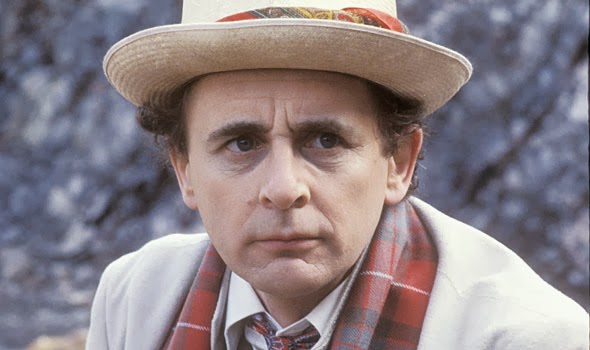
In 2019 we began a sequence of Doctor Who Nights starting with stories from the William Hartnell era, moving through the Doctors consecutively each year until this year, when we reached the Sylvester McCoy era.
I have already watched and reviewed the whole of the McCoy era before, in 2017-18, so for more in-depth reviews from a yonger, more innocent (lol) version of me, you can click the links - or get your thumbs to do it for you if you are a cat.
I last reviewed The Happiness Patrol in 2017, when Theresam A was the Prime Minister of the mannys of the UK. Now it is Keir S, which shows that not much has changed in eight years.
The Kandyman remains one of the least likely Doctor Who baddys to ever return to the TV series, although unlike the others at the top of the list that is because we live in a much more litigious world nowadays than in the carfefree 1980s of myth and legend, and not because of the use of outdated racial stereotyping and/or blackface or yellowface that would get you cancelled right away.
As good as The Happiness Patrol is, it is easy to see why viewers in 1988 did not rate it as highly as it deserves - those watching at the time didn't know that they wanted an allegorical attack on the politics of Mrs Thatcher, because they were mostly either young mannys or kittens who didn't understand the allegory, or else die-hard fans pining for the era of Talons of Weng-Chiang, who didn't appreciate it.
Any casual viewers might have thought that an entirely studio-based TV drama that did little to hide the fact that it was a TV studio, or that everything in the colony took place in about four locations, all a 30-second stroll from one another, was the sign of a dying show with a miniscule budget. Well, I mean, it was those things, but that is missing the point that as an allegorical TV play it manages to turn those crippling limitations into positive virtues.
If you view it in that spirit, I think you'll find that happiness prevails.
Silver Nemesis, as I found when I reviewed it in 2018, is harder to defend. Despite being only three parts long, its first part is padded with the Doctor and Ace running away from security mannys at Windsor Castle simply so that the Cybermannys can turn up in time for the cliffhanger, while the second and third parts see characters wander into scenes when they are required for some plot or dialogue reasons, and then wander out again until the next time they are needed.
The story is partially saved by the brilliantly intriguing and mysterious baddy Lady Peinforte, and her henchmanny Richard, who are by far the most successful component of the story, largely thanks to the actors playing them who transcend the limitations of their scripted dialogue.
Richard, for example, is convincingly disturbed by the sights of what is, to him, 350 years in the future, until he is confronted by a problem he can recognise and deal with - being threatened by two thugs. His line
"Money. say you?"
is followed by a cut to another scene, and when we next see the thugs they have been overpowered (off-screen) and hung upside down from a tree. Viewers are left to infer exactly what it was Richard did to them.
Lady Peinforte, on the other paw, manages to convey the unseen backstory between her and the Doctor, as well as her own non-existent past, through subtle expressions and hinted at turns of phrase. The scene in the car with Mrs Remington is pure padding, an unnecessary but enjoyable way for Lady Peinforte and Richard to get from one plot-relevant scene to another, but gives us lines like this that raise the overall quality of the episode and provide insight into Lady Peinforte's character:
Lady Peinforte: "Dorothea Remington did bribe away my cook."
Mrs Remington: "Oh, now, let me see. Yes, there was a Dorothea. She died in sixteen..."
Lady Peinforte: "...twenty-one. It was a slow poison."
My review from 2018 already explained why Survival is the greatest Doctor Who story of all time (in a word: cats!) so I don't have much more to add, except to say that it is still the best, but now that it is available on blu-ray it is even more obvious that it is the Master in part one, which is supposed to be a surprise for the cliffhanger but really, really isn't.
For our 22nd* annual Doctor Who Night we watched some stories from season 22. We started with Attack of the Cybermannys, which was written by "Paula Moore" - a cunning pseudonym that Eric Saward used to fool the BBC into letting him write more scripts than he was really allowed to under their rules.
While an enormous step up in quality from the preceding story, this is a confused mess of a plot that is trying to be a sequel to Resurrection of the Daleks and The Tenth PlanetandTomb of the Cybermannys, while including topical references to Halley's Comet in a subplot that doesn't really go anywhere.
Speaking of subplots that don't go anywhere - something of a Sawardian trademark - the ultimate example of this has to be the way that escaped prisoners Bates and Stratton never meet or interact with the Doctor or Peri, and are killed off without accomplishing anything relevant to the main plot.
Another Sawardian trademark is the presence of space mercenaries - in this case Lytton (Maurice Colbourne), returning from Resurrection of the Daleks but with an almost unrecognisably different personality - whom it seems the writer would rather spend his time with than the Doctor and Companion. The early scenes establishing Lytton as a London gangster, diamond thief and all-round hardmanny seem to belong to a different show - not necessarily a bad one, but not Doctor Who.
Lytton eventually comes a cropper thanks to the third - and worst - Sawardian trademark: his love of gratuitous violence.
I always thought that radiationgravity gold was the Cybermannys' one weakness, but according to the Doctor:
"The Cybermen have one weakness. They'll react to the distress of their own kind."
I assume there's at least one Big Finish story out there about how undercover policemanny Russell somehow survived and ended up on Skaro, where he became the Kaleds' chief scientist? No? Funny how some actor reuse matters more to the superfans than others, mew.
Revelation of the Daleks, also written by Eric Saward (under his own name this time), is in general a much better story than Attack of the Cybermannys, although it is arguably an even worse Doctor Who story, what with the way the Doctor and Peri are kept away from the main plot for more than half of the duration. It is also an enormous step down in quality from the preceding story, for obvious reasons.
The parade of characters we are introduced to - who are mostly being set up in part one only to get killed off in part two - are interestingly grotesque and have a complex set of relationships with each other and with Davros, who sits at the heart of the story like a pider in its web. In many ways this is his story, showing him as a genius manipulator of the greed and vanity of the mannys around him, as well as the mad scientist we have seen him as before. It is trying to do something new with the character, and it is a pity that this doesn't extend beyond this one story, since the next time we will see him will be In Remembrance of the Daleks.
Most of the characters come in pairs, forming double acts as Saward tries to copy the writing style of Robert Holmes: Kara and Vogel, Orcini and Bostock (the obligatory space mercenaries for this story), Takis and Lilt (with a totally tropical taste), Natasha and Grigory. This gives one member of each pair somebody to tell their exposition to, which is good because this script has a lot of exposition to get through - to the point where there is a character whose role is to give a running commentary on events to all the mannys in suspended animation, a.k.a. the viewers at home.
This is the DJ, played by Alexei Sayle, a baffling inclusion even by the already eclectic standards of this story. Peri thinks he is a Space American, but it turns out he is just putting the voice on, which is ironic because Nicola Bryant is also putting the voice on to play Peri.
While the level of violence is less than in some stories this season (the worst offenders are Attack of the Cybermannys, Vengeance on Varos and The Two Doctors), it still includes a manny getting stabbed with a syringe and injected with embalming fluid. This scene is played for laughs, since even as he goes
his wig falls off, lol.
Not played for komedy is the scene with the see-through Dalek, inside which is a manny being turned into a Dalek. Doctor Who Mazagine once called this "the single most up-chuckingly disgusting thing seen in the show ever." Although this was before the return of the new series, so could easily be superseded by [spoiled for choice when it comes to this punchline -Ed]
After this season aired on the BBC, the series came within a gnat's crotchet of getting cancelled. I think it is quite clear who is chiefly to blame.
* I'm not sure how we managed that when I was only made in 2008. It must have somehow involved time travel.
Since this year is the 60th anniversary of Doctor Who, we had a special extra-looooong Doctor Who Night. Its theme was 'the Bad in the Good and the Good in the Bad.' Even the theme was long!
Caves of Androzani
The Good
Just about everything. I mean. this story is about as close to purrfection that a Doctor Who story can get without having either PaulDarrow or cats in it. Robert Holmes wrote a lot of great stories, but this is his magnum opus in which every character and plot thread come together beautifully. There are three great cliffhangers out of four episodes, culminating in the greatest depiction of the Doctor's regeneration at the end. It's Peter Davison's best story as the Doctor, and Colin Baker's too for that matter.
The Bad
This Magma Beast costume isn't all that great.
Other than that, the only downside to Caves of Androzani is that Doctor Who can't be as good as this all the time. It is Doctor Who written for adults, which is nice to have occasionally. And I mean really written for adults, with grown-up political themes and characterisation, not just putting in gratuitous sex and swearing (like Torchwood, mew). But even though the series could do with being like this more often than it is in reality, the makers mustn't forget the core audience of kittens and little mannys for too long.
If the BBC wanted to make a grown-up sci-fi series they could easily do it, but it wouldn't be Doctor Who. It would be more like... Blakes 7.
Earthshock
The Good
While not in the same league of quality as Caves of Androzani (few Doctor Who stories are), Earthshock is an attempt at making a blockbuster action story on a BBC budget, and it is a pretty good attempt for all that.
A lot of this story's reputation rests on the shock appearance of the Cybermannys at the end of part one, which was a genuine surprise twist for TV audiences in 1982 (it isn't called Earthshock of the Cybermannys for a start), but that doesn't hold up today since it is hard to avoid the presence of the Cybermannys on the DVD box, or the iPlayer episode thumbnails. But even without that it holds up, with the Cybermannys used well as an implacable foe for the Doctor, and we get some classic Cybermanny tropes returning, such as a traitor among the mannys and having Cybermannys bursting out of their cardboard containers to go on a march.
The Bad
This special effect doesn't hold up. They might have got away with it in the era before home video, DVD, iPlayer, etc. but even then it gets used twice because it appears in the cliffhanger to part three and then in the reprise at the start of part four, so twice the opportunity to spot the joins.
You might be surprised that I also consider the death of Adric to be a bad thing. Reducing the number of Companions from three to two was undeniably a benefit of this - almost every story of season 19 showed us proof that three Companions was too many - and choosing the most annoying of the three to get rid of was also to their credit, but the way this was done was... not great.
First, you're never going to convince that Doctor Who is an 'anyone can die' kind of show. It's not The Sandbaggers. Likewise, killing off a Companion to show 'consequences' doesn't W-word when there are dozens of other occasions when the regulars survive similar situations. These general complains aside, the specific way in which Adric was killed off was handled badly because he dies off-screen, and the only confirmation we get in Earthshock that he is definitely ded is that the end credits change to be silent* and over a picture of Adric's destroyed badge on a black background.
Without the meta-confirmation this could simply have been a cliffhanger, with audiences reasonably expecting that Adric would be rescued by the Doctor using his time machine in the next episode. So by having Earthshock end in this way it winds up being a problem for the next story as well...
But before we get to that...
Dimensions in Time
This 30th anniversary story is (for now) the midpoint of Doctor Who's history, so it seems appropriate that it should be the midpoint of our Doctor Who Night celebration.
The Bad
A 15 minute long story that had to juggle all the surviving Doctors, as many Companions as they could get, the Rani and a "menagerie" of monsters, plus a crossover with Eastenders and a requirement that it be shot in 3-D would have been a struggle for even the best of writers. But the way this was written it barely holds together in a coherent manner, with one thing happening after another for reasons that even Sylvester McCoy rattling off technobabble cannot justify.
The only thing that saves this from being utterly terrible is that it isn't long enough to outstay its welcome as a bit of lightweight Children in Need entertainment from the strange days of the 1990s after the cancellation of the original series.
The Good
It's undeniably lovely to see some of the Doctors and Companions on screen together again, regardless of the nonsense they're taking part in. This is also the only time that Brigadier Lethbridge-Stewart appeared together with Colin Baker's Doctor, allowing him to complete the set.
The scene where Lalla Ward as Romana meets Grant and Phil Mitchell (Ross Kemp and... the other one) and icily no-sells their cockney hardmanny act is the one genuinely good bit, ending on her delivering the punchline
"Doctor who?"
By the way, Dimensions in Timeis canon. All cats know this to be true.
Time-Flight
The Bad
So why can't the Doctor save Adric again?
Tegan: "We can change what happened if we materialise before Adric was killed."
Doctor: "And change your own history?"
Tegan: "Look, the freighter could still crash into Earth. That doesn't have to be changed. Only Adric doesn't have to be on board."
Doctor: "Now listen to me, both of you. There are some rules that cannot be broken even with the TARDIS. Don't ever ask me to do anything like that again. You must accept that Adric is dead."
It's come to something when Tegan is the voice of reason, mew. If we take into consideration some of the stunts the Doctor would later perform with the TARDIS in the new series (especially when it came to saving River Sue) then it seems like he just didn't want to save Adric.
But this isn't even the worst of it. Within a minute the Doctor suggests a "special treat to cheer us all up" and after that Adric is practically forgotten about! This is then followed by a knockabout komedy bit when the Doctor dashes out of the TARDIS in a panic to check the cricket scores in a newspaper.
The story has barely begun, and Time-Flight has started as it means to go on. The Master is the baddy in it, but he spends the first half in disguise as "Kalid" for no reason other than so he can be revealed as the Master at the end of part two (including rigging up some green slime to come out of his face when he is 'killed' as Kalid). The studio sets are poor, and many of the effects rubbish - I have to wonder if most of the budget for this got spent on Earthshock instead. Either that or they spent it on getting that Concorde wheel into the studio!
Having just thinned down the regular cast by disposing of Adric, we now get a number of guest characters acting as additional, temporary Companions - Professor Hayter (played by Nigel "Do Not Forsake Me Oh My Darling" Stock) and the three crewmannys from the Concorde (including among them Michael "Sandbaggers" Cashman). Hayter gets to make a noble sacrifice, while the Concorde pilots act like comic relief in their clumsy attempts to help the Doctor, including trying to fly the TARDIS like their aeroplane.
Therein lies the main problem with Time-Flight - that of its tonal inconsistency. If it had been an outright comedy then it could have succeeded much better on its own terms (save for being inappropriately placed right after the tragic - stop laughing - death of Adric), but the light-hearted bits sit uncomfortably alongside the attempts at serious drama.
The Good
Those comedic elements are the parts of the story that W-word best, from the comedy of errors at Heathrow that leads to the Doctor getting involved in the story in the first place (including the exasperated airport manager and his security manny, the latter played by Sir Frank from Yes Prime Minister), to Anthony Ainley's purposefully melodramatic performance as "Kalid" (though this might have been better if it had avoided certain racial stereotypes that mean it hasn't dated well), to the good-natured Concorde crew's clumsy attempts at assistance, and then culminating in the Doctor leaving Tegan on Earth by mistaik.
The Doctor didn't seem in too much of a hurry to go back for her either...
Arc of Infinity
The Bad
What is the worst thing about Arc of Infinity? Giving us Gallifrey on the cheap so the BBC production team could have a holiday film in Amsterdam? No. Wasting Michael Gough in a nothing part? No. Time Lords called "Damon" and "Talor" (pronounced as "Tailor")? No. The ridiculous-looking Ergon monster costume? No. Besides which, that's barely more silly than the helmet Colin Baker has to wear as Commander Maxil. The fact that they produced a story where the Doctor won by (effectively, to all intents and purposes) gunning down the baddy? Not quite, though that is an unforgivable way to end a Doctor Who story.
The worst thing about Arc of Infinity is that it is boring. The first three episodes are some of the most padded in the show's run - quite an achievement for a four-parter. They certainly wanted to get their money's worth out of the Amsterdam filming, with loads of extraneous shots on location bulking out the runtime. At the same time the events on Gallifrey move at a glacial pace, with Maxil and his guards shuffling the Doctor and Nyssa in and out of different rooms just in the hopes that we don't notice that they're not actually doing anything to progress the plot.
Then, in part four, we get something genuinely interesting and unique in the show's history happening (see "The Good" below) and instead of spending time on this, it instead focuses on an extended chase through Amsterdam, showing off the location as much as possible. This was a story with its priorities in all the wrong places.
The Good
Basically, it's this scene.
Omega (Peter "Davo" Davison, although he's voiced by Ian "Stuart Hyde" Collier) has escaped from the anti-matter universe into the real world, but the "transfer" is unstable so he only has a limited amount of time before he is either sent back or else goes
He spends most of this time running away from the Doctor, Nyssa and Tegan, but gets a momentary respite when he stops and watches a quaint touristy steam organ and listens to it play a tinny version of Tulips from Amsterdam. He smiles at a little manny, and we get the sense that this is Omega enjoying his freedom while he can. The story has been at pains to tell us Omega is "insane" and must be stopped (and, to be fair, he has just recently murdered a manny in order to take his clothes for a disguise), but this is us seeing another side to him - the part that only wants to live and be free.
A metaphor for the brevity of life itself, this moment is all too fleeting.
Coda: The Daleks in Colour
Not strictly part of Doctor Who Night, but I also watched this this week.
The Bad
If you want to bring new mannys into watching the classics of Doctor Who, then colourising them makes sense, since it is well-known that, just as doggys see the world only in black and white, some mannys simply cannot watch TV when it is black & white.
What makes no sense, however, is cutting down a properly long seven-parter to less than half its runtime, and still filling it full of flashbacks to scenes from earlier in the selfsame story! Was the target audience for this not only mannys with no attention span but also no short-term memory? Mew!
The only conclusion I can draw is that this was an attempt to cut down Terry Nation's first masterpiece so that it resembled the sort of episode one might see in the new series of Doctor Who. My suspicions were confirmed by the incidental music - slathered over every second of every scene, and doing its best to drown out the dialogue. The resemblance to a modern television production was uncanny. RTD must be so proud - they've turned something written by El Tel in the 1960s into something that could have been produced by him today.
The Good
This scene has lost none of its power after 60 years. Purr.
* Well, that is if we don't count the alternative version:
For this year's Doctor Who Night we watched two consecutive stories from the end of season 12 and the start of season 13.
Revenge of the Cybermannys I have already reviewed here, here, here and here so, as you might imagine, I don't have much more to say about it. Harry Sullivan is still an imbecile.
It is for the cybermannys what Planet of the Daleks or Death to the Daleks are for the Daleks, being full of their greatest hits from their earliest stories (cybermats, a fake plague, a base under siege, an unnecessary and improbable new weakness for the cybermannys to suffer from) as well as a new setting and a few new plot points (the Nerva Beacon and the feuding Vogan factions, respectively) to keep things fresh. Well... a bit fresh. It's not a great story, though neither is it a terrible one.
Terror of the Zygons, on the other paw, is not a story I have reviewed before. It feels like a step up in quality from Revenge of the Cybermannys, which I would put mostly down to the excellent direction, especially for the scenes on location.
The design of the alien Zygons is also great, and it is surprising that they were only used once in the original series of Doctor Who when their look is so memorable. This was probably for the best, given the diminishing returns other monsters suffered from in return stories (I am particularly thinking of the Silurians here), and it is good that they were never crowbarred into more stories where they didn't fit just because the BBC already had the costumes.
The first cliffhanger is a great one (all praise to the great one!) which is due partly to us getting our first proper sight of a Zygon - classic technique - but may be even more due to Sarah's shocking scream. This moment was of course lessened on the original video release when the four-part serial was edited into a single, film-length story and so all the cliffhangers were removed.
No less impressive is the Skarasen monster, despite its resemblance to a massive chihuahua, with all attendant derpiness.
It is of course impossible for me, as a Scottish cat, not to comment on all the appalling Scottish stereotypes evident throughout this story, that frankly border on outright racism at times. The very first line of dialogue includes a mention of haggis, and the final comedic scene between the Duke of Forgill and the Brigadier revolves around the cliché of Scottish meanness.
The only stereotype not in evidence is that of Scottish mannys enjoying alcoholic drinks. But in a story starring Tom Baker this would have been like a pot calling a kettle black... when the pot was black but the kettle wasn't, mew.
For this year's Doctor Who Night we watched The Three Doctors and The Green Death, both from season 10. I don't feel a need to say much about them here, as I will hopefully be doing in-depth reviews of all that season's episodes soon...ish, mew.
What I will do is post some pictures. First, here are the second and third Doctors having a useless argument, which the third Doctor compares to Twitter years before it was invented, thus proving he's been to the future:
I have also been to the future and know that I will certainly be using this joke again in my review of The Three Doctors Episode Three, lol.
Next up, we have the Brigadier in The Green Death.
I can't imagine why the other mannys might think that...
This year I have been mostly in lockdown because the mannys are worried about the coronavirus. Fortunately there is no coronavirus on the internets, so we held our annual Doctor Who Night there.
The Moonbase sees the Doctor, Jamie, Sailor Ben and Polly team up with the employees of Moonbase PLC to fight the Cybermannys. You can tell the mannys W-word for a private corporation because of the way the base is run with a minimal number of staff, even though the gravitron is capable of devastating the Earth when it (inevitably) goes wrong. And Benoit is obviously their IT manny, since he is the one who suggests they try turning the gravitron off and on again to fix it.
The Doctor, Sailor Ben and Polly have all met the Cybermannys before in The Tenth Planet, but they are new to Jamie, and some komedy arises when he first sees a Cybermanny and mistaiks it for "the Phantom Piper" lol.
Maybe when he says "the Phantom Piper" he really means Pipes? Now that would be scary.
By the time of Tomb of the Cybermannys, Sailor Ben and Polly have left and Jamie has become the veteran of Cybermanny stories. There the Doctor, Jamie and Victoria "Vic" Waterfield (the nickname never caught on, despite the supposed-to-be-Americans' best efforts) meet the Shapmeister himself, here playing Viner, who really gives away what sort of story they are in when he says
"These controls are of their earlier dynasty."
(Well, that and all the references to archaeology and archaeologists.)
Viner is easily the most genre-savvy of the guest characters, and as the atmosphere of the tomb gets to him he has further lines such as
"He's dead. Don't you see, he's dead? It's this damn building. It's alive. It's watching us! It'll get us all! We've got to leave!"
and carries on like that right up to the point where Klieg shoots him.
Aside from having the Doctor, Jamie and, of course, the Cybermannys in common, these two stories also both feature the iconic 1960s Cybermanny music, which does a lot of the heavy lifting in creating the menacing atmosphere as they make their slow advance across the Moon's surface or emerge slowly from their tombs.
The War Machines seems strange when looked at from the other side of many years of the Doctor saving present-day Earth, but this was the first.
Sir Charles thinks a handful of policemannys would be enough to defeat WOTAN, but when he describes the War Machines as being "like a tank" the Minister takes no chances and sends in the army - perhaps he had been briefed on the Coal Hill School Incident from a few years earlier?
This is famously the only story where the Doctor is referred to as "Doctor Who" as though that is his name, leading to some speculation as to why WOTAN does so - I like the theory that he has mistaiken the Doctor for Doctor Who, i.e. the character played by Peter Cushing in the two '60s films. It certainly isn't a mistaik by the story's writer - other characters have no problems in calling the Doctor the Doctor.
The War Machines themselves look really derpy, lol.
The Tenth Planet is, in a way, the counterpoint to An Unearthly Child - not only are they the last and first William Hartnell stories, but also in that An Unearthly Child is mainly remembered for its first episode, while The Tenth Planet is mainly remembered for its last part - where we see the first ever regeneration.
Of course the story is also notable for containing the first appearance of the Cybermannys, but the middle of the story goes in some strange directions as though it was being made up as they went along - not only does Snowcap base act as Mission Control for the spacemannys, it also has a Zee-Bomb (short for Zippy-Bomb, designed to destroy any monsters voiced by Roy Skelton) there.
This leads to some highly questionable lines of science dialogue, such as
"But don't you see, General? A nuclear explosion on Mondas would deliver a terrific blast of radiation, enough to destroy all the life on the side of the Earth that's facing it. It might even turn into a sun, a sort of supernova."
I'm no Cat Scientist, but that sounds like bollocks to me. Possibly superbollocks, or even hyperbollocks.
And thank goodness Polly was there to make them coffee, or else those poor mannys might have died of thirst.
Here we see a manny who loves his job. It's the Master, as played by Roger Delgado in his penultimate appearance in Doctor Who.
It would be hard to argue that The Time Monster is one of the best stories of Jon Pertwee's era, but it is easily one of the most fun. From the Doctor speeding up the film to make his car go faster, to the delightful scenes of the Doctor and the Master confronting and one-upping each other from their respective TARDISes. From the Doctor's trippy dream sequence in the very first scene, to the 'this-SFX-isn't-very-good-but-let's-use-it-anyway' approach to the manifestations of Kronos.
There's also a curiously smutty undercurrent to this story. From the Master's evident enjoyment at saying
"Come, Kronos, come!"
(on more than one occasion), to the Doctor's "time sensor" gadget looking a bit rude, to the ending where Sgt Benton is in the nude, lol.
And there's also a cat! What a great story.
Our loose theme for this year's Doctor Who Night was "minotaurs." The other story we watched was The Horns of Nimon, a lesser story from season 17 that is mainly notable for the Co-Pilot saying
"Weakling scum!"
four times over the course of two episodes before he gets killed off...
Not really of course. It is mainly notable for the character of Soldeed, as played by Graham Crowden. Following a story where Roger Delgado played the baddy was never going to be easy, but he rises to the challenge and gives one of the most over-the-top performances in all of Doctor Who.
Crowden took on Tom Baker in his own show and was determined to out-ham him... or die trying. Judge for yourselves how well that turned out.
Doctor Who's 13th season (1975-6) was influenced a lot by the iconography of the Hammer Horror films, which began in the 1950s and were still in production at that time. This gave us our theme for this year's Doctor Who Night, as we watched two classic stories that very obviously draw inspiration (putting it mildly) from Hammer.
Pyramids of Mars sees Tom Baker at the height of his powers as the Doctor, with one of the most definitive portrayals of the character - simultaneously an alien and an exemplar of mannykind, as he battles against the forces of Sutekh.
Sutekh is one of the most powerful and evil baddys the Doctor has ever faced, with a memorable appearance and even more memorable voice - which he needs, because he doesn't actually do very much besides talk. Instead his actions are carried out by his minions, who are all themed around manny mummys from Egypt, as drawn from the Hammer Mummy film series.
It is a very serious story for the most part, with the fate of the Earth and maybe the entire universe at stake if Sutekh wins, but there is still time for some humorous moments such as this bit where the Doctor and Sarah go "Nonononononope!"
The second story we watched was The Brain of Morbius, which is not nearly as Spock's Brain as it sounds. The Doctor doesn't have to search the galaxy for Morbius's brain, it's there in that jar.
This is the story from which the Morbius Doctors Theory comes, as I have written about in the past. But there is a lot more to the story than just that one (in)famous scene - after all, it doesn't even involve the best baddy character in the story, who is not the monster Morbius but his creator, the monster Solon.
Solon, played by Philip Madoc in his second-best appearance in Doctor Who (after The War Games), is a mad scientist blatantly based on Frankenstein. He has a henchmanny called Condo and he makes Morbius a new body out of spare parts to put his brain in. As the old saying goes:
The theme for this year's Doctor Who Night was "the WORST of the 1980s", or more specifically to watch one of the worst stories from each of the three 1980s Doctors: Peter Davison, Colin Baker and Sylvester McCoy.
First up was Warriors of the Deep, in which the most nomable of all Doctor Who monsters, the Silurians and Sea Devils, returned to menace the Doctor, Tegan and Turlough, and with no Paul Darrow to help them this time!
With the Silurians taking over a third of the story to begin their plan of besieging a base under siege, it is a slow start, with the Doctor acting out of character (his rigging a nuclear reactor to overload as a distraction is ridiculously over the top and irresponsible) just to pad out part one and lead to the first hilariously bad moment of the story - the cliffhanger, when Turlough asserts the Doctor must have drowned when he had been in some water for scarcely a few seconds.
There's not much entertainment to be had from the slow invasion of the base, except for unintentional entertainment such as seeing the Doctor and Tegan trying to act as though Tegan's leg is trapped under a heavy door, when it visibly wobbles at the slightest movement.
The Myrka is hilariously bad, being both the best and the worst thing in the story, and the highlight/lowlight is when the evil base doctor tries to fight it before getting electriced.
The battle scenes between the Sea Devils and the base mannys are also laughable, because they are directed so badly and undramatically - the two sides standing around shooting at each other until occasionally a manny goes
and then the Sea Devils advance... very slowly.
At the end of the four episodes, every single guest character who had a speaking part is dead. "There should have been another way," says the Doctor, and I can't help thinking he's right, and that would have been to not watch this story at all.
In an attempt to make Warriors of the Deep look good by comparison, next we watched The Twin Dilemma, a story which always - and it really does seem to be always - comes last in fan polls. It isn't hard to see why: it is dreadful, with every part of the production (writing, acting, directing, design, and - of course - costumes) failing in such a way that even the few things that aren't so bad still seem bad because they are surrounded by other things that are bad. Take the Jocondan alien costumes, for example - in a lot of other stories of that era, they would have seemed perfectly alright.
As the first story with Colin Baker playing the Doctor, this is the first appearance of his costume and cost. Putting a cat badge on the coat is not enough to make it okay, and that is saying something! I wonder if the real reason Space Policeman Hugo Lang (played by Kevin McNally - he was in I Claudius a few years earlier, what did he do wrong to end up in this?) changes from his uniform into a loud, colourful shirt was to try and make the Doctor look good by comparison?
It works about as well as our trying to make Warriors on the Cheap look good. Not very, mew.
The best thing that can be said in defence of The Twin Dilemma is that there are some quite witty lines of dialogue in part three.
The most unforgivable fault of The Twin Dilemma is, of course, the newly-regenerated Doctor's behaviour (which does indeed put the Doctor's out of character antics in the previous story into perspective), which should never have been done the way it was. The Peri-strangling scene may be the most infamous moment in the original series run, and may even have killed Colin Baker's era as the Doctor (he just took a couple of seasons to stop moving, that's all) by making him impossible for viewers to like and think of as the same Doctor as came before.
Having the Doctor act oddly for a time after regenerating is one thing, but this was exactly the way not to do it. It's horrible.
Delta and the Bannermen was, with hindsight, a mistake to include in a "worst" Doctor Who Night. It is actually pretty good - almost certainly the best story from Season 24, although that's not saying very much.
It is funny and silly and entertaining for the right reasons - the only reason I can think of that it might be considered bad is if you wanted to watch a serious science fiction story, as then you would be disappointed. Even the incidental music joins in by pastiching songs and music of the 1950s era where much of the plot takes place.
It is also three parts rather than four, so the plot zips along. The Doctor and Mel get involved in events quickly and Sylvester McCoy's Doctor seems properly the Doctor - even if he is still doing his getting-sayings-wrong thing of his early stories - in a way that the bad writing of Warriors of the Deep and Twin Dilemma meant Peter Davison and Colin Baker didn't.
It may deviate from the standard of Doctor Who's format as a lightweight comedy, but Delta and the Bannermen is easily the most Doctor Who of the three.
The theme for this year's Doctor Who Night was: Daleks!
We started by watching Daleks' Invasion Earth 2150 A.D. which I have already reviewed here. It was unusual to watch a film on Doctor Who Night instead of the TV series, but if we had watched the TV version of the Daleks Invasion of Earth then we may not have had the time to watch two more stories yesterday.
This time I noticed that the character of David Campbell from the TV version seemed to have his characteristics spread across three characters in the film: Tom Campbell got his surname, David got his first name, and Wyler got his Scottishness.
The second story of the Night was Day of the Daleks.
This is a great story even though the Daleks are not actually in it that much, leaving most of their work to Ogrons and the Controller's mannys, but you are never in doubt that they are the real baddys behind it all. The scene where the Controller stands up to them, redeeming himself before he is exterminated, is one of the best in all of Doctor Who.
I have seen Day of the Daleks before but only on a VHS video where the four parts of the story were edited together to make a film-like continuous version. This was the first time watching it on DVD as a four-part serial, and it felt strange because I had come to see the video version as the normal version, even though it would have originally been shown on TV as four parts.
The last story of the night was chosen to be Genesis of the Daleks, which I have already reviewed in six parts here, here, here, here, here and here, so I don't have much to add now. Mew.
The theme for this year's Doctor Who Night was chosen to be "Leela" and we watched the first three stories with her in them. They were all great in their own way. Afterwards me and my friends reenacted some of the scenes we liked best.
The Face of Evil
Here we see Leela (being played by Douglas Puglas) meeting the Doctor (that's me, Big Gay Longcat, with my scarf on!) for the first time after she falled over.
"It's true then? They say the Long One eats bunnies."
The Robots OF DEATH
This is Leela and D84 (Super Robot Bird King) from when D84 says
"Please do not throw hands at me."
The hand is being played by Starscream's hand.
The Talons of Weng-Chiang
Leela is being menaced by a Giant Mouse (Drayko). The Giant Mouses in this story looked cute and extra nomable, but they weren't in it that much.
Robots OF DEATH is my favourite of the three - it is a good story and has great actors and great characters in it (D84 is especially wonderful) and, although it doesn't have Avon in it, it was the basis of the Kaldor City stories and they do cross over with Blakes 7 and have Avon Kaston Iago in them!
All the world's a stage, And all the men and women merely players: They have their exits and their entrances; And one man in his time plays many parts, His acts being seven ages. At first the infant, Mewling and puking in the nurse's arms. And then the whining school-boy, with his satchel And shining morning face, creeping like snail Unwillingly to school. And then the lover, Sighing like furnace, with a woeful ballad Made to his mistress' eyebrow. Then a soldier, Full of strange oaths and bearded like the pard, Jealous in honour, sudden and quick in quarrel, Seeking the bubble reputation Even in the cannon's mouth.
The theme for this year's Doctor Who Night was chosen to be the middle of Doctor Who's 50 years; seasons 24, 25 and 26; the Sylvester McCoy era.
Time and the Rani
Infamously voted the third-worst Doctor Who story of all time by the readers of Doctor Who Magazine in 2009 (although that was before certainotherstories were made), the bubble reputation of Sylvester McCoy's first story precedes it.
This was the first time Duncan had watched Time and the Rani since it was first shown on TV in 1987 (the heart of the 1980s), so he was coming to it almost as fresh as I was. I thought I might need Scary Cat standing by to scare it away if it got too much for me, but it was actually not nearly so bad as it was supposed to be.
That doesn't mean that it was good: the Doctor's seventh character was not settled down and his saying the wrong sayings, which was meant to be funny, wasn't.
But it had redeeming features - I liked the fabulous colours of the setting, and the Tetraps were properly scary monsters (though not too scary; being little more than overgrown flying mouses they would be no match for cats), and the big brain reminded me of Ultraworld.
Remembrance of the Daleks
Now that is more like it. From the pre-titles sequence through to the epic climactic confrontation between the Doctor and Davros, this is a worthy successor to the great Terry Nation Dalek serials of the past. It also makes for a great 25th anniversary story, being set in the same year as the series began. And it's a fantastic story in its own right!
It has Michael Sheard and George Sewell in it as guest-stars, playing the henchmannys of the rival Dalek factions. Poor Michael Sheard dies again, and the Doctor doesn't even think about investigating why he has met him so many times. As for George Sewell, he dies as well, so I guess he will never get his revenge on Paul Foster for stealing all his lines in UFO.
The Curse of Fenric
Cthulhu likes this one (not as much as Love & Monsters), and I have to agree with him. It was very scary towards the end, with vampires and monsters and "love" being the code word to kill mannys and Dinsdale Landen giving an amazing performance as the Fenric-possessed Dr Judson. The cliffhanger to part three is one of my best scary cliffhangers in Doctor Who, and that comes from the way he says one line.
"We play the contest again, Time Lord."
Of course there was also some Doctor Who on the TV yesterday, which there isn't in most years, but by the time we had finished watching these three stories it was time for sleeps. With the power of the internets I watched them the next day...
Steven shows that he can sing almost as well as a cat.
This was a very funny story where the Doctor, Steven and Dodo get involved with lots of mannys with guns. Steven is one of my favourite characters in Doctor Who. In this story he makes funny faces and he sings a song. It turns out that the song is the real villain of the piece.
Also, The Gunfighters is the polar opposite of the TV series Primeval, in that everybody in The Gunfighters has more guns than Steven.
The Ambassadors OF DEATH
What are those mannys doing with that skull there?
Long story is long.
This is from the same season as Doctor Who and the Silurians, which is one of my favourites. Sadly this does not have Paul Darrow in it as Captain Hawkins. You might think that Captain Hawkins dying in the previous story would prevent him from being in The Ambassadors OF DEATH, but that doesn't stop UNIT mannys who die in this story from being alive again later on. Sometimes later on in the same scene.
One of the baddys in this story is Regan. He starts off as a hemchmanny to General Carrington, but he has plans of his own and by the end he is dressing like Regan, King of Space.