Showing posts with label cosmos. Show all posts

Sunday, 18 April 2021

The Day the Universe Changed

Now, I like history documentaries. And I like science documentaries. But which is better?

There's no need for them to fight, Harry Hill-style, because even better than either are History of Science Documentaries. These include such classic TV shows as The Ascent of Man (1973) and Cosmos (both Carl Sagan's original 1980 series and the more recent version with Neil deGrasse Tyson from 2014), as well as shorter, arguably lesser efforts from the likes of Brian Cox and Jim Al-Khalili.

It's no surprise that most of these, at least the ones I know of here in the UK, were made by the BBC. Another such example from the BBC is one that I only became aware of quite recently, called The Day the Universe Changed.


This was a 10-part series from 1985 presented by James Burke. Burke had a long history of presenting science TV programmes before this, including Tomorrow's World and even the BBC's coverage of the first moon landing.

The format of The Day the Universe Changed is very similar to that of Cosmos, combining what is essentially a televised lecture delivered by the presenter to the viewers with filmed reenactments of the historical events described. Indeed the style, and even the film quality, of the reenactment scenes look very similar to that of Carl Sagan's series from only a few years before.

However, this series puts its own spin on things in two ways. Firstly, each episode is focused around a single discovery or advancement in science at some point in history, with sections on what things were like before the discovery, the circumstances surrounding the advance being made, the people involved, and then the consequences and how they are felt even by us today. The episodes are set in roughly chronological order, starting with the development of the first universities in the Middle Ages, then the discovery of perspective that led into the Renaissance, then the invention of printing, and so on.


The second thing that makes this series stand out is the presenter himself. As well as presenting from a series of unusual and exotic locations that help illustrate his point for him, Burke has an eccentric style of delivery that always keeps things interesting, and is consistently witty if not laugh-out-loud hilarious in his turns of phrase. The best documentary presenters are those who can make complex subjects accessible and entertaining, and Burke certainly manages that. Perhaps the closest resemblance is not Sagan or Bronowski, but rather Terry Jones.

The series has one main drawback, which a lot of older TV documentaries suffer from, which is in how dated some of its attitudes are. The focus on the science of "Western" civilisation (meaning Western Europe, the USA, and their allies against the Soviet Union in the Cold War) is not intrinsically bad - it is simply a question of the scope of the series, and while it is unlikely that it would be made that way today (compare the original 1969 Civilisation with the 2018 Civilisations) this series is as of its time as any other.

But even with that in mind The Day the Universe Changed goes further than it needs to, with Burke presenting some sections from the deck and control room of a US Navy Destroyer, bringing the Cold War conflict into his narrative where it really doesn't need to be, and laying it out in us-versus-them, right-versus-wrong terms that seem very strange (in a TV history of science documentary, I mean) to us from the point of view of 30 years after the Cold War ended.

I think James Burke would see the irony in this, since his central point - that gives the series its name - is that the people of the past saw things in a different way to how we see things in the present, as illustrated by a surprisingly graphic sequence of the trial and burning of a witch in episode 10. Between those times "the universe changed" because our understanding of it changed. And between 1985 and 2021 it has clearly changed again.

Monday, 8 February 2021

Big Gay Longcat reviews Blakes 7: Dawn of the Gods (part two)


"Welcome to Kraandor, my friends, an artificial planet, which is the palace of the Lord Thaarn, master of the universe. I am the Caliph of Kraandor."

The arrival of the preposterous character of the Caliph of Kraandor is the moment this episode goes irretrievably to shit. He pewpewpews Tarrant to demonstrate that he can dress as stupidly as he likes when he's the only one with a fuctioning pewpewpew gun, or "neuronic whip" as he calls it. Having captured them, the Caliph then goes onto the Liberator where he captures Dayna as well. At least Dayna can take some comfort that they could be bothered to capture her on-screen this time.

In a cell, Cally tells the others what she knows of the Thaarn:
"The story goes back through the mists of time, to the dawn of the gods."
Clang!
"There were seven gods who discovered the planet Auron, and on it left the first man and woman. A million years went by. The gods returned. They were no older even though a million years had passed."
"Not impossible if they had a spaceship capable of traveling at near the speed of light."


James Follett did research for this sci-fi script of his, and he wants to make sure we know it! Cally continues:
"The gods returned and were pleased with what they saw, and they bestowed on the people of Auron great gifts: new types of crops, which ended hunger, constant peace..."
"And telepathy?"
"...and telepathy was promised. But one of the gods was very jealous. He didn't believe that the people of Auron deserved all this. He was frightened they would one day become so powerful they would challenge the supremacy of the gods themselves. And in his rage, he killed another god. The five remaining gods were so angry, they built a chariot for him and sent him beyond the threshold of space and time. The mad god swore a terrible vengeance. He said that he would return again. He said that he alone would discover the eternal secrets and become the one great master of the universe. You see, a legend."

When the story is done, the Caliph brings Dayna in and takes Cally away to meet the Thaarn.


The Caliph introduces the others to Groff, who is played by Terry Scully, Henry vi from An Age of Kings. First Julian Glover in Breakdown, then Paul Daneman in Killer, and now Terry Scully for Dawn of the Gods. Did the BBC just round up actors from An Age of Kings to be in all the shit episodes of Blakes 7?
That probably means there's a parallel universe out there where...
"When wash the lasht time you felt the warmth of the Earth's shun on your naked back? Or lifted your face to the heavensh and laughed with the joy of being alive? How long shince you wept at the death of a friend? Doeshn't mean a thing to you, doesh it, Mish Moneyp... er, Madam Preshident? You've shurrounded yourself with machinesh and weaponsh, mindlesh men and heartlesh mutoidsh, and when they've done your work, and the machinesh have done your thinking, what ish there left in you that feelsh?"

Now I'm left wondering what Sean Connery would have looked like if he had been in Blakes 7?


Something a bit like this, I suppose. Mew.


Back at the plot, Groff and the Caliph want to know where Orac is, because they know he is one of the regular characters but not what he looks like (this is what happens if you read the Radio Times but don't actually watch the episodes). This leads to what is the only good bit in this otherwise awful second half of the story, where the Caliph whips out his neuronic whip and says
"The neuronic whip is on an automatic setting. It has only to sense one lie and it will boil your brains in your skull. Where is Orac?"
"If he's not on the ship, I don't know where he is."
"How tall is he?"
Tarrant indicates how high off the floor Orac usually is.
"A dwarf?"
"We never think of him as one."
"What is the color of his hair?"
"He hasn't got any. A bald dwarf shouldn't be too hard to find."
Lol, the Caliph is outwitted by Tarrant not lying.

Groff takes Avon and Tarrant to a room where he wants them to do W-Word. Oh noes!


Tarrant wants to at least be allowed to use a computer if he is going to be forced to do W-Word, presumably so that he can skive off and look at the internets when Groff isn't looking... er, I've heard that's something mannys do sometimes. Groff says that the Thaarn will not allow computers on Kraandor. Avon then starts asking Groff about the Thaarn's gravity generator that brought the Liberator here, claiming that he needs to know for the W-Word but we can tell that really he is only W-Wording on a plan to escape, lol.

Groff tells them that the Caliph has sent "a salvage team" to destroy the Liberator and steal all its Herculaneum, so they will not be able to use it to escape. It then cuts to show the salvage team trying to do this, but they are interrupted by the Liberator's self-defence mechanism, as seen all the way back (no, not quite that far back) in Space Fall. Despite them being baddys, Orac tries to warn the salvage team about the danger, but either they ignore him or it was already too late from them, as it pews them and they go


Cally is trying to have some sleeps while the Thaarn is watching Carl Sagan's Cosmos on his three TV sets (pretty impressive, since that series wouldn't be broadcast until later on in 1980), and he is also wittering on about taking over the universe using gravity:
"He who controls gravity, controls everything!"
Also considered as a possible slogan: The gravity must flow!
Cally doesn't want to be a ruler of the universe, clearly considering sleeps to be more important. Cally showing a sensible, cat-like sense of priorities here. The Thaarn eventually agrees to shut up and let her have some sleeps. Maybe he thinks she's just being grumpy and will agree to rule the universe with him after she wakes up?

Avon has deduced that "putting the gravity generator into full reverse would cause Krandor to disintegrate." To this Groff adds:
"Worse than that, it would blow up."
But they can't reverse the gravity generator while the "energy isolators" are on, and only the Thaarn has control of them.

Cally wakes up and pretends to join the Thaarn, tricking him into turning off his energy isolators. As soon as he does this, their pewpewpew guns start functioning again, and Avon and Tarrant immediately shoot their guards and escape, rescuing Vila and Dayna on the way out.

Cally pulls back the Thaarn's curtain (Blakes 7 not having had the budget for a giant Wizard of Oz head - nor even a giant Zardoz head - we have only heard his voice up until now) and we see that he is one of the Talosians who has escaped from Star Trek's The Cage. We even get a double jump cut to show him in dramatic close up.


This is a technique that is made more effective when it is not over-used, so we are lucky that it being used in this piss-poor excuse for an episode in no way detracts from the power of its use at the end of Blake.

Groff tries to aid their escape by reversing the gravity generator. The Caliph comes in, but before he can use his neural whip to stop Groff, Groff punches him and then they have a fight. The Caliph wins and pewpewpews Groff, but he still manages to finish pulling the big lever before he dies, which blows up Kraandor.

Cally catches up with the others and they get back into the Liberator and escape before the planet blows up. The Thaarn also escapes in his own spaceship. For reasons that are not made explicit, but may be due to her pitying the Thaarn for only ever appearing as the baddy in one episode, and an exceptionally shit one at that, Cally lies to the others and tells them she "never saw him." Avon says
"I suspect we have made another enemy."
Orac gets all huffy and says
"It is intolerable! There is insufficient room in the galaxy for his intellect and mine."
Tarrant says
"I don't know, he did have one redeeming feature. He didn't like computers."
and this weak put down passes for the end of episode joke.


Can I use "Dawn of the Gods" and "good" in the same sentence? Certainly: Dawn of the Gods is a good candidate for worst episode of Blakes 7. Perhaps only Ben Steed's episodes are worse, and at least Harvest of Kairos is a lot more fun than this.

Calling this Dawn of the Gods is an insult to both dawns and gods. I wouldn't like to be in James Follett's position when the Hoff hears about this!

Wednesday, 31 December 2014

Cosmos: Unafraid of the Dark


The very first episode of Cosmos: A Personal Voyage discussed the Great Library of Alexandria and the tragedy of its destruction, so it is fitting that the final part of Cosmos: A Spacetime Odyssey should return there, to bookend the series. Tyson's description of the library complements Sagan's without very much repetition.

It acts as an introduction to the chief topic of this programme, how the limits of human knowledge are pushed back over time, but also how they can be lost again if the knowledge is not guarded carefully.

Tyson chooses a superb example to demonstrate the pushing back of the limits of human knowledge by beginning with Victor Hess discovering cosmic rays in 1912. He worked out that they were stronger when higher up in Earth's atmosphere, but didn't know why this was or what they were.

Later, in the 1930s, Fritz Zwicky proposed they came from supernovae, as well as being the individual who theorised neutron stars, gravitational lensing and dark matter.

Later still, his theories were confirmed, by Vera Rubin studying distant galaxies and observing that they were rotating at different speeds than those predicted by the laws of gravity as they were then understood.

Dark matter and dark energy make up 95% of the universe but, as Tyson explains, dark matter and dark energy are "code words" for these things because we still don't know what they really are. This is the frontier of scientific knowledge in astronomy as it stands today. Tyson emphasises that scientists are OK with not knowing more - yet - because admitting ignorance is simply better than pretending to knowledge, a (not very) veiled shot against the opponents of science.

From the frontiers of science, Tyson begins to wrap up the series by moving to the frontiers of human exploration. The Voyager 1 and Voyager 2 space probes will travel through interstellar space for a billion years, carrying with them the gold discs with messages from the Earth. Science is the language the inscription is written in, with the (universally constant) frequency of the hydrogen atom as the base unit. Music and greetings from humans (and whales) form the "sounds of Earth."

Voyager 1 also took the photograph known as the "pale blue dot" of the Earth as seen from beyond the orbit of Neptune, 6 billion km away, which was the idea of Carl Sagan and gave rise to one of his most moving and impassioned speeches, repeated here almost in its entirety.

A billion years ago the Earth was populated by single-celled organisms in the ocean and nothing lived on the land, so who knows how unimaginably different the Earth will be a billion years in the future? Tyson ties together the hopeful message of his Cosmos series in a final appeal for science to always belong to everyone, to prevent misuse by an elite and a recurrence of the fate of the Great Library, and that way to ensure the long-term prospects for humanity in a vast, uncaring universe.


In the final scenes Neil deGrasse Tyson appears on the beach location used by Carl Sagan in some of his most memorable Cosmos scenes. The Ship of the Imagination then flies off without him, symbolic of him bequeathing it to the future, or to us.


"Consider again that dot. That's here. That's home. That's us. On it everyone you love, everyone you know, everyone you ever heard of, every human being who ever was, lived out their lives. The aggregate of our joy and suffering, thousands of confident religions, ideologies, and economic doctrines, every hunter and forager, every hero and coward, every creator and destroyer of civilization, every king and peasant, every young couple in love, every mother and father, hopeful child, inventor and explorer, every teacher of morals, every corrupt politician, every "superstar," every "supreme leader," every saint and sinner in the history of our species lived there – on a mote of dust suspended in a sunbeam.

The Earth is a very small stage in a vast cosmic arena. Think of the rivers of blood spilled by all those generals and emperors so that in glory and triumph they could become the momentary masters of a fraction of a dot. Think of the endless cruelties visited by the inhabitants of one corner of this pixel on the scarcely distinguishable inhabitants of some other corner. How frequent their misunderstandings, how eager they are to kill one another, how fervent their hatreds. Our posturings, our imagined self-importance, the delusion that we have some privileged position in the universe, are challenged by this point of pale light. Our planet is a lonely speck in the great enveloping cosmic dark. In our obscurity – in all this vastness – there is no hint that help will come from elsewhere to save us from ourselves.

The Earth is the only world known, so far, to harbor life. There is nowhere else, at least in the near future, to which our species could migrate. Visit, yes. Settle, not yet. Like it or not, for the moment, the Earth is where we make our stand. It has been said that astronomy is a humbling and character-building experience. There is perhaps no better demonstration of the folly of human conceits than this distant image of our tiny world. To me, it underscores our responsibility to deal more kindly with one another and to preserve and cherish the pale blue dot, the only home we've ever known."

Tuesday, 23 December 2014

Cosmos: The World Set Free

This programme stands as an hour-long challenge to climate change deniers; a remarkably polite way of calling them wrong for an hour. Not that those with political motives for denying climate change would be watching anyway, or even if they did then they're not the sort to let facts persuade them of anything.


Venus. The differences between the atmospheres of Earth and Venus that give Venus a "runaway" greenhouse effect are down to the amount of CO2, and the results are that Venus has clouds of sulphuric acid, insanely high atmospheric pressure, and is hot enough to melt lead.

On Earth, millions of years after this happened on Venus, we have seen a 40% rise in the CO2 level since the industrial revolution. Tyson directly addresses the opponents of climate change by asking the sort of questions they ask (most likely because they think their questions raise unanswerable objections to the scientific point of view), beginning with: Could climate change be down to volcanic eruptions instead of human actions?

Each year the volume of CO2 produced by all volcanic eruptions is equivalent to only 2% of that produced by humans. To give a sense of the staggering scale of the amount of Carbon Dioxide our civilisation creates each year, Tyson explains that it is equal in volume to the white cliffs of Dover, illustrated with an effect showing those cliffs rising out of the ground and doubling in height.

In reality, of course, CO2 is invisible, and Tyson suggests this may be part of the reason we find it so difficult to take seriously as a threat. This is followed by a neat effects sequence showing the CO2 being emitted by cars and planes as a sinister purple smoke.

Linking the scenes on Venus and Earth, Carl Sagan's PhD thesis was on the Venusian greenhouse effect, and in the original Cosmos series he spoke about the greenhouse effect on Earth, as things stood in 1980.


The differences between weather (with chaotic, short term patterns) and climate (showing a predictable pattern in the long run) are illustrated by Tyson taking a dog for a walk and looking at the dog's path - a fun way of making a serious point.

The animated sequences for this episode concern historical attempts to introduce alternatives to humans burning fossil fuels for energy, which go back further than you - or I, before I saw this programme - might have thought. At the great exhibition at Paris in 1878, Augustin Mouchot demonstrated solar energy, but at that time coal was just too cheap for anyone to be interested so it never caught on.

A similar fate befell Frank Shuman in 1913. He went out to Egypt and planned to irrigate the desert using solar power. The British and German governments were interested, but the arrival of cheap coal, and the First World War, got in the way.

We would only need to harness a fraction of the available solar and wind energy to power our civilisation, it seems disheartening that we have not yet made that transition. But, as with previous episodes, we end on a note of optimism and hope, with Tyson giving two examples of where humanity has successfully made difficult transitions before: the passing of the Cold War (which was, of course, still ongoing at the time of the first Cosmos series) and the ending of the threat of instant nuclear armageddon. And, much further back, the dawn of civilisation as humans made the change from nomadic to agricultural societies, made possible by climate change of different sort - a global warming coming out of an ice age.

This says that we can avert global warming on Earth and prevent it from becoming like Venus. The programme finishes with a few lines of John F Kennedy's inspirational, uplifting speech "We choose to go to the moon."

Wednesday, 17 December 2014

Cosmos: The Immortals


I find this is one of the hardest episodes of Cosmos to summarise because its central theme on Immortality, at both an individual and species-wide level, manages to be strong while still covering a wide variety of topics over the course of the hour.

It begins in the Iraq of 5,000 years ago, where writing was developed in the city of Uruk. Enheduanna, daughter of the emperor, is the oldest recorded individual whose writing has survived to the present. This is the first example of a form of immortality possible for a human - that of their writing living on after they themselves are dead.

The epic story of Gilgamesh gives him a variant of this immortality - which he sought in the story, making it a doubly appropriate example - as the subject of the writing rather than the writer. He lives on through the retelling of his story, the oldest such work we have. From Gilgamesh Tyson moves on to talk about DNA, and how it is carried across generations, and so moves from the immortality of a single person to the idea of living on through genetic descendants.

Tracing back the existence of DNA as far as we can, we are forced to speculate about the ultimate origins of life, and Tyson suggests that DNA could have come to Earth from space before providing some evidence to make this sound more plausible. First, a sequence tying in to the original Cosmos tells the story of how meteorites that landed in Egypt in 1911 were eventually shown to have originated on Mars (this was uncovered by the Viking landings in the 1970s, cue clip of Carl Sagan talking about Viking), thus proving that meteorites can travel from world to world.

The following scenes establish that we know some bacteria can survive in space, and we know that this must have happened in the past. I found this particularly interesting, that it must have happened because in the first half of the Earth's lifespan there were asteroid collisions so large that they would have sterilised the Earth, so the only way that life would not have had to start again from scratch is if some bacteria were launched into space before the strike and then came back down afterwards.

This leads Tyson on to talk about the lifespan of civilisations, starting with a seeming tangent to this topic of how humans first began broadcasting signals into space at lightspeed in 1946, since when we have created a 70 light year sphere around the Earth of radio waves. These would be detectable by aliens within this sphere using radio telescopes, and likewise we ought to detect alien radio transmissions, but we never have.

But there are issues with this - we can only a fraction of the sky for such signals, and aliens may not use radio. But the issue Tyson wants us to consider is that if we are not looking during the time such signals are passing the Earth, we cannot detect them. It is part of the question: how long do civilisations last?


In Enheduanna's time her city was destroyed by war and drought, as climate change affected the early civilisations of Europe and Asia. I love the image that briefly - but very effectively - illustrates this. This leads Tyson on to list some of the ways that a civilisation can die:

A supernova within 30 light years would devastate the solar system. Fortunately there is not one due in the next few hundred million years.

A supervolcano eruption would block out the sun for 5 years, with effects like a nuclear winter (except without the radiation - something that isn't mentioned is that an actual nuclear winter is vastly less likely now than in the time of the first Cosmos series). Present civilisations would be "brought to their knees" (Tyson's phrase) but humanity would survive as it survived the last such eruption back in the Stone Age.

An asteroid strike is something Tyson claims we may soon have the technology to prevent by deflecting their paths away from the Earth.

Diseases, such as those that devastated the native American populations when Europeans arrived.

Pollution. Tyson suggests that our current civilisation is in denial about how this could affect us within the next 100 years, but from that pessimistic note he turns to a more optimistic view of the future, saying human intelligence is our best weapon with which to survive against anything.

He returns to the Cosmic Calendar to consider what the next year - the next 14 billion years - might bring, a possible future for the human race. The sun will become a red giant in about 5 billion years, but red dwarfs are the most plentiful type of star and last for trillions of years, making them a more secure place for a habitable planet than the solar system.

But in the much nearer future Tyson suggests that we need to increase our environmental awareness, eliminate poverty and reverse pollution, before colonising nearby planets and then nearby star systems. By the time we are doing this humans will have "more of our strengths and fewer of our weaknesses", becoming an interstellar species with an origin on Earth in common.

This is a moving and beautiful ending for the programme, full of hope.

Saturday, 13 December 2014

Cosmos: The Lost Worlds of Planet Earth


This episode of Cosmos really has something to say as we revisit the Halls of Extinction (previously seen in the second programme of the series, Some of the Things that Molecules do) to examine the Permian extinction of 300 million years ago. Volcanic eruptions released carbon dioxide and methane, causing global warming that wiped out 9 out of every 10 species on the planet.

The animated sequence - a short one in comparison to others in the series - is on Alfred Wegener. In his time geologists believed that there were once land bridges across the Atlantic Ocean, long since vanished, to explain how fossils of the sames species could be found on both sides even with an ocean separating them. Wegener took the evidence, worked backwards and came up with the idea of continental drift and called the original supercontinent he theorised "Pangaea."

His continental drift views were not accepted in his time and he became a laughing stock and a pariah in his field, and one day in 1930 he disappeared while on an Arctic expedition. In 1952 Wegener's ideas were vindicated by Marie Tharp who mapped the mid-Atlantic floor.

Tyson takes the Ship of the Imagination down into the Marianas Trench to look at the animals that live even down there in the deepest place on Earth, but this isn't a David Attenborough series so he soon moves on, deeper, below the crust of the Earth to look at the core and mantle, explaining how continental drift occurs. The flow from one subject to another feels natural, even though they could have been covered without any link to one another.


Another extinction event, most certainly better known than the Permian one, is the asteroid that wiped out the dinosaurs but gave the mammals the chance to become dominant on Earth. Tyson then takes us from that event to the evolution of man, showing how some (less well known) random events had consequences that shaped the course of that evolution: the continental drift that brought North and South America together changed the ocean currents in that part of the world, which had a knock on effect on the ocean currents around Africa. The African climate became drier, and tree-dwelling animals came down from the dying-out trees to the Savannah, where to compete with the other ground animals they evolved to use tools (monoliths may, or may not, have helped with that).

The gravitational effects of Venus and Jupiter had tiny but incremental effects on the Earth's tilt and orbit over millions of years, resulting in the ice ages. We are now in a warm interval between ice ages, due to last for another 50,000 years.

And now the various strands of this programme come together as Tyson warns of the dangers of man-made global warming and climate change, accelerating, changing or amplifying the natural (but very slow) changes the Earth undergoes over time. He points to an empty corridor in  the Halls of Extinction and says we don't know when or how it will be filled. Maybe an obvious message to some of us, but a powerful one nonetheless.

Tuesday, 2 December 2014

Cosmos: The Electric Boy

(This was the tenth episode broadcast when the series was originally shown in May 2014, but it appears ninth on the DVD set. I'm not sure why the order is different, and I'm not sure it matters either. Since I'm watching the DVDs I have used their ordering.)

Michael Faraday, at 21, attended Royal Institution science lectures to see the demonstration of electricity by Sir Humphrey Davy, and was later hired by him as an assistant.Faraday went on to investigate the connection between electricity and magnetism, designing the first electric motors and generators and so turned electricity from a scientific novelty to something... well, to call it "useful" would be a massive understatement.

While Faraday is the focus of the episode and the hero of the piece, Davy is not portrayed very favourably - the animated sequences show him injuring his own eyes from an exploding experiment in a really stupid way (i.e. he had just called out another scientist for being injured doing the same experiment), and is jealous of Faraday's achievements and pettily tries to direct Faraday's researches down a different direction.


Faraday succeeded Davy as the director of the Royal Institute and established the Christmas Lectures for children which continue today. The programme reminds us that Carl Sagan presented them on TV in 1977, they are available to watch here (although the picture quality is not fantastic).

Illness afflicted Faraday with memory loss for the rest of his life, but he continued to work and make discoveries - at age 60 he proved there was a relationship between electricity, magnetism and light.


From the behaviour of iron filings near magnets he deduced the existence of magnetic fields - invisible lines of force between magnets - including the Earth's magnetic field. Tyson goes on from magnetic fields to discuss gravitational fields, as both allow action at a distance. The episode concludes with James Clerk Maxwell's reading of Faraday's work and putting them into mathematical formulae - an animated scene of Faraday receiving Maxwell's book on his work parallels an earlier scene where Davy receives a book on his own work from Faraday.


This isn't the strongest episode of Cosmos by a long way, but that's mostly down to my preferences and the scientific topics I am most interested in learning about or expanding my knowledge of. I do feel that the subject matter of this programme is less interesting, and - as with Robert Hooke in an earlier episode - it seems to resort to caricature (mainly I mean the portrayal of Davy here, but also in the scene of Faraday's schooldays) to inject an artificial level of drama to spice up the narrative.

When it is at its best, Cosmos does not need this.

Saturday, 29 November 2014

Cosmos: Sisters of the Sun

This programme begins with a short sequence on the dawn of astronomy when ancient peoples all over the Earth used the human talent for pattern recognition to name constellations and use their movement in the night sky to predict the seasons.

For the real meat of the episode we jump forward to the late-19th century. A scientist called Edward Pickering employed "computers" - a team of women - to map the stars, taking years to classify hundreds of thousands of stars.

The team was led by Annie Jump Cannon and Henrietta Swan Leavitt, who used spectroscopy to determine the stars' chemical composition and came up with 7 categories and 10 sub-categories with which to classify them.


The animated segments of the episode beautifully show them working at their day jobs as Tyson's respectful voiceover keeps things interesting.

Cecilia Payne came from the UK to join their group and worked out that the categories they had come up with corresponded to a star's temperature. Her PhD thesis was that stars were primarily composed of hydrogen and helium (something I would have assumed was known before then, but before Payne made this discovery astronomers thought that stars were made up of the same elements as the Earth and in roughly the same proportions). If Tyson's voiceover was respectful before, he is positively in awe as he describes this, saying it pioneered modern astrophysics.

The next section of the programme is on the life of stars from 'birth' to 'death', including the sun - we see the sun becoming a red giant in 4 to 5 billion years, then collapsing again into a white dwarf, as Tyson discusses the atomic processes that cause these transformations.

Other stars have different fates in store depending on their size and mass, and if they are part of binary star systems. The heaviest stars end up as supernovas, black holes, or hypernovas. Eta Carinae is 100 times heavier than the sun and could become a hypernova, destroying entire star systems and their planets up to hundreds of light years away from the centre of the explosion. Tyson reassures us earth is 7500 light years from Eta Carinae and is safe, but will see it as the brightest star in the sky when it goes.


Tyson closes the episode by talking about how the milky way galaxy would look from the point of view of a globular cluster, in one of the most poetic speeches in all of Cosmos - and echoing closely Carl Sagan's lines from the original series:

"A still more glorious dawn awaits.
Not a sunrise, but a galaxy rise.
A morning filled with 200 billion suns.
The rising of the milky way."

Saturday, 22 November 2014

Cosmos: The Clean Room


While previous episodes of Cosmos have hung their central narratives around a single historical individual's story, The Clean Room has the strongest such line yet, being really about the life and work of Clair Patterson, a man who made not one but two significant scientific contributions in his lifetime.

Cosmos, while standing head and shoulders above the average science documentary we see on US or UK TV channels these days, cannot escape their trappings entirely. This is never more clear than in this programme's pre-advert break animated sequences showing Patterson being horrified by germ-like apparitions that cover every surface and which only he can see. These scenes are overly dramatised and blatantly exist to create a fake sense of suspense - stay tuned to this channel until after the break to find out what's going on, viewers!


Patterson's first breakthrough concerned the scientific question of how old the planet Earth actually is. Tyson illustrates the difficulty with a visually impressive scene where he lifts the geological layers of the Grand Canyon (beat that Brian Cox!) but they don't hold the answer because the layers are laid down at different rates.

The idea was that meteoric rocks formed at the same time as the Earth, and their age could be measured by the constancy of radioactive decay - to find out when the matter in the solar system (and hence the Earth) was formed, measure the amount of uranium that has decayed into lead in meteorites.

Patterson set to the task but could not get consistent readings on how much lead there was because of the sheer amount of environmental contamination from lead that was not in the sample he was trying to study. It required extreme measures to clean the lab of lead - it took Patterson 6 years and required him to create the world's first ultra-clean room - but this led to success, and the discovery that the world was four-and-a-half billion years old.

So that was Patterson's first major scientific achievement. The second was linked to it, following on from his work on lead, and so Tyson just carries on the story.

Lead poisoning was known about by the Romans, but it was still used as a material by them and right up to the early 20th century, when leaded petrol caused workers exposed to it in quantity to go mad and die. Robert Kehoe - villain of the piece - was the scientist hired by General Motors to say that lead posed no danger to the public and that the amount of lead in the environment was natural and absolutely not the fault of his corporate sponsors. Whew, public relations disaster averted!

Our hero Patterson began to investigate the lead in the atmosphere by looking at the contamination of the world's oceans. When he published his findings in the "Nature" journal, it took just 3 days for the petroleum and chemical industry to withdraw his funding and try to get him fired. Why, it was almost as if they had something to hide!

The government backed Patterson and he supported his findings from the deep oceans by investigating Antarctic ice. For those who were being kept in suspense by the pre-advert teaser scenes, the 'germs' are revealed to be lead, present in everyday scenes at artificially high levels as a man-made byproduct of (leaded) petrol being emitted by cars all over the world.

Senator Muskie held hearings in the US, at which Kehoe (boo!) and Patterson (hooray!) gave evidence contradicting each other. And after 20 years the US government banned lead in petrol.

It may have taken a while, but this was a victory for science over corporate self-interest. Tyson concludes the episode by taking these events as a template for how important the independence and objectivity of science needs to be.

While I have heard of and, in some cases, know the stories of many of the scientists featured in Cosmos, I had never heard of Clair Patterson before seeing this fascinating programme, and never would have imagined that the age of the Earth and the dangers of lead in petrol were discovered by the same man.

Friday, 14 November 2014

Cosmos: Deeper, Deeper, Deeper Still


Brian Cox's latest series Human Universe finished last week, and I can't help but feel that I would have been a lot more impressed by it if it hadn't had the misfortune to come out later in the same year as Neil deGrasse Tyson's Cosmos series. Because in his five one-hour programmes, Cox covers a lot of the same ground as Tyson - both series obviously drawing a lot of inspiration from Carl Sagan's original Cosmos; both men are admitted fans of Sagan's - but Human Universe feels like the bargain basement version, with it looking to me like almost all of the BBC budget must have gone on Brian's foreign travel expenses.

That said, it clearly had a strong sense of purpose and a clear theme: humanity's place in the universe, hence the name. And some of the sequences, while lacking Cosmos's effortless grandeur, were impressive, and some of the locations visited were spectacular. So still an excellent and worthwhile series, with all of Cox's trademark (albeit easily mockable) enthusiasm and charm put to good use extolling the accomplishments of humanity and the virtues of science.

Meanwhile, in Cosmos, part 6 goes Deeper, Deeper, Deeper Still. It begins by looking at atoms, with water molecules given as the example, and introduces us to tardigrades - tiny, literally microscopically tiny, creatures that live in water drops (although they can, it seems, live just about anywhere).

At the even smaller subatomic scale we see the workings of plants as they turn carbon dioxide into oxygen and sugars, the 'machinery' of photosynthesis being represented as animated machinery. (This bit makes me a little sad that I didn't study Biology at school, and perhaps gives me a taste of what watching Cosmos would feel like for someone without my level of education in other sciences.)

The historical animation sequence of this episode takes us to Ancient Greece of 2,500 years ago - the time of the first theatre, the first ideas of democracy, and the first ideas of atoms in the minds of the philosophers Thales and Democritus.

We return to the present with a slightly stupid bit about how objects never really touch because, at the molecular level, the nuclei of the atoms never touch (because atoms are "mostly empty space"). This is something of a useless technicality - perhaps someone should try their luck with it in court!

It quickly gets much better by moving on to discuss a place where atomic nuclei do touch - at the heart of the sun where hydrogen atoms are fused to become helium. Larger stars than the sun fuse helium and even other heavier elements in their cores.

This leads on to my favourite scene from this programme, with Tyson discussing neutrinos.


Tyson visits the Super-Kamioka Neutrino Detection Experiment, deep underground in Japan, required for the detection of the elusive neutrino particle - a scene reminiscent of the way Brian Cox illustrated his Human Universe by visiting interesting locations, laboratories, or scientific establishments.

Neutrinos from a supernova hit Earth about 3 hours before the light - but they don't travel faster than the light, they just get ejected first, before the explosion shockwave. Neutrinos were theorised years before their discovery by Wolfgang Pauli, who needed them to exist for his Conservation of Energy theory.


Tyson illustrates conservation of energy by way of this practical demonstration.

Calling back to the previous episodes, we can see back in time so far by looking for old light. And then neutrinos allow us to see back further - neutrinos from the beginning of time, before any light was able to shine, are spread throughout the universe.

Saturday, 8 November 2014

Cosmos: A Sky Full of Ghosts


“What actually transpires beneath the veil of an event horizon? Decent people shouldn't think too much about that.”
-- Academician Prokhor Zakharov, "For I Have Tasted The Fruit"

As I begin writing this, I think it will perhaps be a shorter review this week, as it is taking time away from my playing of the new computer game Civilization: Beyond Earth. Supposedly Cosmos: A Spacetime Odyssey was an influence on this game, but another obvious influence is the previous Civilization-in-space Alpha Centauri. And this episode of Cosmos reminded me of Alpha Centauri, as we shall see...

The narrative line of A Sky Full of Ghosts concerns William Herschel and his son John. William is credited with the idea that looking into space is looking back in time, because of the speed of light and the distances involved.

Tyson gives examples of how far things are from the Earth as measured in light minutes/hours/years, from the moon (at 1 light second away) to the first galaxies and the big bang, as far away and as far back as we can observe the light. Considering this light is billions of years old, Tyson takes a swipe at Creationists who take the Bible literally, saying that if the universe was only 6,000 years old, then only the light from within 6,000 light years would have had the time to reach us.

As the previous episode dealt with light, so this deals with gravity, taking us (briefly) through the discoveries of Newton, Faraday, James Clerk Maxwell, and finally Einstein, with a bit more time spent on the latter's thought experiment about travelling at the speed of light that gave rise to his Theory of Relativity.

A less well-known scientist who gets discussed is John Michell, who predicted the existence of Black Holes, or "Dark Stars" as he called them - you can't see them because they (by definition) give off no light, but we can now detect their gravitational effect on nearby stars.

Staying with the subject of gravity, there is a very vivid scene where Tyson visits a New York street and 'turns off' the gravity to see what happens, and then turns the gravity up to many multiples of Earth's normal gravity. As with the soundwaves scene last time, this is a visually impressive  and imaginative set-piece.

Back on Black Holes for the remainder of the episode, Tyson takes us through how giant stars become Black Holes at the end of their natural lives, and how scientists discovered the first actual Black Hole, Cygnus X-1, using X-rays and the effects it had on a nearby star. This led on to detecting giant Black Holes at the centres of galaxies, including the Milky Way.


Finally Tyson takes his Ship of the Imagination into a Black Hole, speculating about what lies beyond the Event Horizon - a tunnel to somewhere else in the universe, or maybe even another universe, raising the possibility of universes within universes, and these with their own Black Holes, layered infinitely.

This bit cannot help but remind me of the Singularity Inductor project from the Alpha Centauri game, with the quote I gave at the beginning of the review ironically tying in here - what Zakharov warns against is precisely what Tyson is doing.

Tuesday, 28 October 2014

Cosmos: Hiding in the Light


The fourth part of Neil deGrasse Tyson's Spacetime Odyssey is the most thematically coherent so far, as he takes us through the development of humanity's understanding of light and, hand-in-hand with this, the progress towards the Scientific Method as it is used today.


It begins with the story of Mo-Tzu, an early Chinese scientist - he invented the Camera Obscura, which made use of his discoveries about light, and had come up with a forerunner of the Scientific Method.

Unfortunately the rise of the first Emperor of China, Qin Shi Huangdi, and his totalitarian philosophy of Legalism, destroyed much of Mo-Tzu's learning in great book burnings. This illustrates Tyson's point that freedom of expression is required for science to survive, and it was a thousand years before humans recovered what was lost.

The animation of the China section is really good, capturing the Qin and pre-Qin era very well.

Ibn al-Haytham, in Baghdad during the Islamic golden age of science, is the next subject of discussion. He rediscovered the Camera Obscura and made advances of his own, such as discovering that light moved in straight lines. He laid down another early version of the Scientific Method.

Isaac Newton's work on visible light makes for only a small part of the episode - the real focus is on those who came after him. Perhaps this is because Newton is focused upon in other programmes in the series, or perhaps they just thought that putting the spotlight on some less well known scientists would be more interesting?

150 years after Newton, William Herschel discovered infra-red by accident (it came out of the control part of another experiment he was doing) and, at about the same time, Joseph Fraunhofer rose from poverty to become the leading lensmaker in Bavaria, also discovering the absorption spectra of light - although he didn't know what they were.

This section is my favourite of this episode, for two reasons. First, the visual effects are put to good use to make sound waves appear as if visible (as part of Tyson's explanation of light waves by comparison and contrast with sound waves).


Secondly, Tyson allows himself to become emotional as he explains how the discovery of the absorption spectra from the sun and stars became the foundation of astrophysics - his field. This moment manages to be touching and personal, and if those emotions weren't genuine then Tyson must be a great actor.

As the episode draws to a close, the Ship of the Imagination goes inside a hydrogen atom to show us electrons absorbing and emitting energy and light, and then Tyson takes us through the more modern discoveries of the rest of the electromagnetic spectrum: as well as visible light and infra-red, there are X-rays, radio-waves, gamma rays, and microwaves.

Finally, there are still mysteries about light yet to be uncovered (illuminated?) by science: while spectroscopy allowed the discovery that the universe is expanding, we can't see Dark Matter with any kind of light, so we only know about it because of the effects of gravity.

All in all, this is a fascinating look at the subjects covered.

Sunday, 19 October 2014

Cosmos: When Knowledge Conquered Fear


The majority of this episode is about comets, with a central theme of the transition at one point in history between comets being seen as omens of disaster, which is how they were perceived in every culture when there was no explanation for what they were or why they appeared when they did, and comets being explained - scientifically - as another part of the rational cosmos.

Neil deGrasse Tyson spends a little time talking about Jan Oort and the Oort Cloud explanation of comets, but the real focus is on the 17th century and the work, interactions and relationships of four men: Edmund Halley, Robert Hooke, Christoper Wren, and Isaac Newton.

I have read and seen on TV other accounts of Newton's life and work, but - with the focus here specifically on his work on gravitation in the context of comets - here he takes second billing to Halley. Tyson gives an account of Edmund Halley's achievements in his own right - mapping the stars of the southern hemisphere, mapping the Earth's magnetic field, inventing the diving bell - so he is not just Newton's sidekick in this story.


Robert Hooke is portrayed as something of the villain of the piece. Even though Tyson does mention some of his not unimpressive achievements, his decade-spanning feud with (undisputed genius and therefore in the right) Newton, combined with the artistic decision that - because no portrait of Hooke survives from his time but the unflattering descriptions of him do - he should be a shadowy, hunchbacked figure with, to top it all, an evil voice.

Newton's life is gone into, without glossing over his unscientific obsessions of alchemy and bible codes, and then the story comes together when Halley met Newton in 1684 to persude him to publish a book on his laws of universal gravitation.

The history lesson is never allowed to get dull. In addition to the presence of panto villain Hooke, Tyson tells us about "The History of Fish", the book that the Royal Society used up its annual budget publishing, leaving them unable to finance Newton's revolutionary Principia. In fact they even had to pay Halley with copies of the unsold fish book. Halley backed Newton's book himself, saving the day.

Halley applied Newton's mathematical laws to known comets and deduced that three comets were really one and the same, regularly returning with a gap of 76 years between each visit. He was able to predict its return in 1758, which was still over 50 years in the future, as well as its path across the sky. Tyson makes an unflattering comparison between "mystic prophecies" which are purposefully vague and open to interpretation, and this scientific prediction.

There is a return to the earlier pantomime with a scene showing an older Newton, now head of the Royal Society following the death of Hooke, burning Hooke's portrait. The implication being that the reason there are no portraits of Hooke is that Newton had them all destroyed as a form of revenge.

I'm in two minds over these scenes - on the one hand they are a distraction from the strong central message of the episode - that science has saved mankind from the kind of superstitions such as perceiving comets a heralds of doom, but on the other hand they are both entertaining and illustrative of the characters of these real human beings from the past, however theatrical and speculative. Ultimately I'd say they are a distraction, but they don't dominate the episode or drown out the message, they are used with moderation. The central message remains strong and powerful.

The episode ends with a spectacular computer simulation, made using Newton's laws, of the merging of the Milky Way and Andromeda galaxies in billions of years from now.

Sunday, 12 October 2014

Cosmos: Some of the Things that Molecules do


Neil deGrasse Tyson begins the second episode of Cosmos: A Spacetime Odyssey with the claim that
"This is a story about you, and me, and your dog."
But really this entire programme is about evolution; it's about taking on those that deny evolution is true and essentially calling them out for being the cunts they are. It's just that Tyson takes an hour to do it in a reasoned, eloquent way.


Before talking about evolution by natural selection he shows an example of artificial selection - the breeding of dogs from wolves. This took place over 10-15,000 years, as opposed to the hundreds of millions of years that evolution operates over.

The first example of evolution by natural selection that Tyson chooses is the brown bear becoming the polar bear during the ice age. This occurs by random mutation in the DNA during cell division, which happens to create a bear that is better fitted to the icy environment with a white coat than a brown one.

Tyson then moves on to debunking the classic claim of the anti-evolution, pro-Intelligent Design believers that the human eye is too complicated to have evolved therefore must have been Intelligently Designed.


Big Gay Longcat's eyes definitely were Intelligently Designed, thus proving the existence of the Maker of Cats.

Tyson takes us through the development of the eye as life itself evolved, from light-sensitive bacteria to flatworms to fish. A fascinating insight - one that I was not previously aware of - is that, because eyes evolved to see in water, no eyes since animals evolved to live on dry land have been as good.

That subject dealt with, Tyson introduces the concepts of the Tree of Life and the Halls of Extinction, ways of portraying (respectively) the metaphors of the descent of all life by way of evolution from common ancestors, and the huge number of species that have lived and then become extinct over the history of the Earth.

The Halls of Extinction will be revisited later in the series, but in this episode Tyson uses them to explain about the five mass extinctions that have taken place in the last 500 million years, each of which is represented by a Hall. The worst of these was the Permian extinction, about 250 million years ago, when c.90% of all species died out and it took life 10 million years to recover.

As the end of the programme approaches, Tyson takes the Ship of the Imagination to Saturn's moon Titan - the only world in the Solar System (aside from Earth) to have rain, rivers, lakes and seas... but of ethane and methane. He speculates about what kind of life might evolve there. It is a short and inessential part of the episode, a tangent from the main theme although still on the topic of life and evolution. The graphics of the Ship diving into the Titan sea are beautiful, though.

The last words in the episode come from Carl Sagan, repeating the 40-second animation of the evolution of life on Earth from the original Cosmos series.


I suppose that they considered this short piece to be strong enough to not need updating.

The highlights of this episode are definitely the initial section on dogs and the piece on the eye. As I mentioned, towards the end it gets a little fragmented and the strong theme is diluted a little. But the central argument has already been made by this point (natural selection = true, Intelligent Design = bollocks), so you could see these later sections as just interesting tangents or supporting side-themes.

Thursday, 9 October 2014

Cosmos: Standing up in the Milky Way

Cosmos: A Spacetime Odyssey is going to be very tough to beat as my favourite TV series of 2014.

The original series of Cosmos, subtitled A Personal Voyage, presented by Carl Sagan and first broadcast in 1980, was a magnificent documentary series covering many subjects under the umbrella of science. I first saw it, on DVD, only a few years ago, and it sits with the likes of Civilisation and The Ascent of Man as one of the best factual TV series I have ever seen.

The new series of Cosmos is an attempt to update the series, keeping the same broad format - 13 hour-long episodes on science topics, accessible to non-scientists of all ages, with a single presenter giving their personal take on the subjects being discussed. The presenter this time is Neil deGrasse Tyson, who makes no secret of his following in the footsteps of Carl Sagan, and at times he seems honoured and humbled to be doing so.

While there is a lot of overlap between the subjects covered by the old and new series, the emphasis is different, reflecting the fact that both science and the medium of television have moved on so much in the over-30-year gap that separates them. Visually, this is most obvious in the quality of the special effects - no matter how impressive the 1980 series would have looked in its time, the new series is stunning. In the choice of subject matter, the differences are most obvious when each series tackles subjects that are topical, even political, for their respective times.


Tyson begins the first episode, titled Standing up in the Milky Way, by introducing us to his Ship of the Imagination. This is also carried over from the original Cosmos, and is a bold, breathtaking departure from the typical documentary format. Instead of just moving from subject matter to subject matter, Sagan - and now Tyson - travel there in a spaceship that can go anywhere in time and space.

Hmm, a scientist with a ship that can go anywhere in time and space... where have I seen something like that before?

The only limit to this ship's capabilities is the limit of the human imagination.


Well, that and the series budget, I suppose.

It may be the realm of science fiction rather than science fact, but it illustrates the ideas on display perfectly and really helps draw you in to the stories Tyson is telling. Later in the series he uses the ship to show us the Earth's past and possible future, as well as going inside an atom and to the event horizon of a black hole.

But to return to this episode, the first thing the Ship of the Imagination is used for is to show us where we are in the universe, our "cosmic address." Travelling out from the Earth we see the Milky Way galaxy, the "local group" of galaxies, the whole of the known universe, before speculating that the universe we know is just a - metaphorical - single drop of water in a waterfall.

And no sign of the series budget being limited here.

Tyson then tells the story of Giordano Bruno as the man who, more than any other, helped enlarge mankind's imagination of the scale of the universe - the first man to propose that the universe is infinite (or unbounded) in size. He also stands for knowledge against ignorance in the way he comes up against the dogmatic church of his time, with the result that he was burned as a heretic.

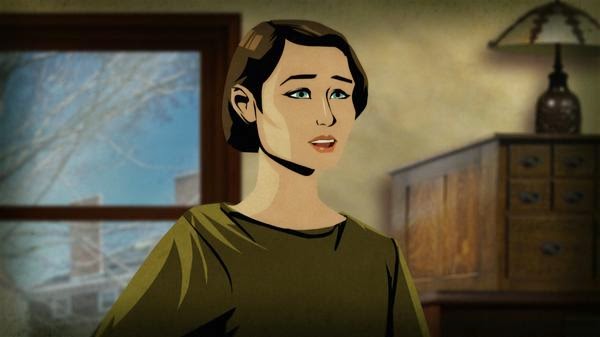
This section, as with most of the historical-set narratives throughout the series, is done as an animation with a distinctive style. I don't know if this was because animation was cheaper than doing a series of mini costume dramas, or if it was purely a stylistic choice. This one works well in that format (perhaps better than some of the later ones), since the pseudo-reality of the animation allows Bruno to escape his prison cell by flying beyond the limits of the world in his imagination, an act that parallels Tyson in his Ship of the Imagination.

A direct lift from the original Cosmos is the idea of the "Cosmic Calendar" as a way of demonstrating the immense age and scale of the universe - the entirety of time from the Big Bang to the present is imagined as one single year, with every event in between compressed accordingly. Tyson uses the Cosmic Calendar concept to show where the creation of the sun and the Earth fall in this 'year', and the beginning of life on Earth, and finally how late the dawn of recorded human history comes relative to the history of the entire universe.


Finally for the first episode, Tyson pays a tribute to Carl Sagan, with a brief biography of Sagan's life and work as a scientist, and touches on how he was inspired by Sagan as a young man. This is quite touching, but also serves to show they are not attempting to ignore or replace the original Cosmos series. By acknowledging their debt to it, the makers of the new series confirm that this is a companion piece to Sagan's series.

Standing up in the Milky Way is a great prologue for the series, although - Giordano Bruno section aside - it is little more than an extended introduction to Cosmos. The best is yet to come.