Showing posts with label CHAAAAADBON. Show all posts

Sunday, 17 March 2024

Big Gay Longcat reviews Doctor Who: The Trial of a Time Lord Part Four


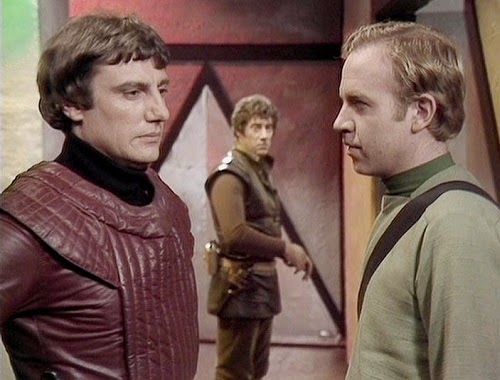
CHAAAAADBON turns out to be a goody after all when he shoots Grell intead of the Doctor. This ought to be an emotional moment, and CHAAAAADBON tries to play it as though it is, but he and Grell have had so little character development and screentime that it is wasted upon us viewers.

Katryca and her mannys get into "the Immortal's castle" to see that the Immortal is still alive. Well, the clue's in the name, I suppose. Mew.


Drathro kills Katryca and Broken Tooth in a needlessly gory way that fully justifies the Inquisitor's complaints in the previous episode about excessive violence and "graphic detail."

All sense that the plot is rapidly building to a dramatic climax goes out the window like Hitler escaping from Danger 5 when it cuts back to the courtroom so that the Doctor can suddenly go on a rant about the Valeyard.
Doctor: "I always thought 'Valeyard' meant 'learned court prosecutor.'"
Valeyard: "And so it does."
Doctor: "Not in your case, sir. Your points of law are spurious, your evidence weak verging on the irrelevant, and your reasoning quite unsound. In fact, your point of view belongs in quite another place. Perhaps the mantle of 'Valeyard' was a mistake. I would therefore suggest that you change it for the garment of quite another sort of yard, that of the Knackers' Yard!"
The Inquisitor then says "I tire of this empty banter" even though it was her who paused the trial in the first place - this strongly points to this scene being a hastily written bit of padding that adds nothing to the story, except that the Doctor said "knackers" lol.

A second scene of Glitz and Dibber is bleeped, not because Glitz is foul-mouthed but because the High Council of Time Lords have ordered him censored. This bit is essentially to remind viewers of what we learned from the similar scene in part three, and it suffers from exactly the same problem - that there was no good reason for the Valeyard to include it as part of his evidence except to give the Doctor a hint about the secret and sinister goings on.


Drathro has a very low opinion of mannys and refers to them as "work units" which, aside from being a callback to Robert Holmes's 1977 story The Sun Makers (in which the baddy also called mannys "work units"), indicates that Drathro needs the mannys to do all the W-word because, unlike him, they have opposable thumbs. Sounds familiar. Nevertheless, calling them 'W-word units' seems particularly lacking in tact or discretion. What's wrong with calling them mannys, or perhaps 'thumbs'?

Drathro won't let the Doctor shut him down and would prefer to explode and kill all the mannys as well. The Doctor tries to talk Drathro into seeing that mannys are of more value than robots like him, but he is no Captain Kirk so he does not succeed. The Doctor's appeals to Drathro's conscience fail because he does not have one, and the Doctor's increasingly exaggerated claims about what will happen when Drathro explodes fall on deaf ears:
Doctor: "Some people think it might cause a chain reaction which could roll on until all matter in the galaxy is exhausted. Is that what you want?"
Drathro: "It is no longer of concern to me."
Doctor: "Others believe an explosion might cause dimensional transference, which would threaten the stability of the entire universe."
It is unclear if the Doctor is supposed to be bluffing here, but if he is then he has clearly taken the wrong approach and should have tried to fool Drathro into thinking he was saving him instead of shutting him down, a bit like the plan he tried with Omega.

Glitz, Dibber, CHAAAAADBON and Peri arrive, thanks to Dibber shooting a hole through the wall. Balazar gets gunged with a face full of noms, in a poorly-timed attempt at a komedy moment. Glitz does what didn't occur to the Doctor to do and tricks Drathro into thinking they will save him by giving him the black light wot he claims they have on their spaceship, Dibber backing him up with the line
"Oh, the black light? Yeah, we've got so much of that sometimes we can hardly see."
That's how you do a komedy moment, Balazar. A witty line that also contributes to the plot.


Glitz insists that Drathro takes "the secrets" with him, which Drathro has in a pawy pawbag. The Doctor says
"Strange how low cunning succeeds where intelligent reasoning fails."
but the Doctor has on many, many occasions proved himself capable of both (including earlier in this very story), so it is only by writing him out of character that we get Glitz and Dibber becoming the heroes in this situation. Robert Holmes often gave the impression of being fond of his double act characters, for instance by giving them a lot of the best dialogue even in stories with Tom Baker in them, but never to the extent of letting them overshadow the Doctor at climactic moments. That was far more common in stories by Eric Saward, the script editor of Trial of a Time Lord, so I think I can detect his meddling with this bit.

With Glitz and Dibber taking Drathro away, the Doctor is able to shut him down so that he explodes more safely, and when he explodes (quite a good special effect, to give it its due) he lands on top of the secrets, squashing them. Glitz and Dibber are seemingly left with no prize, except they realise they can steal and sell the metal from the black light converter, which was made out of "the hardest known metal in the galaxy." This resembles the ending of an episodes of Blakes 7, except with Glitz and Dibber instead of Avon and Vila making the best out of a heist gone awry.


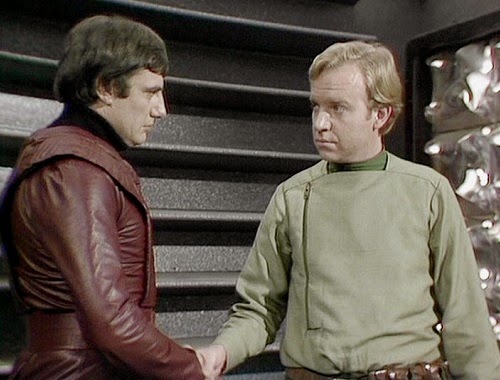
The Doctor and Peri say goodbye to Balazar and CHAAAAADBON (the Doctor even gives CHAAAAADBON a manly handshake - naughty Doctor!) almost like the traditional ending to a Doctor Who story after the day has been saved. Except this time:
"But there are still one or two questions that have to be answered, like who moved this planet two light years off its original course, and what was in that box that Glitz and Dibber were so interested in?"
the Doctor asks these questions rhetorically of Peri, and the viewer, to make it clear to us that this story is not yet concluded. And the traditional final joke - in this case Peri laughing at Balazar calling the Doctor "old one" like he did at their first meeting - isn't followed by the end credits, but by a transition back to the courtroom.

The Doctor claims "to have saved the entire universe" there, which means either he wasn't bluffing about the danger posed by Drathro's explosion - implying certain horrifying things about the health & safety environment in the constellation of Andromeda - or else he is trying out his bluff on the Time Lords. Neither the Valeyard nor the Inquisitor are impressed, and the Valeyard hasn't finished his prosecution. He says:
"The most damning is still to come. And when I have finished, this court will demand your life!"


Crash-zoom to the Doctor's face: cliffhanger!

Jayston does his best, but this is basically just a retread of the ending of the first part, so is pretty underwhelming as cliffhangers go.

Linking the stories in this season, or making them all just parts of one larger story, was a good idea in principle - one used repeatedly by the 21st century revival of the series, for better or worse - but the mistaik came in having the framing story of the trial intrude so much into the substories. Not only did they mess with the pacing - breaking up scenes of rising excitement with static, talky scenes - they nomed into the screen time of the "Mysterious Planet" plot and never let it stand on its own.

The subplots with minor characters suffered the most from this, ensuring viewers had no real emotional connection with the likes of CHAAAAADBON and Grell, Tandrell and Humker, or Balazar and Broken Tooth. These script problems might have been fixed had Robert Holmes been given the time to improve them in later drafts, or if the show's script editor had been any good at his job, but neither was to be. Still, with the next episode pawing over to a new writer, a new director and a new guest cast for a new substory, hopefully The Trial of a Time Lord will only improve from here on...


Crash-zoom to face cliffhanger count: 3

Sunday, 10 March 2024

Big Gay Longcat reviews Doctor Who: The Trial of a Time Lord Part Three

The day is saved when it turns out Balazar knows one of the tribesmannys, and he gets them to pewpewpew the robot instead.


The Inquisitor complains about the violence she is being forced to watch, but the Valeyard claims that "a certain amount of graphic detail is unavoidable." Is this Robert Holmes having a bit of fun at the expense of the Mary Whitehouse types, i.e. the sort of viewer who complained that the previous season, his own The Two Doctors included, was too violent?

The Doctor, Peri, Balazar, Glitz and Dibber are all captured by the tribesmannys and taken back to the village. The Doctor tells Queen Katryca the truth about Drathro and the black light converter, but because she has already been told so many lies by Glitz (and, we are given to infer, other "star travellers" before him) she does not believe the Doctor's story either.

Imprisoned again, Glitz says to the Doctor
"You're the Time Lord, haven't you got a rring you can rrub? A magic lamp?"
which is a none too subtle way of reminding us that Glitz knows something about the Time Lords already - at least enough to have seen Genesis of the Daleks at any rate. Glitz confirms that this planet is Earth, and that it was moved out of position "only by a couple of light years" in order that the rescue ship sent for Drathro and "the Sleepers" should miss their target. This begins to unravel the mystery of Ravolox, although it does not explain how the Earth or the Solar System could be mistaiken for anything other than what it is at the scale at which star systems operate at.


The robot hulks through the wall and captures the Doctor.

Back (or should that be forward?) in the courtroom the Doctor calls the Valyard more names, this time "the Farmyard" and "the Scrapyard," but this scene also contains some useful exposition about how the trial can watch scenes that the Doctor is not in, so long as "they are within the collection range of a TARDIS." The Valeyard reveals that the Doctor's TARDIS has been fitted with a "new surveillance system" (or "bugged" as the Doctor puts it), which explains why all of the trial evidence must come from a point after the bugging began. This may explain why the Doctor chooses the story he does for his defence, rather than simply bunging on a classic story or two that would be certain to get him off. The Inquisitor dismisses this as "an unimportant issue" but I think this is one of the subtler moments in the story.

Queen Katryca and her mannys pewpewpew the robot, and are convinced that they have killed the Immortal. As the queen plots to plunder "the Immortal's castle" her dialogue gets increasingly theatrical, reminding me of Irongron and the medieval mannys from The Time Warrior.
"It is ours now. All the tools and metal. All the strange materials that bend and do not break. All the mysteries and treasures of our ancient forefathers that we shall learn to use again. Do you not agree? Then let us... attack!"
I'm not the only one reminded of season 11, since when the Doctor wakes up he does a Jon Pertwee impression and says
"Oh, my head hurts abominably, Sarah Jane."


Katryca's dialogue continues to get even more exaggerated and flowery once they go underground:
Katryca: "We have no need for indecision in the tribe of the Free. Long we have waited for this moment. The Immortal is dead, and we shall plunder his castle. The spoils of triumph are ours. Now think, which is the way?"
Balazar: "This way."
Broken Tooth: "This way."
Katryca: "Am I to be surrounded by fools? We go forward. Forward, I say! I have read it in the flames many times... we go... forward!"
Perhaps this is meant to be a symptom of her increasing megalomania, a trait often possessed by Robert Holmes's baddys.

Glitz and Dibber, meanwhile, continue to play the double-act komic relief:
Glitz: "Do I look like a philanthropist?"
Dibber: "Well, how do I know? I've never seen one."
Glitz: "A philanthropist, my son, is someone who gives away all their grotzits out of the simple goodness of their heart."
Dibber: "Oh, you mean they're stupid? Oh yeah, you probably do look like one, then."
While not the worst material, it does feel a bit forced, rather than seeming to arise naturally out of the plot. Similarly, there is a very clunky bit of plot introduced when Glitz's dialogue is suddenly bleeped out midway through a sentence to Dibber:
"Whatever you do, don't open your big pie-hole and let him know that we're after the stuff..."
It then cuts to the courtroom.
Valeyard: "The remainder of that evidence has been excised, my lady."
Inquisitor: "Excised? Why?"
Valeyard: "By order of the High Council."
This is obviously included to let the Doctor, and the more astute of us cats watching at home, know that there is something suspicious going on here, but it is a bit of a plot hole - there is nothing vital to the Valeyard's case in this scene, so why show it to the courtroom at all, with or without the censored part? It's not an insurmountable plot hole - it could be an early hint that the Valeyard does not have total control of the Matrix, but this is a plot thread that will never be properly resolved or explained (like so much of Trial of a Time Lord), perhaps due to the clusterfuck surrounding the writing of the final episodes - which we shall reach in due course.

The Doctor and Peri have also gone underground, and they meet up with CHAAAAADBON, who hasn't done much this episode except have Grell make insinuations at him. He makes up for this by getting in on the cliffhanger, pointing his crossbow at the Doctor and firing it.


Crash-zoom to... wait, this one doesn't end with a crash-zoom! Surely this can only be so there is no mistaiking that the crossbow has definitely been fired. A clever bit of foreshadowing for Colin Baker's fate at the end of the season.

Thursday, 29 February 2024

Big Gay Longcat reviews Doctor Who: The Trial of a Time Lord Part Two


CHAAAAADBON arrives and saves the Doctor on behalf of the robot, who wants to meet him. While Balazar gives the Doctor, and us, some exposition about "the Immortal" (as the underground mannys call the robot), watch out for CHAAAAADBON in the background doing some great waiting-for-my-next-cue acting.

Peri meets Queen Katryca, who says
"I shall provide some excellent husbands for you."
"Husbands? Plural?"
"Such women as we have must be shared. Think about it."
This confirms my theory that they still have fanfiction in the future. The naughty kind. And it also goes to show that you can take the manny out of Carry On but you can't take Carry On out of the manny. Peri is locked up with Glitz and Dibber, and Glitz immediately pervs on her:
"Ah, it seems we have a pretty visitor. I'm beginning to feel better already. Sabalom Glitz, my dear, and this youth with the vacuous expression and single track mind is Dibber."
This is only mild perving compared to what Peri was used to from viewers the previous season, which I suppose is progress of a sort.

Glitz's backup plan for if he cannot blow up the tall, thrusting totem pole-cum-light converter is to dig a deep hole down to the hidden, dark tunnels of the underground station. Sigmund Freud eat your mum heart out, lol. It's worth remembering when we see him in his subsequent appearances that this 'lovable rogue' Savlon Glitz was planning on gassing all of the mannys who live underground to death so that they couldn't W-word for the robot, an act which Peri says "would be mass murder."


CHAAAAADBON sends the Doctor in to meet the robot, whose name is Drathro, and his two henchmannys Tandrell and Humker. They are the two mannys who "passed the selection" to "find the two cleverest youths," which is writer Robert Holmes reusing an idea from all the way back in his very first Doctor Who story, The Krotons.

Back in the courtroom, the Doctor starts to call the Valeyard names - "the Boatyard" and "the Graveyard." The general level of humour in these scenes doesn't rise much above that, with one exchange being:
Doctor: "I protest!"
Inquisitor: "What now?"
Doctor: "Yes, now!"
Inquisitor: "I meant, what are you protesting about this time?"
Did Bob Holmes write this, or Bob Block? Don't get me wrong, it's not that these interrupting courtroom scenes are tedious and unnecessary, although there does appear to be a manny sat behind the Inquisitor who has brought a book along just in case.


The Doctor tricks Drathro, Tandrell and Humker into getting electriced (electricked? Please yourselves, mew) and then makes his escape. Drathro sends another robot to chase him. Meanwhile Glitz, Peri and Dibber also stage an escape and get chased by the primitive tribesmannys. They split up so that Dibber can blow up the light converter/totem pole.

CHAAAAADBON reveals to Balazar that, instead of being the Immortal's executioner, he has been helping mannys to escape from the underground to the surface whenever he was supposed to kill them. He now plans to send Balazar outside, and the Doctor too if they can find him before the robot does.


In theory this is a lovely little subplot that adds depth to the minor characters, but it isn't developed enough in the time, and the way it is directed is rather flat and unengaging - there is no subtlety at all to the way CHAAAAADBON says
"I have to be careful, I think Grell already suspects."
while we viewers can clearly see Grell watching them, in the centre of frame, barely concealed from them around a corner. I do, however, like the way that CHAAAAADBON covers his microphone with his paw whenever he is conspiring, lest the Immortal overhear.

They meet the Doctor while he is escaping and Balazar goes with him. This is supposed to be the first time that Balazar has ever been outside, and his line
"It's beautiful!"
manages to capture something of the existential horror of going outside* by referencing the climactic scene of the then recent film Raiders of the Lost Ark, but I think more could have been made of this moment in the paws of a more skilled director, or even just any director who gave a shit about what they were making.

The Doctor, Balazar, Peri, Glitz and Dibber all meet up outside of the entrance to the underground station (the Doctor doesn't even know who Glitz and Dibber are yet, but he can see they're with Peri so he accepts they must be friendly... what a mistaika to maika!) but they are chased inside by the pursuing tribesmannys. Inside, Drathro's robot is waiting for them, and they are trapped between the mannys and the robot. The Doctor says
"I really think this could be the end!"
Crash-zoom to face: cliffhanger!


Crash-zoom to face cliffhanger count: 2

* I went outside once. It was awful.

Sunday, 25 February 2024

Big Gay Longcat reviews Doctor Who: The Trial of a Time Lord Part One

During season 23, Doctor Who was on trial. With enemies at the BBC out to get it, the series only narrowly avoided cancellation after the 22nd season and was put on an 18-month "hiatus" instead. The behind-the-scenes war between the Doctor Who production team - most notably the producer John Nathan-Turner and script editor Eric Saward - and the BBC management - especially head of series and serials Jonathan Powell and controller of BBC1 Michael "is a cunt" Grade - is told more fully in the documentary Trials and Tribulations (found on the Trial of a Time Lord DVD box set) and in two chapters of Richard Marson's book JN-T: The Life and Scandalous Times of John Nathan-Turner. It is such a fascinating and dramatic time that I hope one day to see it made into the subject of a TV dramatisation, along the lines of Mark Gatiss's An Adventure in Space and Time or RTD's Nolly.

The off-screen shananigans at the BBC would end up having a significant effect on the shape of the season and what was eventually shown on screen. One of the first outcomes was that JN-T and Saward threw away their original plans for season 23 and started all over again from scratch. Perhaps this is for the best, since the outlines for the stories intended for that first version of the season have leaked out over the subsequent years and none of them sound like they would have been good - with the possible exception of The Nightmare Fair, intended to be a rematch between the Doctor and the Celestial Toymaker. That might have been a good idea, we'll never know.

Saward's new plan was to have a single story across the entire season, in which the Doctor would be on trial. While a common suggestion is that this was inspired by the real-world situation he felt they were in, another possibility is that this was pitched to appeal to Jonathan Powell, who had previously been a producer of the long-running ITV courtroom drama series Crown Court. There's no solid evidence for this (none that would stand up in court, mew), but it is circumstantially backed up by the casting of Michael Jayston in a major role, who had played a barrister in several episodes of Crown Court as well as a leading role in the other series Powell was best known for producing, the BBC's Tinker Tailor Soldier Spy.


The Trial of a Time Lord stars Colin Baker as the Doctor, Nicola Bryant as Peri, and Bonnie Langford as Mel. It is 14 parts long, making it the longest TV story in all of Doctor Who, and since we all know longer is better, that means it is surely gong to be great! The first four parts were written by Robert Holmes, who along with Eric Saward had planned the overall Trial storyline.

Holmes first wrote for the series in the 1960s, but it was in the 1970s when he would come to be regarded as one of the greatest writers the show ever had, writing or script-editing many of the best stories of Jon Pertwee and Tom Baker's eras. He then wrote several scripts for Blakes 7, where he took the relationship between Avon and Vila to a level not reached by other writers of the series (not in that way, you naughty cats!) and returned to Doctor Who in the mid-1980s to write the superb Caves of Androzani and the appallingly rubbish The Two Doctors. The Trial of a Time Lord would be his last contribution to the series, since he then went


It starts with a fade from the title sequence to the best looking model shot Doctor Who ever achieved, of a space station hanging in space. The camera flies up to it and across its surface, like at the start of a Star Wars film or the end of an episode of Red Dwarf. At the same time ominous music plays, reminiscent of the music in the 1984 film of Dune, with added tolling of a bell. This was an era where the TARDIS cloister bell was still heard only infrequently, not like in the new series era when it sounds at the least provocation. The TARDIS flies into the space station through a beam of light, and the camera zooms into the light so that the screen turns white.

This is a genuinely impressive opening, and a creditable effort at getting the 14-part epic off to a suitably epic start. It also shows that the BBC could compete with the movie-quality SFX of the time if it was prepared to spend the money on it. Of course for the entire 14-part season to look as good as this it would have cost orders of magnitude more than the actual budget. The production team could not possibly satisfy their management's demands that they make something that looked like a big-budget Hollywood sci-fi film without being given anything approaching the resources that such films had access to. This one scene is perhaps their attempt to say: this is what it could be like.

Reality comes crashing back in the second scene - an overlit, obvious studio set that is supposed to be the interior of the space station we have just seen, despite a lack of any similarities in design to tie them together. The TARDIS materialises and the Doctor comes out, and makes his way to the next room where, thankfully, somebody has turned the lights down.


"At last, Doctor."
The first line of dialogue comes from the distinctive voice of Michael "Peter Guillam" Jayston as the Valeyard, sat for the present in the shadows. This can't last, and the lights come on when the Inquisitor (Lynda "more Oxo!" Bellingham) enters. When he tries to talk to her, she addresses the Doctor as "the accused" and the Valeyard says
"By order of the High Council, this is an impartial inquiry into the behaviour of the accused person, known as the Doctor, who is charged that he, on diverse occasions, has been guilty of conduct unbecoming a Time Lord."

Big Gay Longcat reviews Doctor Who: The Impartial Inquiry Into The Behaviour of a Time Lord Part One

Doesn't have quite the same ring to it, does it? Mew. But the Doctor is also charged with "transgressing the first law," so is this a trial, with charges and laws broken, or not? Courtroom dramas set in real-world courts are notorious for how often they dispense with the reality of the legal process for the sake of the drama, so this being a made-up alien legal system is a perfect opportunity for Holmes, as the writer, to invent one where the customs and procedures serve the story, and where the potential for dramatic revelations and reversals can be maximised. In doing so he would only be following in the footsteps of the great Terry Nation, who did this all the way back in The Way Back Sentence of Death. So perhaps there is a story reason why this is only an "inquiry," not a trial, despite what the on-screen title told us?

The Inquisitor and the Valeyard mention that "the Doctor has faced trial already for offences of this nature," which is a continuity reference to The War Games (and also to Scratchman because, although that wasn't written until many years after this story, it is set before it). This isn't dwelt upon, but it is a bit of a giveaway that this is a plot that has been used before in the series.

Another continuity reference, this time to The Five Doctors, comes when the Doctor claims that he is "Lord President of Gallifrey" and says
"You can't put me on trial."
He is told that he has no immunity because it's just been revoked he has been deposed and isn't president any more. I'm sure there's a parallel with recent real-world political events that I could draw here, but it would be too easy; like shooting fish on Fifth Avenue.

After the Doctor "refuses the services of a court defender" and elects to defend himself (he's obviously not watched enough Crown Court to know what a bad idea this is) the Valeyard, as the prosecution barrister, opens his case:
"I intend to adumbrate two typical instances from separate epistopic interfaces of the spectrum."
So, aside from telling us that the Valeyard is one of those characters who will never use a short word when a long one will do (which we long cats naturally approve of), it is also worth noting that, according to Wikipedia, the word "epistopic" was coined in 1993. Well, the Valeyard is a Time Lord, presumably, so he must have picked it up on a visit to the future.

He is going to show his evidence on a big TV screen hanging on the courtroom wall. This means that for much of this story we are going to be watching a TV show playing within the TV show.


The Doctor and Peri are wandering around on location. The Doctor thinks this planet, Ravolox, is very similar to the Earth, while Peri complains about the Earth-like weather. They are observed by Sabolom Glitz (Tony Selby), in his first appearance in Doctor Who - we will meet him again in Dragonfire - and his friend Dibber. Robert Holmes has written some wonderful double-acts in his time, such as Jago & Litefoot, Irongron & Linx, and, of course, Avon & Vila. Glitz & Dibber are not one of them. They are an example of Holmes trying way too hard to recapture the glory days of the 1970s, with the circumloquacious Glitz paired with the much more straightforward Dibber coming across as a bargain basement Garron & Unstoffe.
"Whereas yours is a simple case of sociopathy, Dibber, my malaise is much more complex. 'A deep-rooted maladjustment,' my psychiatrist said, 'brought on by an infantile inability to come to terms with the more pertinent, concrete aspects of life.'"
"That sounds more like an insult than a diagnosis, Mr Glitz."
"You're right there, my lad. Mind you, I had just attempted to kill him."

The Doctor and Peri go inside an ancient building. There's a fan-baiting moment when the Doctor almost says his name, but he is interrupted by Peri before he can finish his sentence:
"You know, I'm glad I decided to come here. I might stay here for a year or so and write a thesis. Ancient Life on Ravolox by Doctor..."
Are we quite sure Steven Moffat didn't write this? Or if he watched this as a young manny, then that line could have a lot to answer for, mew.


Peri has found the remains of a sign that says "MARBLE ARCH" on it.
Peri: "Doctor, we're on Earth aren't we? I said it felt like Earth."
Doctor: "It's in the wrong part of space for it to be your planet. Besides, according to all the record books, this is... Ravolox."
Peri: "Well then, how do you explain this?"
Doctor: "I can't. Not yet. Unless of course, perhaps they collected railway stations."
Peri: "That's ridiculous."
Doctor: "But not impossible though. Not as impossible as the other explanation."
Peri: "What's that?"
Doctor: "Well, that somehow or other your planet and its entire constellation managed to shift itself a couple of light years across space, after which, for some reason, it became known as 'Ravolox.'"
The Doctor must surely be drastically understating the true distances involved when he says "a couple of light years" because if that was literally how far the Earth was moved then it would still be readily identifiable as the solar system, what with two light years being scarcely halfway to the nearest other star. On the other paw, this would hardly be the first time a Doctor Who writer got astronomical scales wrong or misused astronomical terminology - what does the Doctor mean by the Earth's "entire constellation" anyway?

The story-within-the-story is interrupted by the Doctor in the courtroom asking where Peri is, to which the Valeyard replies
"You don't remember? Obviously a side effect of being taken out of time. The amnesia should soon pass."
The Doctor suffering from laser-guided amnesia is one of the most frustrating parts of the Trial story, which I shall return to when it becomes more relevant in future episodes. If I remember to. For now I shall pass over it in much the way that it is passed over on screen, with the story in a hurry to return to the Ravolox plot.

The Doctor goes deeper into the building through a "hermetically sealed" door, leaving Peri behind where she is immediately captured by some mannys. The Doctor wanders around a cleaner, more futuristic-looking studio set until he also gets captured by a different set of mannys.


A robot talks to Tom CHAAAAADBON over a futuristic video call. Jokes about how they must be in lockdown and using Zoom would have W-worded better if I had reviewed this back in 2020 instead of season seven, so I won't bother doing them now.

Meanwhile, Glitz and Dibber have been off in their own subplot meeting with the primitive local inhabitants of Ravolox, led by Queen Katryca (played by Joan "Carry On" Sims). They want to blow up the "light converter" that sits in the locals' village and supplies the robot with energy. But the locals think it is "a totem pole" to their god so they don't want it to be blown up. This disagreement results in Glitz and Dibber getting captured as well.

The Doctor is chained up and about to be stoned to death, so that means it is time for some komedy (the incidental music clues us in that this bit is supposed to be funny). He speaks to "Balazar, the reader of the books." The mannys stuck in this underground place have only three books "from the world before the fire." The books are "Mo By Dick by Herman Melville," "The Water Babies by Charles Kingsley" and "most mysterious of all the sacred texts, UK Habitats of the Canadian Goose by H M Stationery Office." That doesn't sound much fun, and it is not made clear if any of their Blakes 7 DVDs survived the fire so it could be even worse. But at least they must still have internets, or else how could CHAAAAADBON have made his Zoom call with the robot? It is reassuring to know that all the Blakes 7 fanfiction will survive into the far future, even if the original programme does not.

The Doctor uses his umbrella to deflect as many of the stones as he can to survive being stoned to death, a scene with no dramatic tension due to following on from the komedy of the books scene and then a brief cutaway to Glitz and Dibber arguing. It then cuts back to the courtroom, where the Doctor is pleased at how clever he was being on the screen. The Valeyard counters by becoming very serious.
Valeyard: "Hear how the Doctor takes pride in his interference. Hear how he boasts! This is not the reaction of a responsible Time Lord."
Inquisitor: "We are all aware of that, Valeyard. What is the point you are trying to make?"
Valeyard: "These proceedings started as a mere inquiry into the Doctor's activities. I'm suggesting now that it becomes a trial. And if he is found guilty, I strongly suggest the termination of his life!"


Crash-zoom to face: cliffhanger!

This is a bit of a rubbish way to end the episode, but at least it explains why this started out as an "inquiry" instead of a trial: so that it could become a trial in time for the first cliffhanger - a bit like the Daleks only showing up for the end of part one in a story with "of the Daleks" in the title.

Crash-zoom to face cliffhanger count: 1

Sunday, 26 March 2023

Rumpole of the Bailey, Season One (1978)

In 1975 the Play for Today of Rumpole of the Bailey was made by the BBC and told a self-contained story about the character and his family. Three years later Rumpole returned, this time on ITV in a long-running series that saw seven seasons broadcast between 1978 and 1992.

Eventually this series settled down into a somewhat cosy formula, but there is as yet little evidence of this final form in the first season, which is only the first part of a bridge from the original Play for Today 'pilot' episode to the familiar Rumpole of the later years.

Unlike all the subsequent seasons, which would be set near-contemporaneously with the years in which they were made, the first season is set over the course of 10 years from 1967 to 1977, as is made clear from on-screen captions seen shortly after the opening titles. While most characters seem to change little over the course of the decade, this is crucial for the development of the Rumpole's son Nick, who goes from a senior schoolboy in the first episode to a university graduate, engaged to be married, and about to embark on an academic career by episode three.

The third episode, Rumpole and the Honorable Member, is the standout story of the season, and one that is tough to imagine coming any later in the series' run. In it, Rumpole defends an MP accused of rape, which he does by (as was a standard practice for defence barristers at the time) attacking the character of the accuser. The cross-examination scene is the most brutal of the entire series, with Rumpole pulling no punches, and it makes for a difficult viewing since this is supposed to be 'our hero' doing this.

What makes it even worse is when it later comes out that the accused is guilty after all, meaning Rumpole had been attempting to discredit an innocent and honest person. He is left having to defend his actions to his future daughter-in-law (who was horrified at having witnessed the cross-examination in court) by arguing that the accused was entitled to be defended until he was proved guilty (that is what "innocent until proven guilty" means). This is true enough, but that doesn't make it any easier to watch.


The MP Rumpole was defending was played by Anton "Susan died a year ago, Number Six" Rodgers in a guest appearance. Speaking of The Prisoner, we are introduced in the first episode to Guthrie Featherstone QC MP, a recurring character played by Peter "A" Bowles. As a fellow barrister in Rumpole's "chambers," he is sometimes an ally and sometimes a rival to Rumpole. Appearing in four of the six episodes, he benefits from possibly the most character development of any of the supporting cast in chambers, potentially matched only by Claude Erskine-Brown (Julian Curry), also appearing in four episodes but not really heavily involved in the plots of any of them. Never mind, Erskine-Brown will get his chance in later seasons - aside from Rumpole himself, he is the barrister we will see the most of, across all seven seasons.

Other one-off guest appearances of note include Jane Asher as Rumpole's client in the second episode, Rumpole and the Alternative Society, appearing alongside one of her colleagues from The Stone Tape, Tom CHAAAAADBON, here playing a police detective. Also in that same episode is Peter "Count Grendel " Jeffrey as an old friend of Rumpole's.

While Rumpole of the Bailey would feature several memorable recurring judges throughout the length of the series (each with an adversarial attitude to Rumpole that often made them more of an opposition to him than the other barristers), the only one to be seen here in the first season is Judge Bullingham, "the Mad Bull." This head start, combined with the distinctive snarling characterisation from Bill Fraser, arguably makes him the most memorable of all the judges Rumpole would face over his career.

In the final episode of the season, Rumpole and the Heavy Brigade, Rumpole is set up to fail by two conniving brothers, played by Bruce "Pirate Captain" Purchase and Derek "Greg Sutton" Newark, who employ Rumpole to defend their third brother, who stands accused of a murder they themselves were responsible for. Trevor "Professor Litefoot" Baxter also appears as a solicitor whose loyalties are divided between the two villainous brothers who are paying him, and the accused brother with whom his sympathies lie.

The brothers' plot is foiled when Rumpole successfully defends the case, leading the police to look for the real killers. A triumphant Rumpole realises that he was only chosen for the case because of his eccentric mannerisms and disheveled outward appearance (which includes his old and battered hat that he wears in spite of derogatory comments from judges), and that without these his client might have been found guilty.

Far from covering up a hollow interior life, Rumpole's eccentricities conceal that he is a seeker after justice and a defender of those in need of him. This is a thematic reversal of the ending of the Play for Today, and sets Rumpole up for his new life as a continuing character and, eventually, a television institution.

Monday, 18 July 2022

Countdown to what?


Blake's Threesome

Or should it be Blakes Threesome?

Sunday, 25 May 2014

The Countdown Starts Now

Countdown is one of my favourite Blakes 7 episodes, probably my most favourite out of the whole of the first two seasons. I have already reviewed it here but that was in 2010 which was a long time ago, and anyway this post will have more pictures of Avon in it!


Obviously that's not Avon; that's Space Major Provine, the baddy for this episode. He is played by Paul Shelley (who was also really good in Secret Army, which was made around the same time as this) and manages to be almost as good at being a baddy in this one episode as Travis manages in the whole season.

Blake is looking for Space Major Provine to tell him about Star One, but that plotline occupies very little of the episode. Most of it is about trying to stop Space Major Provine's bomb that will blow the planet up, and that job is up to Avon. It is made even more complicated when Avon meets Del Grant, played by Tom CHAAAAADBON! Del Grant has not been in Blakes 7 before, or even mentioned before this episode, but the two actors instantly convey their shared backstory through their facial expressions upon their first meeting.


CHAAAAADBON!


But there isn't time for them to fight, or even to make up and have hugs and kiffs, because they have to work together to stop the bomb from blowing up the planet.


Blake looks a bit left out in the background there. I think this episode is where Paul Darrow really makes an effort to take over the series in his superlative acting in his scenes with Grant. He is helped by Terry Nation's script, which sees Avon and Grant work out their differences as they work together on the bomb.


They work very closely together. Blake would be jealous. Avon is very quiet as he explains to Grant what happened to him and Anna, Grant's sister.


Contrast that with the scene where Blake questions Space Major Provine. Gareth Thomas suddenly hams it up, as if it is Blake who is dying instead of Space Major Provine. Maybe he was just projecting his jealousy issues with Avon on to poor Space Major Provine?
Anyhow, Paul Shelley just about manages to salvage this scene, and Blake and Vila get the necessary exposition about Docholli and Star One from him to set up the story arc for the rest of season 2.


Avon seems to be enjoying himself, smiling (purr purr) as he puts himself in danger to help save the planet even when he doesn't need to. Not for the first time and not for the last.


The roof collapses on Avon and Grant, forcing them to get physically close together just as their shared experience has forced them to get emotionally close. They save the day and become good friends.


Back on the Liberator, instead of having hugs and kiffs they have a manly handshake to show how good friends they have become. Maybe they had hugs and kiffs offscreen?


But Avon's new friendship with Del Grant has created a coolness between him and Blake. Blake wants to know about Anna, but Avon is unwilling to share that with him.


The episode ends with them sharing a look, but something has changed between them. Avon's backstory has begun to come out, and things will never be the same again...

Sunday, 21 April 2013

Duncan reviews Doctor Who: Hide

"This isn't a ghost story, it's a love story!" says the Doctor towards the end of this episode. Given that it spent its first half looking almost exactly like a ghost story, you could be forgiven for feeling a bit cheated by this.

Yesterday evening, not long after Hide finished its premiere showing on BBC1, I watched The Stone Tape, a one-off drama by Nigel Kneale first shown on BBC2 in 1972. An early scene of Hide directly references The Stone Tape, when guest character Professor Alec Palmer talks of finding American Army Spam left over from WW2. By doing this I would say that Hide, were it a ghost story, was inviting us to compare it with its 40 year old predecessor. Fortunately it is not a ghost story, as the comparison would do Hide no favours at all.


For a start, Hide doesn't have Tom CHAAAAADBON in it.

The reason for this I have to put down to the Doctor and Clara, who at no point take the story seriously and, from the moment they appear, prevent the kind of atmosphere that Hide would need to be an effective ghost story (which, fortunately for it, it isn't) from being established.

So about halfway through, with Hide still looking to the audience like a ghost story - just not a very good one - we get the intrusion of this year's story arc. The less said about that the better, but the point is that it does intrude on the plot and disrupts the flow of the story, something I have less and less tolerance for the more that Doctor Who does it.

Back to the story we came here for, and time for the Doctor to explain what the ghost actually is, because of course it isn't going to be a real 'ghost' or supernatural phenomenon. Credit where it's due, the explanation is a pretty good one, and we can all now stop pretending that we're watching a ghost story.

The business with rescuing the time traveler from the pocket universe ought to have been the conclusion of the episode - the nonsense with the monster that is scary and ugly but which really just wants to escape too feels tacked on and unnecessary. Perhaps it would have been more effective as a metaphor for the Professor and his assistant's they-love-each-other-but-they-don't-know-it, except that particular subplot was intensely annoying in its sledgehammer unsubtlety.

Now I've said "subplot" there, but it turns out that this was really the plot! "This isn't a ghost story, it's a love story!" My mistake; the ghost story was the subplot. (Apologies for hammering this point into the ground.) The phrase 'bait-and-switch' comes to mind, and I'm left thinking that this is yet another Doctor Who episode that showed early promise that it then failed to deliver on.

A final thought on Hide before I roll my eyes and head off into the sunset: the name. I'm guessing it's called Hide to try and echo the effective titling of Blink, an episode that set out to be a scary and atmospheric story and succeeded at both. And of course in Blink, the secret of defeating the Weeping Angels was to not blink. Here the secret to success was to not hide.

Thursday, 4 March 2010

Big Gay Longcat reviews Blakes 7: Countdown

There's a bomb that's going to blow a whole planet up, and it's up to Blake and Vila and Avon to stop it.
This story, written by Terry Nation, comes in the middle of season 2, and reveals some of the backstory of Avon for the first time.

It starts with lots of mannys fighting each other. I don't know why they're fighting yet, but some of them are Federation so they must be the baddys. The other side appears to be winning, and one of them is CHAAAAADBON!


CHAAAAADBON!

His name is Del Grant, but he is played by CHAAAAADBON! I have seen him before in Doctor Who and Rumpole of the Bailey. He has a voice that makes me go CHAAAAADBON! when I hear it.
Avon appears after almost 7 minutes, along with Blake and the rest. Avon, Blake and Vila teleport down. They find a space rocket that has fuel to last 100 space-hours.

Blake gets caught, but it is by the goodys so they team up straight away and soon Avon knows what's going on. Space Major Provine is the baddy. He has a bomb to blow up the planet unless Avon can stop him. The Federation put the bomb in so people would do what they say, but now it is going to go off.
Blake and Vila try to find the bomb so Avon can turn it off, then Avon meets Del Grant, played by CHAAAAADBON, who wants to kill him.

Blake finds out about Provine while Avon and Del Grant teleport to where the bomb is. Blake says if anything happens to Avon then he'll come looking for Grant, because Avon is his best friend and Blake would be sad without him.

Avon finds the bomb inside some ice and he tries to axe his way into it, but it would take too long so he gets Grant to use the space-heaters. While they turn the bomb off, Avon tells Grant about his sad story of how he got arrested and Anna got killed. Anna was Del Grant's sister - he blamed Avon for Anna dying, but now he sees that Avon is sad about it.

Avon is in danger from three different things here: the bomb is still counting down (that's why the story is called Countdown!), and the roof is in danger of falling on his head any minute, and Grant wants to kill him. This is very clever writing by Terry Nation to have so many dangers at once for Avon. And it shows how brave Avon is that he and Grant take their teleport bracelets off so they can't be rescued until they have saved the planet. And then the roof does fall on them so Avon can only stop the bomb in the nick of time.

Avon and Del Grant finish as friends, and Blake finds out about Docholli and "Star One" from Provine. But that's another story...

This is an amazing episode. It is fast-paced and tense with a countdown going all the way through. Avon saves the day again because he is brave, and it is a whole planet he saves. Blake and Vila are also good in this, though there's not much of Jenna, Cally or the Liberator in this episode - there isn't time!
When it finished I was feeling excited and happy because it was so good. It is another one of my favourites. Now my excitement is going away and I am feeling sleepy, but still a happy cat! It is time for sleeps now. Bye bye. Zzzzz