Sing now, ye longcats of the Buddha Cushion,
for the reign of Hoover is ended for ever,
and it's back in the cupboard.
Sing and rejoice, ye longcats of the Broken Sofa,
for your watch hath not been in vain,
and the Loud Noise is stopped,
and your sleeps have come back,
and they are glorious.
Sing and be glad, all ye longcats of the flat,
for the internets shall come again,
and you shall dwell upon it
all the days of your life.
And the Sofa that was broken shall be renewed,
and be planted next to the television,
and the TV shall be blessed.
Sing all ye longcats!
Thursday, 12 January 2012
Sunday, 8 January 2012
The Sleeping Beast
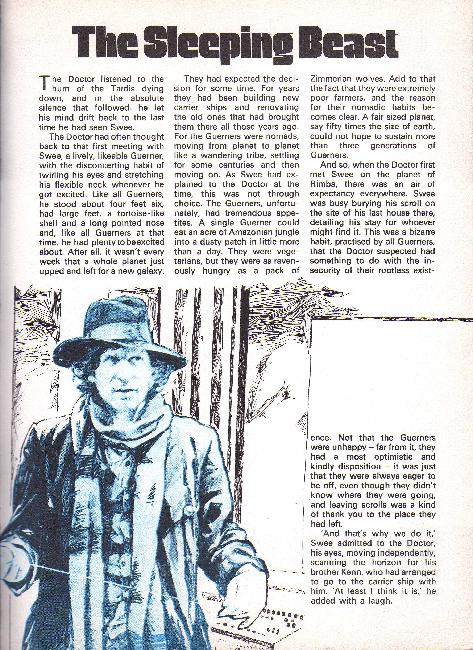
As the picture shows, the Doctor is now being played by Tom Baker. But this story starts with the Doctor immediately having a flashback.
"The Doctor then had not been as he is now. He'd had checked trousers and a flute and straight brown hair cut in a fringe. He'd changed twice since then."
In his flashback the Doctor remembers the first time he met Swee the Guerner.
"Like all Guerners, he stood about four feet six, had large feet, a tortoise-like shell and a long pointed nose and, like all Guerners at that time, he had plenty to be excited about."
They were excited in the flashback because they were about to all go into space in great big spaceships to colonise another planet. They had to do this because they had nommed all the noms on their planet Rimba. The Doctor met them by accident.
"He'd been trapped in a cosmic whirlpool by the deadly stinging butterflies of Phlok, and his only means of escape was to jaunt through space and time without plotting a course. In this instance the Tardis had emerged from inter-dimensional non-space into the comforting planetary environment of Rimba."
Fortunately for the Doctor the Guerners are all very friendly. The Doctor helped Swee, his brother Kenn, and all the other Guerners into their spaceships and watched them fly off. The flashback ends and the story goes back to the Doctor and Sarah in the Tardis. The Doctor switches on the scanner and he sees Swee and other Guerners.
"It was not Swee's agitation that shocked the Doctor however, it was the fact that all the Guerners were carrying weapons, and the place that they had materialised inside looked like the old mission control building at Houston on earth."
The Doctor and Sarah leave the Tardis and are, of course, captured straight away.
I think this must be Sarah, the Doctor and Swee in this picture, because I don't know who else they could be. I wonder if Sarah is meant to be Sarah Jane Smith or if she is a new Companion not from the TV series? Anyway, back to the story.
"'Seize them!' Swee's voice was stern.
'But, Swee, don't you remember me?'
'My name is not Swee. It is Nass! We know why you've come here!'
'But- but-'
It was useless."
Now there are two mysteries in the story - why the friendly Guerners are now unfriendly, and why Swee is called Nass and doesn't remember the Doctor.
The Doctor thinks Swee may not have recognised him because he has regenerated since they first met, but then he remembers that Swee has seen the Tardis and would have recognised that.
"Maybe Swee had never seen him before. Maybe when he had jaunted through space and time from Phlok he had landed in a time ahead of this one. Maybe his first meeting with Swee was yet to happen. He quickly checked the figures in his mind. No, the first meeting with Swee took place some twenty-three thousand years before, of that there was no doubt. So what could it be?"
I don't know what's happening in this picture at all. The mannys with big noses are Guerners, but where are they and what are they doing?
The Guerners say they know why the Doctor has come here, but they are wrong. They think he is to blame for the thing that is attacking them. Just then, it attacks again.
"'Sto-cat attack!'"
Cat! They are being attacked by some kind of cat! The Doctor tells them he doesn't know anything about it, but they don't believe him.
"Listen to this.' Swee turned up one of the dials on a radar screen near him. 'Our electro-voc will translate his gruntings into a word pattern intelligible to you.' Suddenly a halting, pitiless, metallic voice came out of the speaker, backed up by the sound of rending metal."
This Sto-cat sounds like a bad cat. It says:
"'Ha! Another one destroyed! Another victory for the mighty Kryptolian race. One more step on our glory trail across the universe!' There was a pause, and then the voice went on. 'You, inside the ships, you who are still alive - be ready to serve us! Be ready to work for us if you want to live! We are the masters! Now, at last, my comrades have come to activate me! We shall conquer the whole of the cosmos!'"
Even though they think the Doctor is friends with the Sto-cat they still answer his question when he asks them to tell him everything they know about the Sto-cat.
"'Well, it's a very large, four-legged robot that appears to be made of a kind of stone. How it moves I don't know, but it keeps attacking our ships.'
'And you're sure it's alone?'
'Positive. Our scanners are extremely accurate.'
'And how long has this been going on?'
Swee seemed flustered.
'How long? Why... why... for ever!'"
"The Doctor stared hard into Swee's eyes. They showed nothing but bewilderment. Finally the Doctor spoke, confidentially, but with considerable authority."
This is a clever paragraph, because we can see that the Doctor has gone from being as confused as a cat who has been confused by a confusing picture, to having solved all the mysteries of this story. He persuades Swee to trust him and he speaks to the Sto-cat using Swee's "electro-voc."
"'You say your friends have come to activate you?'
'Yes. At this moment they are activating thousands of millions of robots similar to me. Each one of us was placed on a life-support capability planet, waiting for that moment one million Brelian years later when they would come and activate us so that we may subjugate the planet and exploit whatever life has developed in that time."
The Doctor points out that none of the Sto-cat's friends are withing scanning range.
"'There must be some mistake...'"
The Doctor convinces the Sto-cat that it has been activated by the Guerners by accident.
"The Doctor continued. 'You are spoiling the plans of your creators. You are jeopardising their mission. You must de-activate. You must! Logic demands it!'"
The Doctor sounds a lot like Captain Kirk there. His persuade attempt works and the Sto-cat deactivates itself. Then the Doctor persuades the Guerners to go back into "suspended animation" and sends their ships off to another planet. He explains why to Sarah:
"'As far as I can understand it, whenever they make a journey through space while under suspended animation, all memory of their previous life leaves them. When their ships land and they awaken, they immediately adopt the role best fitted for their survival. If everything is to their liking they are friendly and optimistic. If they wake up to find themselves under attack, as they did here, they can be very nasty indeed."
Then they go down to the planet to look at the Sto-cat.
"There, lying like a cat on a wall, was a huge stone lion with a humanoid head. Sarah gasped.
'Why, Doctor... it's a sphynx!'
The Doctor nodded.
Sarah tugged at his sleeve. 'Then... then the sphynx on earth... just waiting...'
'Exactly, Sarah. The trouble is, nobody knows how long a Brelian year lasts.'"
The story ends with this picture, in which it looks as if Sarah then begins to take her clothes off. Cthulhu says this is an example of a manny's reaction to loss of Sanity. I say it is a good job the story ends when it does!
Saturday, 7 January 2012
Best Caturday Present Ever?
Sunday, 1 January 2012
Saturday, 31 December 2011
Monkey Challenge: Epilogue
So the TV series of Monkey concludes - whichever episode you watch last - with the pilgrims continuing on their way, never actually reaching India. But there is an ending to the story if you go back to the original story by Wu Cheng'en...
My copy (also titled Monkey) is a heavily abridged version of the full story of the Journey to the West, but the last 3 chapters, out of 30 total, tell the end of the story. Here's a brief overview of how it goes:
Chapter 28
Having passed through many inhospitable lands, the pilgrims finally come to one where the people are friendly.
"'Monkey, that's a fine place,' said Tripitaka, pointing to it with his whip.
'Considering,' said Monkey, 'how often you have insisted upon prostrating yourself at the sight of false magicians' palaces and arch-impostors' lairs, it is strange that when at last you see before you Buddhas's true citadel, you should not even dismount from your horse.'"
To reach Buddha's palace they have to cross a wide river. It has a bridge, but "the bridge consisted simply of slim tree trunks laid end on end, and was hardly wider than the palm of a man's hand." Monkey goes across but the rest are too scared, so they stay on the bank until a ferry appears. However, the ferry boat has no bottom.
"'You may well think,' said the ferryman, 'that in a bottomless boat such a river as this could never be crossed. But since the beginning of time I have carried countless souls to their Salvation.'"
Tripitaka still hesitates, until Monkey pushes him on board. With no bottom to the boat, he goes straight into the water and the ferryman fishes him out. From the boat Tripitaka, and the others, see Tripitaka's body float down the river. Tripitaka has "discarded his earthly body."
They then get to the Temple of the Thunder Clap and meet Tathagata Buddha, who gives Tripitaka a selection from the scrolls of the Scriptures to take back to China. However, the two spirits that hand over the scrolls play a trick on Tripitaka when he doesn't give them any gifts; the "commission" they feel is their due. The scrolls they hand over are blank.
A lesser Buddha and a character called "The White Heroic Bodhisattva" come to their aid, exposing the fraud before they get too far on the way back. Monkey takes them straight back to Buddha and they get replacement scrolls, this time with writing on them. Buddha says:
"As a matter of fact, it is such blank scrolls as these that are the true scriptures. But I quite see that the people of China are too foolish and ignorant to believe this, so there is nothing for it but to give them copies with some writing on."
Kuan-yin points out to Buddha that it took the pilgrims 5,040 days to reach the temple, and they have been given 5,048 scrolls. He suggests that it should take 8 days for them to get back to China so the two figures are equal. Buddha agrees to this, so they don't have to walk back, instead they are given 8 "Vajrapani" spirits who will fly them back to China in the requisite 8 days.
Chapter 29
Kuan-yin is apparently obsessed with some form of numerology.
"'In our Faith,' said the Bodhisattva, 'nine time nine is the crucial number. I see that the number of calamities listed here is eighty, thus falling short by one of the holy number.'"
The "calamities" here being the number of encounters the pilgrims had on their way to the temple. So presumably there would still be a number of these "calamities" that never got made into TV episodes...
The upshot of this is that they have to have one calamity on the way back, and for this to happen Kuan-yin arranges for the Vajrapanis to drop the pilgrims on their way back. They land in a river and the scriptures get wet, necessitating them being rolled out to dry in the sun. One of them is damaged when they pack them all up again.
"That is why the Lalitavistara as we have it today is incomplete, and why there are still traces of writing on the Rock Where the Scriptures Were Dried."
This done, the Vajrapanis magic them the rest of the way back to China. The delay helps the journey back to last the full 8 days.
Chapter 30
Back at the capital of China, they meet the Emperor and the priests from Tripitaka's old temple, who were alerted to his return by a pine-tree magically bending towards the east.
Tripitaka tells the Emperor the story of his travels and shows his passport with stamps from all the countries they passed through. The Emperor composes an "Introduction to Buddha's Holy Teachings" to go with the scriptures, and because he's the Emperor everyone has to say how talented he is.
Tripitaka sets about organising for the scriptures to be copied, then is about to give a public reading when the Vajrapanis arrive to take the pilgrims back to the west. Assembled before Buddha, they receive their rewards: Tripitaka and Monkey become Buddhas - Tripitaka is the "Buddha of Precocious Merit" and Monkey is the "Buddha Victorious in Strife" - Pigsy is made "Cleanser of the Altar" and has a strop about not being made a Buddha too. Sandy becomes the "Golden Bodied Arhat" and Yu Lung is promoted to "one of the eight senior Heavenly Dragons."
Finally Monkey asks if he can be released from the golden headband (or "fillet" as it is called in the book) so he will no longer be subject to the Headache Sutra, and Tripitaka points out that it is already gone.
My copy (also titled Monkey) is a heavily abridged version of the full story of the Journey to the West, but the last 3 chapters, out of 30 total, tell the end of the story. Here's a brief overview of how it goes:
Chapter 28
Having passed through many inhospitable lands, the pilgrims finally come to one where the people are friendly.
"'Monkey, that's a fine place,' said Tripitaka, pointing to it with his whip.
'Considering,' said Monkey, 'how often you have insisted upon prostrating yourself at the sight of false magicians' palaces and arch-impostors' lairs, it is strange that when at last you see before you Buddhas's true citadel, you should not even dismount from your horse.'"
To reach Buddha's palace they have to cross a wide river. It has a bridge, but "the bridge consisted simply of slim tree trunks laid end on end, and was hardly wider than the palm of a man's hand." Monkey goes across but the rest are too scared, so they stay on the bank until a ferry appears. However, the ferry boat has no bottom.
"'You may well think,' said the ferryman, 'that in a bottomless boat such a river as this could never be crossed. But since the beginning of time I have carried countless souls to their Salvation.'"
Tripitaka still hesitates, until Monkey pushes him on board. With no bottom to the boat, he goes straight into the water and the ferryman fishes him out. From the boat Tripitaka, and the others, see Tripitaka's body float down the river. Tripitaka has "discarded his earthly body."
They then get to the Temple of the Thunder Clap and meet Tathagata Buddha, who gives Tripitaka a selection from the scrolls of the Scriptures to take back to China. However, the two spirits that hand over the scrolls play a trick on Tripitaka when he doesn't give them any gifts; the "commission" they feel is their due. The scrolls they hand over are blank.
A lesser Buddha and a character called "The White Heroic Bodhisattva" come to their aid, exposing the fraud before they get too far on the way back. Monkey takes them straight back to Buddha and they get replacement scrolls, this time with writing on them. Buddha says:
"As a matter of fact, it is such blank scrolls as these that are the true scriptures. But I quite see that the people of China are too foolish and ignorant to believe this, so there is nothing for it but to give them copies with some writing on."
Kuan-yin points out to Buddha that it took the pilgrims 5,040 days to reach the temple, and they have been given 5,048 scrolls. He suggests that it should take 8 days for them to get back to China so the two figures are equal. Buddha agrees to this, so they don't have to walk back, instead they are given 8 "Vajrapani" spirits who will fly them back to China in the requisite 8 days.
Chapter 29
Kuan-yin is apparently obsessed with some form of numerology.
"'In our Faith,' said the Bodhisattva, 'nine time nine is the crucial number. I see that the number of calamities listed here is eighty, thus falling short by one of the holy number.'"
The "calamities" here being the number of encounters the pilgrims had on their way to the temple. So presumably there would still be a number of these "calamities" that never got made into TV episodes...
The upshot of this is that they have to have one calamity on the way back, and for this to happen Kuan-yin arranges for the Vajrapanis to drop the pilgrims on their way back. They land in a river and the scriptures get wet, necessitating them being rolled out to dry in the sun. One of them is damaged when they pack them all up again.
"That is why the Lalitavistara as we have it today is incomplete, and why there are still traces of writing on the Rock Where the Scriptures Were Dried."
This done, the Vajrapanis magic them the rest of the way back to China. The delay helps the journey back to last the full 8 days.
Chapter 30
Back at the capital of China, they meet the Emperor and the priests from Tripitaka's old temple, who were alerted to his return by a pine-tree magically bending towards the east.
Tripitaka tells the Emperor the story of his travels and shows his passport with stamps from all the countries they passed through. The Emperor composes an "Introduction to Buddha's Holy Teachings" to go with the scriptures, and because he's the Emperor everyone has to say how talented he is.
Tripitaka sets about organising for the scriptures to be copied, then is about to give a public reading when the Vajrapanis arrive to take the pilgrims back to the west. Assembled before Buddha, they receive their rewards: Tripitaka and Monkey become Buddhas - Tripitaka is the "Buddha of Precocious Merit" and Monkey is the "Buddha Victorious in Strife" - Pigsy is made "Cleanser of the Altar" and has a strop about not being made a Buddha too. Sandy becomes the "Golden Bodied Arhat" and Yu Lung is promoted to "one of the eight senior Heavenly Dragons."
Finally Monkey asks if he can be released from the golden headband (or "fillet" as it is called in the book) so he will no longer be subject to the Headache Sutra, and Tripitaka points out that it is already gone.
Tuesday, 27 December 2011
Monkey Challenge: Monkey's Yearning
If Hungry Like The Wolf was a fine example of a typical Monkey episode, then Monkey's Yearning is a fine example of the flexibility of the Monkey format. The feel of this episode is that of a Western, with Monkey in the role of the gunslinging protagonist, only with his Magic Wishing Staff in the place of the six-shooter, and the demon-of-the-week in the place of the black-hatted antagonist.
The pilgrims meet a young boy on their travels when he steals some food from Pigsy. Monkey takes the boy home and immediately falls in love with the boy's mother - a widow. Her husband was the strongest man in the village but died when they were raided by a Tiger Demon. She abhors violence as a result, but knowing nothing of the nature of Monkey, invites him to stay.
Monkey stays to do chores and to teach the boy (though he has to get Sandy to teach him everything first), while the other pilgrims continue on the journey. Then the Tiger Demon's two hench-demons turn up and Monkey teaches them a lesson with his Staff.
Monkey has found happiness with the widow and her boy, but he cannot make a promise to her that he will never use violence. After he has confronted and defeated the Tiger Demon he realises it is not his fate to be a peaceful farmer, so he leaves the home to return to Tripitaka and the others.
The boy does not understand why Monkey is leaving, and the last thing Monkey hears from him is "I hate you!"
The other regulars besides Monkey are hardly in this story, and the demon-of-the-week only appears in two scenes (one a flashback to his killing the woman's husband), the focus of this episode is very much on Monkey, and on his relationship with the widow and her son. This really helps make this feel unlike the 'typical' Monkey plot.
That said, it is very moving and well done, with Monkey's 'emotional journey' conveyed powerfully by both the physical and voice acting. I'd go so far as to say this is one of the best of the series, and a high to end the Monkey Challenge on.
Of course there's no 'ending' to the series - no conclusion, no finale, no India. I don't even think Monkey's Yearning was supposed to be the last episode of season 2 anyway, I think it far more likely that At The Top Of The Mountain was the intended last episode.
Admittedly my only evidence for this is the presence of Buddha, who made appearances at the start and end of season 1, and at the start of season2, so it seems fitting she (he?) should return at the series end. Also I really, really don't think Mothers would have made for a satisfying ending of any sort.
The pilgrims meet a young boy on their travels when he steals some food from Pigsy. Monkey takes the boy home and immediately falls in love with the boy's mother - a widow. Her husband was the strongest man in the village but died when they were raided by a Tiger Demon. She abhors violence as a result, but knowing nothing of the nature of Monkey, invites him to stay.
Monkey stays to do chores and to teach the boy (though he has to get Sandy to teach him everything first), while the other pilgrims continue on the journey. Then the Tiger Demon's two hench-demons turn up and Monkey teaches them a lesson with his Staff.
Monkey has found happiness with the widow and her boy, but he cannot make a promise to her that he will never use violence. After he has confronted and defeated the Tiger Demon he realises it is not his fate to be a peaceful farmer, so he leaves the home to return to Tripitaka and the others.
The boy does not understand why Monkey is leaving, and the last thing Monkey hears from him is "I hate you!"
The other regulars besides Monkey are hardly in this story, and the demon-of-the-week only appears in two scenes (one a flashback to his killing the woman's husband), the focus of this episode is very much on Monkey, and on his relationship with the widow and her son. This really helps make this feel unlike the 'typical' Monkey plot.
That said, it is very moving and well done, with Monkey's 'emotional journey' conveyed powerfully by both the physical and voice acting. I'd go so far as to say this is one of the best of the series, and a high to end the Monkey Challenge on.
Of course there's no 'ending' to the series - no conclusion, no finale, no India. I don't even think Monkey's Yearning was supposed to be the last episode of season 2 anyway, I think it far more likely that At The Top Of The Mountain was the intended last episode.
Admittedly my only evidence for this is the presence of Buddha, who made appearances at the start and end of season 1, and at the start of season2, so it seems fitting she (he?) should return at the series end. Also I really, really don't think Mothers would have made for a satisfying ending of any sort.
Monday, 26 December 2011
On Curiosity
Look what happened to me when I investigated what I thought was a Caturday Present...
I will call him Pincat.
Pincat is a very handsome cat.
I will call him Pincat.
Pincat is a very handsome cat.
Subscribe to:
Posts (Atom)