Monday, 30 August 2021

Expensive Luxury Cat strikes! ...like Thunderball

Big Gay Longcat and Expensive Luxury Cat review James Bond: Thunderball

The fourth expensive luxury James Bond film, made in 1965, was the most successful yet, and had an enormous influence on the films that followed it, arguably creating the template that many later Bond films would go on to copy to a greater or lesser extent. I mean, 1983's Never Say Never Again is practically a remake!

These days, overshadowed by some of these later films that do what it does, only better, Thunderball is mainly remembered as the source of a lawsuit between the film's producers that kept the makers of Bond from using the character of Blofeld and the organisation of SECTRE for many years. Given what happened when they did eventually return to the film franchise, this is something we should all be very grateful for, mew.

Thunderball starts with a pre-titles sequence where Bond is at a funeral, then goes straight off to have a fight with the manny who was supposed to be ded but is really in disguise as a lady.


After killing him, Bond escapes through the air using an implausible jetpack and some rear projection (of the kind they used to use back before Barry Letts invented CSO) until he reaches his car, where he squirts the other baddys chasing him with water, which dissolves into the title sequence as well as foreshadowing the film's heavy water theme.

This may be controversial, but in our opinion this has the best theme song of the films so far. If you don't agree then you are entitled to your opinion, but you are wrong.

In Paris (which we can tell because, in accordance with French law, we can see the Eiffel Tower in the background) we see Adolfo Celi as Largo, the film's main baddy. He has an eyepatch for no reason, and is here to meet with SECTRE Number One, returning From Russia With Love, so that they can start the main plot.


Number One has Number Nine electriced in his chair for embezzling from them, which is an iconic (as well as much-parodied) scene. Largo is revealed to be SECTRE's new Number Two and he starts to explain their plan for the film to us under the cover of giving the exposition to the other SECTRE numbers.

Speaking of Number Twos, their agent Count Lippe is played by Guy Doleman, the first Number Two we saw in the Village. He is at the same health resort as Bond, who suspects he is a baddy and so starts investigating him.

A manny with a bandaged face spots Bond snooping, and then tries to kill him in a health resort-themed way. Bond gets rescued, and then - in possibly his sleaziest moment yet across any of the films - he sexually harasses the manny who just rescued him. She doesn't seem to mind that much, so I think we are supposed to assume this makes it all fine.

A manny called Major Duval gets killed by another manny who looks just like him. The double then makes the mistaik of wanting more money from SECTRE to go on impersonating Duval. Fiona Volpe is Count Lippe's superior, and she pretends to go along with it for now, but the fake Duval's moments are clearly now as numbered as a real SECTRE agent.

Bond sees Lippe taking the body of the real Duval into the health resort to replace the bandaged manny, and does more snooping to see the manny's face. Lippe is about to shoot him when Bond knocks him out with a telephone.

The fake Duval goes on an aeroplane carrying "two atomic bombs" where he gasses the other mannys and steals it and, more importantly, the bombs. He flies the 'plane over Largo's ship the Disco Volante ("Flying Saucer") and then lands it on the water, where it sinks to the bottom. Largo sends his mannys out from his ship to the 'plane, and one of them (it may even be Largo himself, but one of the downsides of all the underwater scenes in this film is that it is frequently hard to tell mannys apart) cuts the fake Duval's breathing tube so he goes
They take the bombs off and give them to Largo's pet mad scientist Professor Kutze, played by George Pravda, best known as Castellan Spandrell in Doctor Who's The Deadly Assassin but most recently seen by us in The Mutants where he played another baddy's pet mad scientist.

Number One doesn't just want the fake Duval killed, he also wants Lippe killed for choosing poorly. Lippe is following Bond in his car and shooting at him when a motorbike drives up and blows up Lippe's car, killing him and at the same time allowing Bond to escape unharmed. This the James Bond equivalent of that bit in Star Wars where the Imperial gunner doesn't blow up the escape pod with C3PO and R2D2 in it. If SECTRE hadn't killed Lippe right now then he might have prevented everything that follows from taking place the way it does.
Lippe's assassin is shown to us (but not to Bond) to be Fiona Volpe, demonstrating that she is a dangerous killer as well as a SECTRE agent.

Bond must find himself in random encounters like this all the time, since he scarcely thinks of it again save for a quick quip to Miss Moneypenny when he arrives at M's office.


Bond gets his briefing in the conference room where there are nine seats for nine 00 agents (who may, or may not, be doomed to die). M plays them the tape that Number One has sent to the Prime Minister:
"My dear Prime Minister, two atomic bombs, numbers 456 and 457, which were aboard NATO flight 759, are now in the possession of SpECTRE [spic]. Unless within the next seven days your government pays to us £100,000,000 sterling, in a manner to be designated by us, we shall destroy a major city in England or the United States of America. Please signal your acceptance of our terms by arranging for Big Ben to strike seven times at six o'clock tomorrow."

We've already established that James Bond and Thunderball were a big influence on aspects of The Prisoner, but I wonder how deep it goes - could this bit have been the inspiration for the episode The Chimes of Big Ben?

M says this mission is "codename Thunderball." Clang!

Bond sees a photo of Duval as part of the briefing and realises that he has already been involved in the plot of this film since the start. He tells M about it and gets himself assigned to go to Nassau where Duval's sister Domino lives.

The film wastes no time, and cuts immediately to Bond finding Domino and rescuing her when she gets her foot stuck during some underwater filming. He pretends his own boat is borked so that she will give him a ride... in her own boat, lol. Naughty Bond.


Bond goes to a casino where he sees Domino and Largo playing Baccarat - the most expensive and luxury of all card games. Bond joins in and wins. He says to Largo
"I thought I shaw a shpectre at your shoulder"
"What do you mean?"
"The shpectre of defeat."
This is Bond's way of subtly letting Largo know that he is a secret agent and so should only be killed by placing him in an easily escapable situation involving an overly elaborate and exotic death. I'd make a joke about Largo's asking Bond "what do you mean?" simply being due to him not understanding Bond's accent, but Adolfo Celi is hardly in a position to take the high ground there. This bit ends with Largo inviting Bond to visit his house, setting up a later scene.

Another sinister-looking manny has been following Bond about, but it is only Felix Leiter, who is once again such a master of disguise that they had to get in a different actor to play him.

Largo sends a henchmanny to kill Bond in his hotel room, but Bond surprises him with a soaking in the shower and beats him easily, then sends him back to Largo telling him "the little fish I throw back into the shea." When the henchmanny gets to Largo's house and tells him what happened, Largo keeps the metaphor going by throwing him into his shark pool where the "little fish" becomes shark noms.


Bond rushed off to Nassau in such a hurry that there wasn't time for a scene with Q before he left, so Q has to come out on location "in the field" to give Bond some gadgets. Bond actually says "oh no" when he sees Q, which is the exact opposite reaction to us cats, because the scenes with Q in them are already establishing themselves as lovely little bits of comic relief.

Bond swims underneath Largo's ship where he has a knife fight with a baddy. Largo sees him and gets his chief henchmanny to throw grenades at Bond, and then some of his other mannys to chase Bond in a little boat of their own.

Bond escapes from them and then he meets Fiona Volpe when she gives him a ride... in her car, lol. Naughty Bond. She drives very fast for no reason, although it is perfectly safe because they are obviously using rear projection.


Bond spots her SECTRE ring, which is a bit of a giveaway that she is a baddy. But she doesn't try to kill Bond or anything, and instead just takes him back to his hotel.

The next day Bond takes Largo up on the offer to visit his house, and they have a shooting contest where Bond shows off his leet shooting skillz. That night, Bond arranges for a power cut at Largo's house and uses it to sneak back in. He follows Professor Kutze to a secret room where he sees more clues. A manny catches Bond while he is trying to sneak back out and they both fall into the shark pool. The sharks nom the other manny so Bond gets away.

Bond gets back to his hotel room and finds Fiona Volpe waiting for him with naughtiness on her mind. Naughty Fiona Volpe! After they are dressed again, Largo's henchmannys come in and capture Bond. Fiona Volpe has clearly watched the last two Bond films and knows about what happened with Tatiana Romanova and Pussy Galore, because she says
"James Bond, who only has to make love to a woman, and she starts to hear heavenly choirs singing. She repents, and turns to the side of right and virtue... but not this one!"

They take Bond away in their car, but he escapes into a crowded festival scene. The henchmannys shoot after him, and injure his leg, but he still gets away and forces them to hunt for him through the crowds. This is quite a tense scene (although not a patch on the equivalent scene in On Her Majesty's Secret Service) with Bond wounded, outnumbered and outgunned.

They catch up to him in a club where Fiona Volpe meets Bond on the dance floor. One of the henchmannys shoots her by mistaik, and Bond quips
"Do you mind if my friend shitsh thish one out? She's jusht dead."
And with Fiona Volpe ded, it is just sort of assumed that Bond easily gets away from the rest of the henchmannys because the film doesn't even bother to show it.

The next day Bond and Felix at last find the 'plane, where Largo hid it under some camouflage netting. With proof that her brother is ded, Bond goes looking for Domino. He tells her the plot of the film so far and then asks her to help him. Largo's chief henchmanny Vargas tries to sneak up on Bond but Domino warns him (thus signalling she is now completely on Bond's side) so he shoots Vargas with a harpoon, then makes one of the all-time classic Bond quips:


"I think he got the point."

Domino tells Bond about a secret location of Largo's, so Bond goes to investigate it. He finds Largo's diving equipment, and waits to follow him and his mannys when they arrive and all go in the water. They go to a secret underwater lair where the atomic bombs have been hidden. Despite looking exactly like all of the other underwater mannys in his disguise, Largo somehow recognises Bond and sends his other mannys to chase him.

Back on his ship, Largo catches Domino trying to use the geiger counter Bond gave her. He is about to torture her to find out how much she knows (or rather, how much Bond knows) when Professor Kutze interrupts.

Felix rescues Bond by helicopter. Now they know where the bombs are, this leads in to the final act as Bond and Felix send* their allies (all in orange so we can at least tell the two sides apart) to fight Largo's black-clad baddys in a great big underwater battle. I hope you like watching mannys shoot at each other with harpoons, because this goes on for a long time, although at one point an octopus looks like it joins in by attacking a baddy - foreshadowing for Octopussy perhaps?

Bond chases Largo back to the Disco Volante, which is itself being chased by ships on the side of the goodys.


Largo leaves the back of his ship behind so that the front part can get away faster, and the back half soon gets blowed up. The front half still has one atomic bomb on board, but Kutze has switched sides (I think after having finally noticed that he was on the side of the baddys), he deactivates the bomb and releases Domino from her imprisonment.

Bond gets on to the bridge and has a fistfight with Largo and the last remaining henchmannys. Largo is about to shoot Bond when Domino shoots Largo first. The ship is now out of control and going implausibly fast (I suspect they speeded up the camera for this) so Bond, Domino and Kutze have to jump overboard before it hits land and explodes.

Bond and Domino get collected by a 'plane and are lifted into the air, the unconvincing rear projection taking us full circle.


Expensive Luxury Cat's rating: Expensive and Luxury

* Felix doesn't go in the water, showing that it is more than just his name that is cat-like.

Sunday, 1 August 2021

10 more actors who could have played Number 2 in The Prisoner


This is a sequel to a previous blog post of mine from November 2016. The same criteria for selection applies here as before - as much as I would like to nominate all the main actors who starred in Blakes 7, it seems unlikely that they would have the profile to have been cast as a Number 2 when The Prisoner was being made over 10 years earlier... or would they?

In ascending order, here are 10 more actors who could have (maybe even should have) played Number 2 for an episode of The Prisoner. Any and all of whom would have made a better go of it than John "A Change of Mind" Sharp, as low a bar as that is.


#10. William Hartnell


William Hartnell was much more than just the first Doctor, he was a legitimate character actor of theatre and film. He left Doctor Who in October 1966 and sought other acting parts, and a villainous role in The Prisoner could have been just what he needed to shake off the spectre of typecasting. In reality, of course, he had few TV roles after 1966 due to his declining health, which is why I don't place him higher up this list.


#9. Alan Badel


Star of the BBC's astoundingly good 1964 adaptation of The Count of Monte Cristo, Alan Badel is probably best known as the Minister of the Interior in the 1973 film Dave the Jackal. He would have made a wonderful Number 2, but places low on this list only for the same reason as Anthony Hopkins did in my first list - he would have been better used as the faux-Number 6 in Do Not Forsake Me Oh My Darling. Better than Nigel Stock was, anyhow.


#8. Oliver Reed


Oliver Reed was already a film star by the late 1960s, but it is not impossible that he could have been lured to play a TV role opposite Patrick McGoohan, as he did make a pawful of guest appearances in another telefantasy series, The Saint. A couple of his greatest film roles came around this time - Bill Sykes in Oliver! (1968) and Ivan Dragomiloff in The Assassination Bureau (1969) - so hopefully he could have fitted The Prisoner into his schedule without us having to miss out on either of those.


#7. Robert Vaughn


I had David McCallum highly placed on my earlier list, so perhaps his Man From UNCLE co-star would also have made a good Number 2?

But wait, you know who would have been even better? Not Robert Vaughn, but Peter Vaughan.

The new #7. Peter Vaughan


Peter "Denethor" Vaughan had a long acting career, although he is probably still best known for playing Grouty in Porridge (1974-79). While he was rarely cast in leading role, in 1969 he did star in the series The Gold Robbers as main character DCS Craddock, so I think it reasonable to say his profile around that time may have been such that he could have been a Number 2.


#6. Earl Cameron


Aside from being in Danger Man no less than five times, Earl Cameron was already in The Prisoner, as the Supervisor in The Schizoid Man. Surely only a small step from there to the big round chair...


#5. Bernard Lee


While Bernard Lee was, of course, M in the James Bond films throughout the 1960s and '70s, he was also still making regular appearances on television and was frequently being cast in spy series, having been in an episode of Espionage in 1964, then two episodes of Danger Man with Patrick McGoohan, and then an episode of Man in a Suitcase (playing very much against his 'M'-type as a down-at-heel has-been trying to recapture some of his lost glory) at around the time The Prisoner was being made.

Seeing Bernard Lee in the position of Number 2 would have immediately drawn the audience into making associations with M and Bond, which could have made for a very interesting episode - is this M himself W-wording for the Village?


#4. Burt Kwouk


'You know, Harry, when I was in The Prisoner...'

Another face familiar from the Bond films of the '60s (and about a thousand other things besides) is Burt Kwouk. Having been in Danger Man three times, including the penultimate episode before McGoohan resigned, it's easy to imagine him being cast in The Prisoner, but whether the culture of the times would have permitted him to have such a significant part as Number 2 is another matter, sadly.

Personally, I'd like to hope that they could have been progressive enough to not only cast Burt Kwouk as Number 2, but in an episode that made no reference to his race or with any hint of the 'Yellow Peril' nonsense that was all too common in the 1960s, and for quite a while afterwards as well.


#3. Vladek Sheybal


Yet another actor familiar from Danger Man and James Bond is Vladek "Kronstein" Sheybal, although a better guide to how he might have played Number 2 in a different and interesting way can be found in his portrayal of psychiatrist Dr Jackson in UFO - particularly in earlier episodes such as Exposed where he is an enigmatic and even sinister outsider figure, before he settled into the more comfortable role of SHADO's pet mad scientist.


#2. Julian Glover


Long before he would go on to be the Bond villain Kristatos in For Your Eyes Only, or even his memorable turn as Scaroth, last of the Jagaroth, in Doctor Who's City of Death... In the late '60s Julian Glover was something of a telefantasy rent-a-baddy, with four appearances in The Avengers between 1965 and 1969, plus The Saint and The Champions on top of that.

With that in mind, how he managed to entirely avoid appearing alongside Patrick McGoohan in Danger Man or The Prisoner is something of a mystery, but there's no doubt in my mind that his brand of smooth villainy (as perfected by him by the time of Indiana Jones and the Last Crusade) would have made him ideal for Number 2.


#1. Jacqueline Pearce


Supreme Commander Servalan herself!

Until quite recently (guess what prompted this article?) I was under the impression that Jacqueline Pearce's TV roles in the 1960s were limited to small bit-parts, such as her earliest screen credit on her IMDB page "Jeannie" in the 1964 episode of Danger Man Don't Nail Him Yet, or the part of Marianne in 1966's Avengers episode A Sense of History

That was until I watched the episode of Man in a Suitcase called Somebody Loses, Somebody... Wins? This was first broadcast in early 1968 (so must have been filmed in 1967), in between the premiere showings of Once Upon a Time and Fall Out. In a plot very obviously influenced by John le CarrĂ©'s The Spy Who Came in from the Cold, Jacqueline Pearce plays Ruth Klinger, a British double-agent in East Germany with a complicated history between her and the main character McGill (Richard Bradford). In order to preserve her cover with the East German police, Ruth is required to betray McGill.

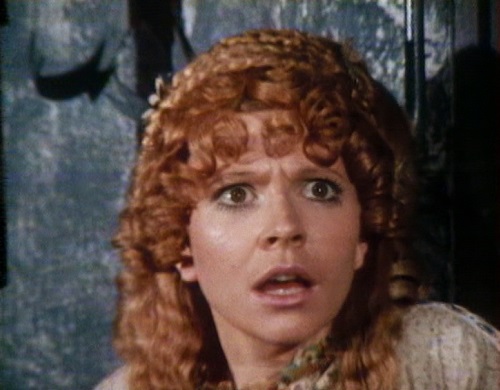
After McGill himself (the only regular character in the series), Ruth is the second main character for the episode, and Pearce is wonderful in it - far more than just a romantic sidekick for McGill. Quite apart from looking almost exactly like she would when she first played Servalan 10 years later, some of the same mannerisms were already observable (see picture above). A treat for any Blakes 7 fan, but also proof - if proof be need be - that Jacqueline Pearce could easily have made a success of being Number 2 in The Prisoner.

Saturday, 24 July 2021

Big Gay Longcat reviews Doctor Who: The Time Monster Episode Six


It's the minotaur! D'aww, he's super-cute!

Lakis warns the Doctor, so he runs straight into the labyrinth to help Jo. Hippias fights with the minotaur until he gets thrown through one of the many mirrors they have about the place for some reason - possibly to try and make the studio look bigger than it is. When the Doctor meets the minotaur he does a komedy bullfight with it until it charges through a wall and goes

The Doctor and Jo reach the crystal of Kronos, but then Krasis comes in with his guards, captures them and takes them to the Master, who has, since we last saw him, usurped the place of King Dalios with the help of Queen Galleia. But there is trouble in paradise for the Master, as after he has sent the Doctor and Jo to the dungeons, he has a row with Galleia over which of them is really in charge:
The Master: "You must learn to obey, my love, to do my will. To carry out my commands without question, like a soldier."
Galleia: "You mean like a servant girl? Then you must learn, my love, that Galleia is a queen."


In the dungeon, the Doctor tells Jo a story about "the daisiest daisy" he ever saw. It would appear at first to be revealing a previously unseen side to the character of the Doctor and his backstory from long before the series began, but when Jo laughs at the story he lets slip that he is only telling her a story he himself "heard" as though it had happened to him - so although it tells us something about the Doctor, it is what makes him the sort of character who would tell that tale to a despairing Jo to lift her spirits, not about what once happened to him in the long past.

The plot resumes when Dalios is thrown in the dungeon with them and is struck by a guard. We saw in part five that the mannys of Atlantis were near to the point of revolution, but the guard expresses such hatred for the recently deposed king that it must have been a powder keg awaiting a spark when the Master and the Doctor arrived. Dalios puts his trust in the Doctor and Jo before he dies in their arms.

The Doctor and Jo are taken to the court where they almost immediately reveal the fact of Dalios's death to Galleia, which turns her against the Master when he is forced to admit it. Before she can have the Master arrested, he gets Krasis to switch on TOMTIT (now upgraded with the larger crystal) to summon Kronos.


Kronos flies about wrecking both the set and the Master's plan. Jo tries to wrestle with the Master, but he takes her and the crystal into his TARDIS and dematerialises. Galleia frees the Doctor so that he can follow in his own TARDIS.

The Doctor threatens to deliberately time ram the Master's TARDIS, an eventuality that was cleverly foreshadowed back in part four when it was something the Doctor wanted to avoid doing by accident. But after only a moment's hesitation the Master dares him to do it, calling the Doctor's bluff and knowing that he might sacrifice himself but never Jo. So it is up to Jo to act, and she saves the day by forcing the time ram from the Master's TARDIS.

Jo and the Master are knocked out, and when Jo wakes up first she goes across a void consisting of some extremely fringing-heavy CSO (making this sequence even more trippy than it would have already been) to the Doctor's TARDIS. She thinks they are both ded and that this is the afterlife, but instead of a waiter played by Jack May it is the giant CSO face of Kronos they meet.


When Jo questions why her appearance now is different from the flappy birdy Kronos of earlier, she replies
"I can be all things. A destroyer. A healer. A creator. I'm beyond good and evil as you know it."
This short speech places Kronos firmly in the category of being one of the most titanic beings in Doctor Who, and this scene is a suitably epic-level climax to the story. The time ram released her, and in gratitude Kronos offers the Doctor and Jo a wish - they are both wise enough to only wish to be able to go home.

Kronos plans to keep the Master here, for
"Torment, of course. The pain he has given so freely will be returned to him, in full."
The Master comes out of his TARDIS and begs for mercy, so the Doctor asks Kronos to release him as well. When she does so, he escapes back to his own TARDIS and leaves. The Doctor had hoped to take him back to Earth with them as a prisoner, but Kronos, in true wish-granting style, says
"You asked for him to be given his freedom: he has it."

We haven't seen anything of the characters left behind on Earth for two whole episodes, but now we go back to see Ruth and Stuart (and baby Benton) still trying to reverse the time-freeze effect on the Brigadier and his soldiers. The Doctor and Jo arrive just in time to see them finally succeed, but then their machine blows up with a disappointingly small explosion - especially coming after Stuart built it up with a dramatic cry of
"Everybody get down, it's going to go up!"

The Brigadier bursts in and demands to know what's going on in this denouement:
Brigadier: "Right, stand quite still, everyone. Er, where's the Master?"
Doctor: "A very good question, Brigadier."
Brigadier: "Doctor, glad to see you're back. Miss Grant, what on Earth are you doing in that extraordinary get-up? And where, for heaven's sake, is Sergeant Benton?"
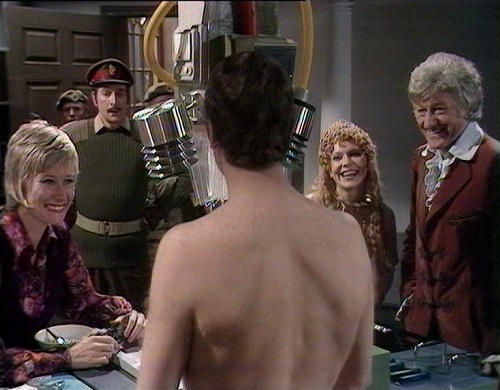
His question is answered, and the episode, story, and season ends with everyone laughing at the fact that Benton has been restored to normal... but with no clothes on.


What's so good about The Time Monster?

As usual for any story with Roger Delgado in it, he's a large part of what makes it so good, though as with The Dæmons this is an ensemble piece with all of the regulars contributing their part to its success.

The Time Monster is a very light story which makes for an easy and fun viewing experience. There are probably more komedic moments than is typical for Doctor Who (and certainly for the Jon Pertwee era up to this point) but even the more dramatic moments are played with a lightness of touch that stops them from being so dark they clash with the komedy. Jon Pertwee deserves a lot of the credit here, his central performance as the Doctor walking the line between taking the plot seriously and winking to the audience.

You do get the sense that the cast and crew had fun making the show, from the Doctor speeding up the film to make Bessie go faster, to the Master's irritation at being outwitted by Benton (twice), to the Brigadier's 'oh FFS' face at the Doctor's invention made out of Stuart's odds-and-ends. On top of that, there's a surprising amount of innuendo in this story, enough that it surely can't be coincidence and the show's makers must have been in on it - from the shape of the Doctor's time sensor, to the Master's repeated shouting of "come, Kronos, come!" through to the final shot of Benton, with the implication that the other characters are all looking at his willy.

There's even a cat in episode five - I mean, what more could a viewer ask for? This is a great story.

Pertwee Six-Parter Padding Analysis

Just as was the case with The Sea Devils, the presence of the Master can cover up a lot of plot padding, keeping the show watchable in the knowledge that viewers will find it fun seeing his interactions with the Doctor or, when the Doctor is elsewhere, just watching him going about hypno-eyesing mannys and being generally villainous. 

The difference between this and previous six-part Master stories is that here the padding is highly concentrated - we are treated to almost two entire episodes of continuous padding. From the Master saying to Krasis 'get in, loser, we're going to Atlantis' about halfway through part three, to them actually arriving at Atlantis near the start of part five, the main plot of the story advances not a jot, save that the concept of "time ram" is introduced, so that it is not a complete saturn ex tardisa when suddenly used in part six. 

But we do get some excellent scenes in amongst this padding, including some of the most fun and enjoyable of this whole fun and enjoyable story - the Doctor and the Master one-upping each other from their respective TARDISes, and in front of their respective Companions, is a highlight - and it would have been a shame to miss out on these, as would have undoubtedly been the case if this had been only a four-parter.

Friday, 23 July 2021

Big Gay Longcat reviews Doctor Who: The Time Monster Episode Five

The Doctor is able to talk to Jo as a voiceover, because
"The TARDIS is relaying my thoughts to you."
The Doctor is thus able to tell Jo to pull a lever on the TARDIS console that makes him reappear inside the TARDIS.


Well, after the dire situation that the Doctor and Jo were left in at the end of part four I'm bound to say that the resolution is a bit of an anticlimax. Then again, it is also quite fitting that a very abstract moment of peril should be solved in an equally abstract way.

The scene now shifts to Atlantis - the main focus of the rest of the story, which maybe explains why it now ceases to be shot in soft-focus? Hippias and Dalios talk to each other in an oldey-timey way, as if they're in some kind of BBC historical costume drama, but I can't find it in me to care about what they're saying because my eyes are being irresistibly drawn to the outstanding physical attributes of the figure seated to their left.


It's a cat!

Why are there so many stories with the Master in them that also have cats? His first and last stories both had cats in them, and there was also a cat at the very start of The Dæmons (which was written by the same writers as wrote this story). I think it is an attempt by the makers of Doctor Who to put an association into the brains of the viewers - because cats are best, therefore the Master is also best! Well if that was their intention, it succeeded, although casting Roger Delgado would probably have been enough on its own.

The Master's TARDIS appears in front of them and he steps out, bringing Krasis with him. He claims to be "an emissary from the gods."
Queen Galleia says
"He has the very bearing of a god himself."
and practically purrs like a cat when she sees him.

The Doctor's TARDIS materialises right next to the Master's. When the Doctor and Jo come out, Krasis orders the guards to capture them and take them to the king - although this is probably where the Doctor would have wanted to go anyway.

The Master tries hypno-eyesing King Dalios, and even turns his music on to reinforce this, but Dalios laughs it off and the music tails away like Orac when his key is removed. Dalios mocks the Master's claim to be from the gods with wit:
"Tell me then, what of great Poseidon? What did he have for breakfast? Fish, I suppose? And what of Zeus and Hera? What is the latest gossip from Olympus? Do tell me."
Mmmmm, fish. Also lol.


The Master leaves Dalios and passes the Doctor and Jo on his way out. He makes an astonished face at seeing them still alive.

They go in to see Dalios. There is a mix of the comic and the serious in their dialogue, as the Doctor introduces Jo to the king as "Jo, Jo Grant" and then Dalios calls her "Jojo Grant," a joke form that would later be used in The Hitch-Hiker's Guide to the Galaxy with "Dent Arthur Dent."
Dalios then tests them by calling Jo a goddess, passing it off as "clumsy gallantry" when Jo denies it, but really he was seeing if they were more honest than the Master had been.


The Doctor makes friends with Dalios, but meanwhile the Master is making friends with Queen Galleia (and her cat). Jo finds out that the Master is there and listens to their conversation. The Master knows exactly what Galleia wants, and plays her:
"Lady Queen, you are beautiful."
He's no Jarvik, but the effect is much the same. Galleia starts to tell him exposition about "the guardian" of the crystal. It then cuts to Dalios giving the same exposition to the Doctor. The Doctor realises from Dalios's description of the guardian that it is the minotaur that keeps all mannys away from the crystal.

Galleia plans to send Hippias with a sword to try and kill the minotaur, but says if he died trying then his "death would be of little account." This turns her servant Lakis, who is in love with Hippias, against her, so Lakis teams up with Jo to try to help Hippias. But they are too slow, because suddenly the lesiurely pace of the episode speeds up and Hippias is already on his way with Krasis.

Jo tries to shout a warning, but Krasis grabs her, throws her in the room, and then locks the door behind her. There is a "rar!" from off-screen and Jo sees something in there with her. Crash-zoom to her face - cliffhanger!

Thursday, 22 July 2021

Big Gay Longcat reviews Doctor Who: The Time Monster Episode Four


Mike Yates survives, but one of his soldiers suffers a fate worse than death when he has to listen to a komedy yokel tell him all about the original bomb and explosion that the Master brought through time.

The Master takes Krasis and the crystal into his TARDIS. I love the way Krasis exclaims the traditional "it's bigger on the inside" reaction in an old-timey way:
"So vast a space inside so small a box!"
And, for all his evil, it's nice to know that the Master still takes a responsible attitude towards environmental issues:
"Just a few minutes recycling and we shall be ready to leave."


The time sensor detects the Master's TARDIS activating so the Doctor and Jo go into the Doctor's TARDIS. The Doctor's plan is to land his TARDIS inside the Master's, and he explains the difficulty of this to Jo:
"This is the time setting. Now it's critical to a billionth part of a nanosecond, do you see?"
"Yeah."
"Now hold this. If it's infinitesimally low, we'll miss it entirely and goes whistling off to heaven knows where. But if it's too high, even by a fraction of a moment: time ram!"
"Time ram?"
"Yes. You see, the atoms making up this TARDIS would occupy precisely the same space and time as the atoms making up the Master's TARDIS."

For all that this is a risky and dramatic moment for our heroes, there's still time for some komedy, as the yokel witnesses the TARDIS's dematerialisation and is unimpressed by it. He says
"Pft, Londoners!"

Benton, Ruth and Stuart run about on location as they stealthily approach the building TOMTIT is in. This could almost be a send-up of the similar scene of the three guerillas from the future approaching Auderly House in Dave the Daleks, at the other end of the season.

The TARDIS landing doesn't go as planned, and the Master's TARDIS appears inside the Doctor's TARDIS. But it's worse than that - when the Doctor and Jo leave the TARDIS, they find they are inside the Master's TARDIS. So the TARDISes are inside each other.
"Well, it's perfectly simple, Jo. My TARDIS is inside the Master's."
"Yes, but his is inside yours."
"Exactly. They're both inside each other."
I just explained all that, mew. The Doctor's explanation has ended up inside mine!

The Brigadier arrives at the institute with his UNIT reinforcements, but the Master just sends them all into slow motion using TOMTIT. Ruth and Stuart enter the lab, and Ruth says
"Take a look behind you."
"Oh, come on, really."
says the Master, knowing this is exactly the trick he pulled on Benton back in part two. But Benton really is behind him, so the Master has been tricked by Benton twice in the spacetime of a single story.


The Master looks even more pissed off, but he manages to escape into his own TARDIS and dematerialises, taking the Doctor's TARDIS with him.


The Master soon appears on the scanner of the Doctor's TARDIS (with perfect timing to have a quick perv at Jo, the Naughty Master!) and begins a dialogue exchange between the two Time Lords (and Jo and, I suppose, Krasis) that makes for one of the most enjoyable of all the Doctor-Master scenes in the whole series. I would quote some highlights, but that would just end up being the script for most of the rest of the episode.

Meanwhile Benton, Ruth and Stuart are left with the run of the TOMTIT lab and try to turn it off so that they can free the Brigadier and soldiers from the slow-mo. But all that happens is that Benton gets turned into a tiny manny by mistaik, lol.


The Doctor is forced to leave the safety of his TARDIS to talk to the Master in person.
"You're risking the total destruction of the entire cosmos."
"Of course I am. All or nothing, literally! What a glorious alternative!"
"You're mad! Paranoid!"
"Who isn't? The only difference is that I'm a little more honest than the rest. Goodbye, Doctor!"
The Master summon Kronos to nom the Doctor:
"Behold, Kronos, a rare and delicate feast for you. A Time Lord! Devour him!"
Kronos flaps around and the Doctor disappears. Jo asks the Master
"You mean that thing, that... that creature really swallowed him up?"
"Ah, that's a nice point. Yes and no. Yes, it engulfed him. No, it didn't actually eat him up. He's out there in the time vortex, and there he's going to stay."
"Then he is alive?"
"Well, if you can call it that. Alive forever in an eternity of nothingness. To coin a phrase: a living death."
"That that's the most cruel, the most wicked thing I ever heard."
"Thank you, my dear."

Then, with Jo still in it, the Master ejects the Doctor's TARDIS from his own. It's an odd point to put the cliffhanger - several seconds after the Doctor has seemingly been killed off - but it succeeds mostly because the Master's explanation to Jo of what happened to the Doctor makes the situation seem even worse than if the episode had ended with the Doctor being attacked by Kronos or just after he disappeared.

Wednesday, 21 July 2021

Big Gay Longcat reviews Doctor Who: The Time Monster Episode Three

The pope of Atlantis introduces himself to the Master:
"I am Krasis, high priest of the temple of Poseidon in Atlantis."
The Master introduces himself in turn, and lays out his deal to Krasis, ending with "together we shall become masters of the universe."


The Master learns what he can from Krasis's seal, which has on it knowledge about Kronos that Krasis didn't even know he had, then he switches the machine back on.


"Come, Kronos, come!"
he says again, presumably because he enjoys it. Benton escapes back to tell the Doctor and the Brigadier about what the Master has done.

Kronos appears and noms Dr Percival (who, now that Krasis is here to be the Master's henchmanny, is superfluous to the plot), and then flaps about scaring the Master until he realises that he can use the seal to control Kronos. Krasis disagrees:
Krasis: "For all your sorcery, you are as a child trying to control a rogue elephant. A puny child."
The Master: "But I have the crystal?"
Krasis: "That crystal is but a part of the true crystal of Kronos. A small fraction."
The Master: "Fraction? And the rest is in Atlantis?"
Krasis: "Deep in the vaults of the temple of Poseidon, guarded by night and by day from such thieves as you. You may command the slave but never shall you command the mighty one himself."

A lucky side effect of Kronos's return is that Stuart gets returned to his real age. Less luckily, the Doctor sees the Brigadier, Benton and Ruth all running in slow motion, so he rescues them from the field of slowed time by running in at normal speed and pulling them out.

Back in soft-focus Atlantis, Hippias is talking to King Dalios. I know he's called "Dalios" from the credits, but it always sounds to me like they're saying 'Darius' due to the echoey effect and the incidental music. Dalios claims to be over 500 years old and takes Hippias to see the "true crystal" and hints about how he also has a minotaur down there. Well, he says it is
"A creature too horrible to imagine. Half man, half beast."
but I have a suspicion the BBC budget will not be doing that description justice any time soon.

The Master wants to go to Atlantis to get his paws on the "true crystal," but the story would be way too short if he managed that immediately so it's time for some padding or, as the Doctor calls it "delaying tactics" (I suspect the series Producer called it that as well). Stuart offers to make tea and sandwiches for everybody, which annoys the Brigadier.
"This isn't a picnic!"
he says, having gone from being a competent commanding officer last episode to a komedy sidekick in double-quick time.


Despite giving every impression that he's trolling the Brigadier on purpose, the Doctor makes a gadget out of the odds and ends in Stuart's room.
Doctor: "It's a time flow analogue."
Stuart: "Of course it is, Ruth. You should have seen that at a glance."
Doctor: "The relationships between the different molecular bonds and the actual shapes form a crystalline structure of ratios."
Brigadier: "Does this make any sort of sense, Dr Ingram?"
Ruth: "None whatsoever."
Brigadier: "Just as I thought. Doctor, please stop this silly game at once."

Only once he gets it going does the Doctor deign to explain what he's doing:
"Well, it's just like jamming a radio signal, Jo. We used to make them at school to spoil each other's time experiments."
The Master soon overloads it using TOMTIT. 
"Ah, well. It was fun while it lasted."
says the Doctor, and I have to agree with him. This whole bit was padding, but it was fun padding.


The Master sees that Mike Yates is on his way with the Doctor's TARDIS using his wrist-mounted, CSO-powered TV, a different model from the one we saw in Colony in Space - he's obviously upgraded from a csoPhone to a csoWatch in the meantime. He uses TOMTIT to summon a knight on a horsey to charge at Yates's convoy. When Yates reports this to the Brigadier, the Brigadier replies
"Are you suffering from hallucinations, Captain Yates, or have you been drinking?"
Lol.

Next the Master summons up some historical reenactors to exchange fire with the UNIT soldiers.
"Oh get on with it, you 17th century poltroons."
he says when they're not very effective, lol.

The Doctor and Jo head towards the TARDIS in Bessie. The Brigadier drives his own jeep, expecting it will be faster than the Doctor's car, but is swiftly overtaken - another komedy moment.

As his "grand finale" the Master summons a V1 "buzzbomb" to try to blow up the convoy with. The Brigadier, suddenly serious again, tries to call Yates to warn him:
"Yates, get out of it, man! It's a bomb! It's a bomb! Get out of it, Yates!"
but the reception is poor and it is not clear if he heard the warning in time. We see things from the Doctor, Jo and the Brigadier's point of view as the bomb explodes in the distance, and the episode ends with Yates's fate unclear - and we can only hope he has been blown to bits.

Tuesday, 20 July 2021

Big Gay Longcat reviews Doctor Who: The Time Monster Episode Two


The Master runs off to hide just before the Doctor runs in and tells Ruth to "reverse the polarity," which allows her to turn off TOMTIT. But it has already turned Stuart into an old manny. Ruth starts to tell the Doctor about Professor Thascales when he says
Doctor: "Thascales? Really the arrogance of that man is beyond belief..."
Brigadier: "Whose arrogance? Doctor, I wish you wouldn't talk in riddles."
Doctor: "Perhaps a classical education would have helped you, Brigadier? 'Thascales' is a Greek word."
Jo: "Thascales? I get it. 'Thascales' is Greek for 'Master.'"
Continuing what we saw in part one of Jo "learning," this is a neat reversal of the similar situation in The Dæmons.

The Doctor hears Stuart say "Kronos" and he says
"Kronos? Yes, of course, I should have known."
The Brigadier takes over the place and sends for Mike Yates to come with reinforcements for him and the TARDIS for the Doctor, showing a level of competence scarcely seen from him since season seven, although when ordering Dr Percival to evacuate the mannys from the institute he doesn't perceive that Percival has already been hypno-eyesed by the Master.


When Ruth shows the Doctor (and Benton) the crystal, the Doctor recognises it as "the crystal of Kronos" and tells Ruth - and us - what he knows about it:
"Well, luckily you are already familiar with the idea of stepping outside of space-time."
"I've lived with the concept for months."
"And I've lived with it for many long years. I've been there."
"You have?"
"Yes, I have. Strange place it is, too. A place that is no place. A dangerous place where creatures live beyond your wildest imagination. Chronovores: time eaters. They swallow a life as quickly as a boa constrictor can swallow a rabbit, fur and all."
"Are you saying that Kronos is one of these creatures?"
"I am. The most fearsome of the lot."
The incidental music playing under the Doctor's speech helps sell this dump of exposition as being more dramatic. The Doctor continues:
"Kronos, a living creature, was drawn into time by the priests of Atlantis, using that crystal as its centre."
"You mean, that that crystal is the original? The actual crystal from Atlantis?"
"It is, and your friend the Professor is trying to use that crystal, as it was used four thousand years ago, to capture the Chronovore."

The incidental music segues into the Master's theme as the scene cuts to him and Percival, who also have some great lines:
The Master: "E = mc cubed."
Percival: "Squared."
The Master: "What?"
Percival: "E = mc squared, not cubed."
The Master: "Not in the extra-temporal physics of the time vortex! Oh dear, now you've made me lose my place. You're an interfering dolt, Percival!"

Back with the Doctor, Ruth and Benton, and Benton can't pick up the crystal because, as the Doctor explains, it "isn't really here at all." The writers then get a bit too clever for their own good with their next bit of technobabble, with the result that it seems like they couldn't make up their minds about what the crystal is:
Doctor: "It must to be linked to that other crystal all those thousands of years ago. Or rather it is the other crystal."
Ruth: "But then where is the original one?"
Doctor: "Where do you think? In Atlantis, of course."


A zoom in to the crystal is followed by a fade to the crystal in ancient Atlantis, where soft-focus was the order of the day and the pope* of Atlantis says
"At last! At last, Kronos, the time is come, and I await your call!"
He is being observed by some other manny, but what this all means is left mysterious for now so that we can go back to watch Benton answer the telephone.

Stuart wakes up and doesn't recognise himself in the mirror. Poor old manny, but it can happen to the best of us.

The Master wants to get back to the lab, but it is being guarded by Benton, so he impersonates the Brigadier's voice on the telephone and orders him to leave the lab unattended. But although the vocal impression is so good that they had to get Nicholas Courtney to dub it on, the Master makes a silly mistaik that tips Benton off.

The Master and Percival go into the lab where Benton is waiting for them with a gun. This is a wonderful scene with great dialogue, which kicks off with the Master ironically getting captured just after saying
"I tell you that nobody and nothing can stop me now."
(That sort of dialogue must be obligatory in Doctor Who stories featuring Atlantis.)


This is followed by Benton saying
"You didn't really think you could fool me with a fake telephone call, did you? It's the oldest trick in the book."
The Master looks genuinely horrified to have been outwitted by Benton.
"I underestimated you, Sergeant. How did you know?"
"Simple. The Brigadier's not in the habit of calling Sergeants 'my dear fellow.'"
But Benton's victory is short-lived, because the Master distracts him and then knocks him out, while saying
"You're wrong, Sergeant Benton. That is the oldest trick in the book!"

The Master turns TOMTIT back on and we go back to Atlantis, where the pope is still ranting and raving - or possibly praying - to Kronos. There are flashes of lightning SFX (which are quite scary, I will admit) and he disappears, leaving the other manny looking at the empty space where the pope disappeared from.

The scene fades back to the lab, where the pope appears and surprises Percival, who just has time to make a surprised face before there is a crash-zoom to the pope's face - cliffhanger!


* He's addressed as "holiness" and his name isn't spoken on screen in this episode, so I think it is fair to call him that for now.